Wazal | Medicinal plant in the Akhdar Encyclopedia
The drug possesses sympathomimetic properties, acts as a vasoconstrictor, and raises blood pressure. It is used medically to treat circulatory disorders. In folk medicine, the plant has been used to treat constipation, stomach ulcers, fluid retention, vomiting, liver diseases, gout, and other ailme…
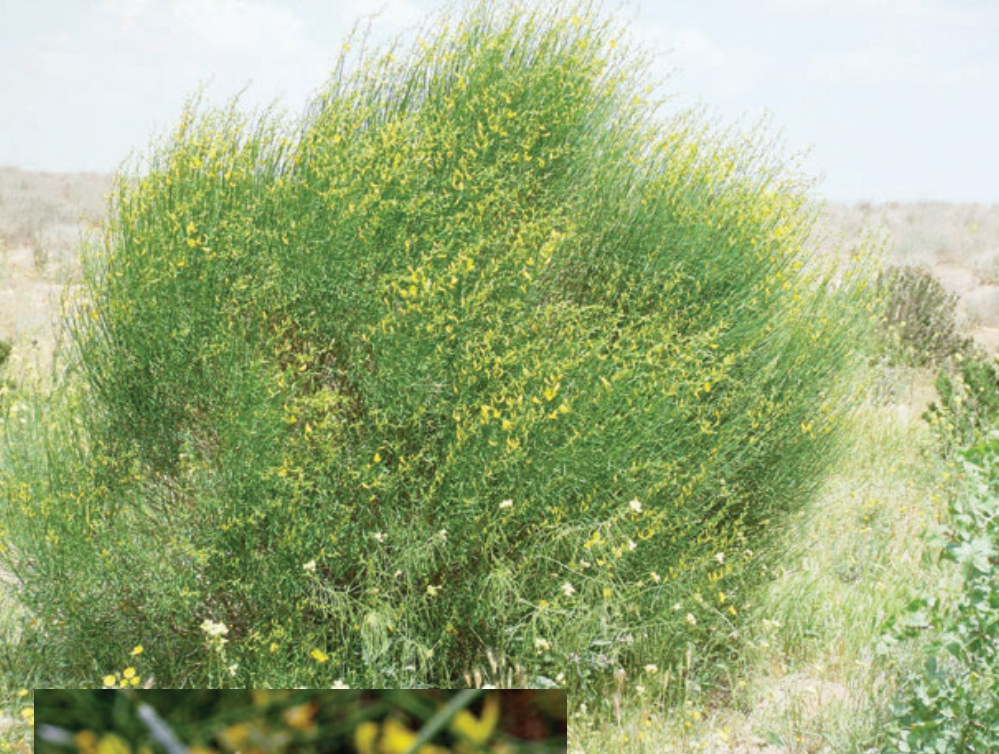
Plant name
And it disappeared
Latin name
Spartium junceum L
Common names
And it disappeared
foreign names
Eng. Rush broom, Fr. Genét d'Espagne
The group
Pea beans
Habitat and Geographic Distribution
It is Mediterranean, growing wild in Syria, Lebanon, and Jordan, and is also widespread in northern Asia and southern and central Europe.
Botanical description
The market is gray, 3 cm long, shrubby, glabrous, with green, serrated branches.
The leaves are simple, linear, auricular, early-fallen, uterine, tapering gradually towards the base, glabrous or 1 cm long, 0.5 x 4 cm - semi-glabrous, with spadixes slightly widened at the base and sheath-like.
The flowers are about 1 cm long, arranged in terminal, loosely packed clusters.
The calyx is membranous and sheath-like, bilipped, the upper lip ending in two teeth and the lower lip in three small teeth, with filaments very tightly fused.
The corolla is yellow, the flag is obovate broad to semi-round, flatter than a boat.
The stamens are seed-like or stromal, linear, glabrous or 1 cm long, containing 0.6 x 9 cm - all in a stomatal tube.
The ovary is superior, slender.
The pod is brown, mottled, and turns brown when mature; the two segments are twisted when opened.
The seeds are linear, compressed, and reddish-brown. Flowering occurs from April to June.
Used part
Herbaceous plants and flowers
chemical components
And its derivatives, including cyticin, chinolizidine alkaloids (all parts of the plant contain chinolizidine alkaloids), lupanin, ammodenderin, and spartein. In addition to spartein, rhombifolin is also present.
Properties and medical uses
The drug possesses sympathomimetic properties, acts as a vasoconstrictor, and raises blood pressure.
It is used medically to treat circulatory disorders.
In folk medicine, the plant has been used to treat constipation, stomach ulcers, fluid retention, vomiting, liver diseases, gout, and rheumatism.
The plant's aromatic water is toxic to cancer cells (melanoma RPMI 7932, leukemia K562, breast cancer cells MCF7-Bart, colon adenocarcinoma SW480, CF7-ICLC), while it does not alter the viability of normal keratinocytes, suggesting the plant's potential use as an antitumor and cancer preventative agent.
The plant has a toxic effect on animals when mixed with feed, causing neurological disturbances, tonic spasms, followed by muscle paralysis, and associated edema.
Pupil dilation, tremors, irregular heartbeat, rapid breathing, and diarrhea are possible side effects.
Large doses may cause nausea, vomiting, tinnitus, excessive salivation, mouth, throat, and pharynx pain, sweating, and headache.
Severe vomiting, colonic spasms, and subsequent paralysis and death may occur.
It should not be given to pregnant or breastfeeding women, or children under 12 years of age.
It should also not be given in cases of high blood pressure, or with monoamine oxidase inhibitors.
Side effects and precautions
Large doses cause nausea, vomiting, tinnitus, excessive salivation, mouth, throat, and pharynx pain, sweating, and headache.
Severe vomiting, colonic spasms, and subsequent paralysis and death may occur.
It should not be given to pregnant or breastfeeding women or children under 12 years of age.
It should also not be given to individuals with high blood pressure or concurrently with monoamine oxidase inhibitors (MAOIs).
the environment
An environmentally resilient plant, it thrives in rocky and high mountainous areas, dry and degraded forests, and along roadsides.
It tolerates varying temperatures, although it cannot withstand prolonged frost.
It is also drought-tolerant and grows on different soil types, particularly calcareous ones, and is considered a type of soil prone to degradation.
Agriculture and productivity
The large, mature seeds are sown immediately after winter in warm, sunny locations.
It can also be propagated by cuttings.
Flowers, new shoot tips, and seeds are collected in spring and summer.
The plant is also cultivated for ornamental purposes.
Other names for this plant include: Trigonella foenum-graecum L., Buceras foenum-graecum (L.) All., Fenugraecum officinale Czechov, Foenum-graecum officinale Moench, and Foenum-graecum officinale var.
cultum Alef., Foenum-graecum sativum Medic., Medicago foenugraeca (L.) E.H.L.Krause, Telis foenum-graecum (L.) Kuntze, Xiphostylis erectus Gasp
History and Heritage
The scientific name of the genus is derived from the Greek "spartos" or "spartion," ancient names for species in the genus Genista, named after the region of Sparta in Greece, where this plant is found in its natural habitat.
The species name junceum is derived from Juncus, meaning "reed." The parts used are the herbaceous plant and the flowers.
Medical note
This information is for educational purposes only and does not constitute medical advice.
Poisonous or potent plants should only be used under the supervision of a qualified physician or pharmacist.
Related images


