Rough air | Medicinal plant in the Akhdar Encyclopedia
Rhizomes possess diuretic properties and are used to treat urinary tract infections. They help eliminate uric acid and kidney stones. A decoction of rhizomes is traditionally used as a medicinal tea for dysuria, phlebitis, rheumatism, gout, liver and spleen diseases, bronchial asthma, and tachycard…
Plant name
rough air
Latin name
Asparagus officinalis L
Common names
Rough air, asparagus, metal,: dhughnus, diamond kiosk
foreign names
Eng. Asparagus, Fr. Asperge
The group
Asparagus
Habitat and Geographic Distribution
Mediterranean, Western Asia
Botanical description
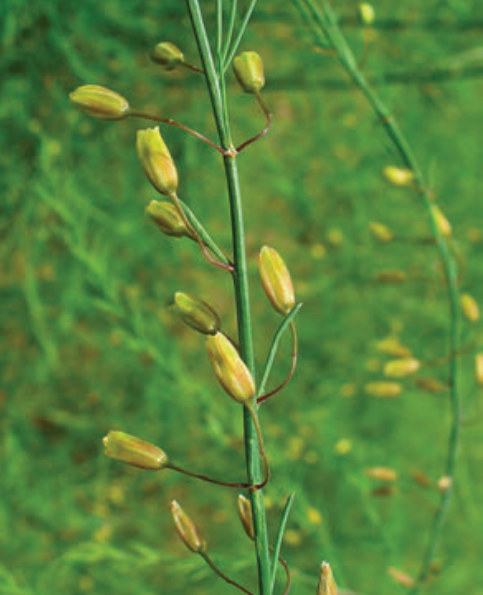
A perennial herb propagated by rhizomes, climbing, succulent, highly branched, 100-inch in length, woody at the base, twigs and branch tips rhizomatous, velvety hairy.
True leaves are semi-scaled, found mainly on the underside of the plant, becoming prickly with age.
Leaf-like stems are green, clustered into branches, 12-inch in length, in groups of equal or nearly equal length, 9-inch in length, semi-needle-like, stiff, gradually tapering to form a yellow spine.
Flowers are unisexual.
The peduncle is jointed towards the middle, slightly longer than the flower.
The calyx is petal-like, bell-shaped, with nearly equal segments, fused free stamens at their bases.
The male part of the flowers is a carpel; the ovary is tertiary in the female flowers, where the stamens are reduced to sedges.
The stigmas are 5 mm long and green.
The fruit is a berry, spherical, about 3 mm in diameter.
It turns black when ripe.
Flowering occurs from August to September.
Several varieties exist: sweet asparagus, which grows underground (sweet), flower asparagus (slightly bitter), and Akhdar asparagus.
Used part
Roots (rhizome). Latin name: Asparagus officinalis L
chemical components
The rhizomes contain steroidal saponins, including sarsapogenin derivatives, the most important of which is asparagoside.
They also contain various carbohydrates, such as glucose and inulin, fatty oils, flavonoids, amino acids and proteins, organic acids and salts, the most important of which is potassium salt.
Asparagus is rich in fiber and nutrients, and is an excellent source of vitamins A, B9, C, E, and K, minerals, and folic acid.
Studies have shown the presence of amino acids such as L-arginine, L-glutamic acid, and L-asparagine, as well as soluble sugars, aldonic acid, organic acids and their derivatives, and more specifically, quinic acid, malic acid, and abscisic acid.
Asparagus contains phenolic derivatives of hydroxycinnamic acid (chlorogenic acid) and ferulic acid.
The discovered flavonoid compounds belong to the flavonol class and include quercetin, isorhamnetin, and kaempferol.
Quercetin-3-O-3-rutinoside (rutin) constitutes 60-80% of the total phenolic content of asparagus extracts.
Properties and medical uses
Rhizomes possess diuretic properties and are used to treat urinary tract infections.
They help eliminate uric acid and kidney stones.
A decoction of rhizomes is popularly used as a medicinal tea for dysuria, phlebitis, rheumatism, gout, liver and spleen diseases, bronchial asthma, and tachycardia.
Asparagus also protects against the formation of free radicals, which are primarily responsible for cell aging.
Side effects and precautions
Allergic reactions may occur, especially with topical application.
Asparagus has strong effects on the kidneys, so those with kidney problems or a predisposition to kidney stones should not consume it excessively.
Additionally, it causes an unpleasant odor in urine and sweat due to the accumulation of methylmercaptan.
Asparagus thrives in dry areas and along field edges, particularly on calcareous soils. It prefers sandy loamy soils and can tolerate temperatures as low as -10°C.
Other uses
Asparagus is included in diets designed to reduce obesity, and it is often recommended to eat asparagus, which is rich in fiber and cellulose, to help cleanse the digestive system. Side effects and
the environment
Asparagus thrives in dry areas and along field edges, especially on calcareous soils. It prefers sandy loam soils and can tolerate temperatures as low as 10°C.
Agriculture and productivity
Asparagus is easy to propagate.
It is propagated by seeds sown in a nursery in the spring or immediately after ripening in the fall, after soaking them for about 12 hours in warm water.
History and Heritage
Derived from Asparagus, the Latin name for the genus, which is the ancient name of the plant, the Greek asparagos meaning "medicinal." The species is called Asparagus acutifolius, meaning "sharp-leaved." The genus includes several medicinal species, some of which were used by the ancient Chinese, Babylonians, Persians, Greeks, and Egyptians.
It is said that Akhenaten and his wife Nefertiti considered asparagus food for the gods.
It was mentioned by Ibn al-Baytar and al-Antaki, and Ibn Sina wrote that asparagus opens blockages in the intestines, especially the liver.
Medical note
This information is for educational purposes only and does not constitute medical advice.
Poisonous or potent plants should only be used under the supervision of a qualified physician or pharmacist.
Related images


