Wild chicory | Medicinal plant in the Akhdar encyclopedia
Amaroid is a plant with hypotensive, cholesterol-lowering, anti-edema, diuretic, and digestive-stimulating properties, used in cases of loss of appetite and digestive disorders. Wild chicory is popularly used to treat loss of appetite, indigestion, liver ailments, constipation, fluid retention, and…
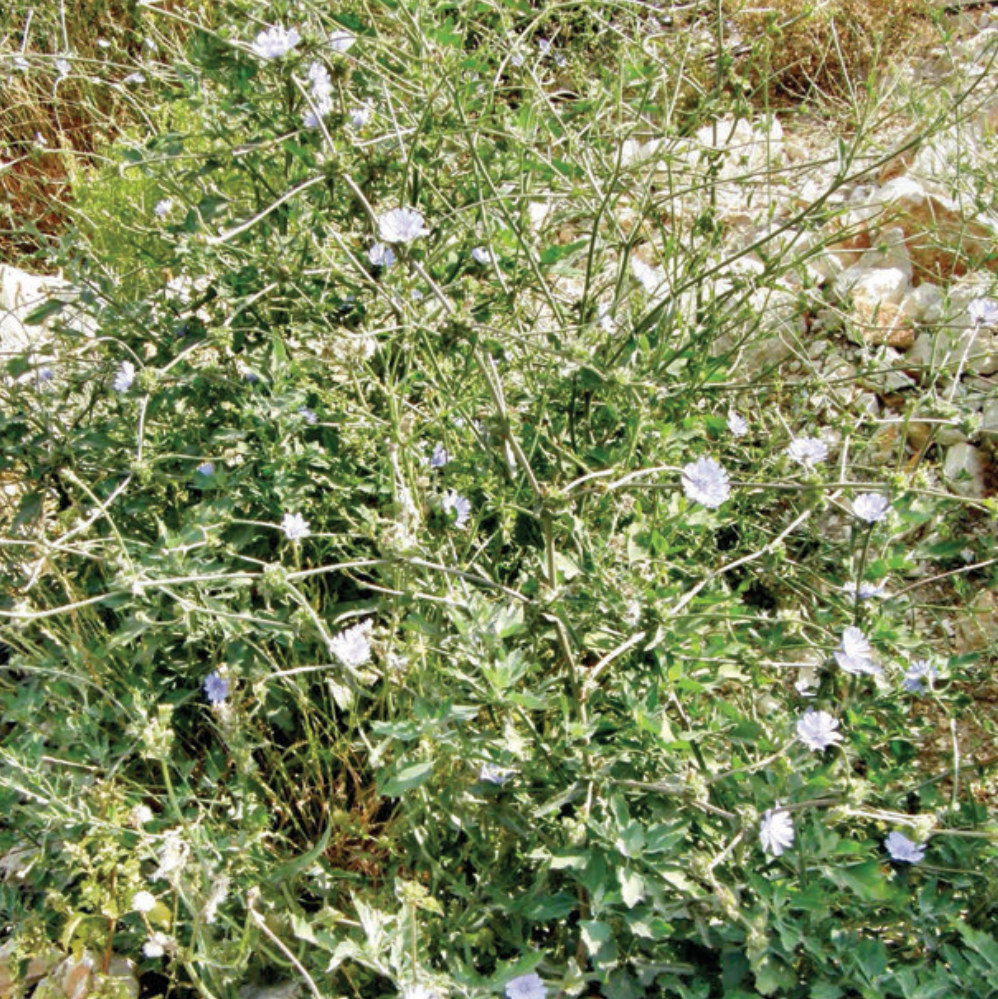
Plant name
wild chicory
Latin name
Cichorium intybus L
Common names
wild chicory
foreign names
Wild chicory (English), wild chicory (French)
The group
Star
Habitat and Geographic Distribution
The plant is believed to have originated in the eastern Mediterranean basin, from where it spread to Europe, America, and many other parts of the world.
Botanical description
The stem is erect, branching, and slender.
The leaves are simple, covered with 100 hairs.
It is a perennial herb with deep roots, long and hairy, with the sclera on the midrib.
The lower leaves are petiolate, lobed, with the lobes pointing towards the base, and the terminal lobe being the most prominent.
The stem leaves are semi-petioled, and the upper leaves are entire.
The head contains only sessile flowers.
The lateral head is thin and occurs in pairs or bundles.
The apical head is solitary and spike-like.
The bracts are double.
The outer bracts are ovate, forming a cup-like structure, while the inner bracts are linear and longer, all glandular and ciliated.
The flowers are sessile and blue, several times longer than the bracts.
The fruit is a short acinus.
The spore is stamen-like and short, composed of numerous small scales that are several times shorter than the acinus itself. Flowering from May to June
Used part
The flowering plant is complete (with roots), succulent and gummy.
Latin name: Carthamus persicus Willd., C. flavescens sensu Boiss., C. palaestinus Eig.
chemical components
Lactucopicrin, lactucin (including lactusine), sesquiterpenlactone (sesquiterpenes), chicoroisides, sonchuside, hyperoside (valvonoids), cinnamic acid, chiroric acid, chlorogenic acid, isochlorogenic acid, dicaffeoyl tartaric acid (derivatives of caffeic acid), amaroid, bitter substances, and umbelliferone (coumarins).
Properties and medical uses
Amaroid is a plant with hypotensive, cholesterol-lowering, anti-edema, diuretic, and digestive-stimulating properties, used in cases of loss of appetite and digestive disorders.
Wild chicory is popularly used to treat loss of appetite, indigestion, liver ailments, constipation, fluid retention, and hemorrhoids. Chicory juice is used as a laxative for children.
pharmaceutical forms
Chicory is available as a raw herbaceous plant, roasted or unroasted root, and other products, and is sold under the name chicory.
Side effects and precautions: It should be strictly avoided in cases of allergy or skin irritation to any of the components of chicory, or in cases of heart disease, as it may affect the heart.
Side effects and precautions
It should be completely avoided in case of allergy or skin irritation to the components of dandelion, or in case of heart disease, as it may affect the heart.
Other uses
Roasted chicory roots are sometimes used as a coffee substitute due to their coffee-like flavor and aroma, and because of their calming effect.
Consequently, some people add them to coffee to counteract the stimulating effects of caffeine.
The young leaves of the plant are used as a spice, while older leaves are dried and eaten like celery.
The roots can be boiled and eaten with butter, or more commonly, they are roasted and added to tea or coffee for a better flavor.
the environment
The plant grows wild in farms, vegetable and ornamental gardens, along roadsides, and in irrigation canals.
It thrives in arid and semi-arid environments in hot, warm, and temperate regions.
It tolerates low temperatures relatively well and is suitable for growth.
It can be grown in areas with low light.
It grows well in most soils, especially medium and light yellow soils with good drainage.
The pH should be between 5.5 and 6.5.
Planting it in heavy soils leads to irregular root formation. The appropriate pH level is 15-17°C.
Agriculture and productivity
The plant is propagated by seeds sown in early autumn in special seedbeds, either broadcast or in rows, with a spacing of 1-15 cm.
Care continues, including weeding and irrigation, until the seedlings reach 12-15 cm in height, at which point they are transplanted to their permanent location in raised beds or rows.
Approximately 100 g of seed is required to cultivate one dunam (1000 square meters).
History and Heritage
The word "hindaba" comes from the Greek word "intubus," and its scientific name is "unin" or "altin." It is the name of a medicinal and edible plant that has been used for centuries.
The Arabs called it "hindaba." The plant was known to the ancient Egyptians, Greeks, and Romans.
The Romans called it "hindaba," and its leaves are eaten green. In traditional medicine, it was used to treat liver ailments.
Medical note
This information is for educational purposes only and does not constitute medical advice.
Poisonous or potent plants should only be used under the supervision of a qualified physician or pharmacist.
Related images


