Hashab | A medicinal plant in the Akhdar encyclopedia
Gum arabic helps stabilize suspensions and emulsions, making it an excellent stabilizer, thickener, binder, and adhesive. It resists the organic decomposition caused by bacteria in the mouth, which commonly leads to tooth decay. Gum arabic is used in the manufacture of pharmaceutical capsules and l…
Plant name
Hashab
Latin name
Acacia senegal (L.) Willd
Common names
Hush, Acacia Senegal gum, Gum Arabic
foreign names
Eng. Gum Arabic Tree, Fr. Gum arabic
The group
Acacia (Fabaceae)
Habitat and Geographic Distribution
The tropical savannah regions of Sudan (Kordofan region), Senegal, and Somali to Zambia and northern Nigeria, form the gum arabic belt in central Sudan (N°14 - Sudan).
Botanical description
The young branches are downy, 6 - a small tree, grayish in length, with scale-like scales.
The old branches are bluish-green in the old stems, in the form of dark-colored scales.
The spines are in triangular incisions at the base of the leaf petioles, two of which are lateral, straight or slightly curved upwards, and the third is curved, 5 cm - 2.5 mm long.
The pubescent of the compound leaf is about 5 cm long.
There are brown glands below and above the pair of secondary axils.
Pairs of secondary axils: 5 - the main axis bears 2.5 cm.
Opposite (sometimes alternate), 15 - leaflets borne by the secondary axils are 1.5 mm long, linear, almost 1.5 mm rough.
The inflorescence is a spike-like spike, 1 cm long, bell-shaped, glabrous.
The flowers are inflorescences.
The calyx is about 5 mm long.
The stamens are numerous, their filaments are about 1.7-2.5 cm long, and the corolla is rough: 8-8 mm.
The pod is 7-7 cm long, thin, flat, almost straight, with a beak-like apex, disc-shaped, rounded, and slightly hooked. The seeds are ovoid. Flowering occurs from August to December.
Used part
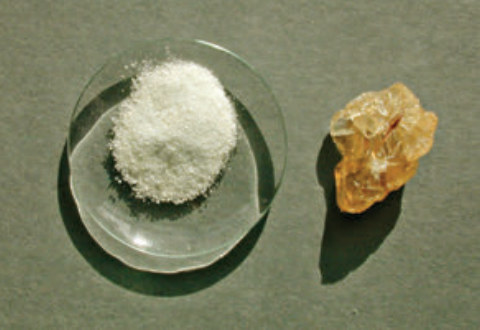
gum
chemical components
The chemical composition of gum arabic is not yet fully known.
The gum consists mainly of a branched polyunsaccharide composed of lactose subunits, bearing side chains of arabinose, polysaccharides, and uronic acid.
It also contains protein, oxidase enzyme, water, uronic acid, rhamnose, and uronic acid.
Properties and medical uses
Gum arabic helps stabilize suspensions and emulsions, making it an excellent stabilizer, thickener, binder, and adhesive.
It resists the organic decomposition caused by bacteria in the mouth, which commonly leads to tooth decay.
Gum arabic is used in the manufacture of pharmaceutical capsules and lozenges, and its emollient properties are utilized in various preparations such as cough syrups, throat medications, nasal drops, and diarrhea remedies.
Research has demonstrated gum arabic's positive effects in reducing kidney problems by lowering uric acid levels in the blood, thus reducing the risk of kidney failure.
It is used in the preparation of cosmetic products such as face creams, hairsprays, and ointments for maintaining skin freshness and clarity.
In food and industrial applications, gum arabic is of great interest due to its unique properties compared to other natural gums.
It retains its natural properties for extended periods without alteration, dissolves easily in water, and has a low viscosity, making it a globally permitted additive for food, beverages, and pharmaceuticals.
Gum arabic is used in food processing and manufacturing, and is considered one of the best substances for preserving flavor and taste.
It also reduces sugar crystallization in sweets and prevents water crystallization in ice creams and popsicles.
Gum arabic is used in the manufacture of some types of syrups and is a key component in all solutions requiring stability, even in challenging conditions imposed by acidic environments.
From the global trade of gum arabic, its content is %.
The soft drink and confectionery industry consumes approximately [amount] of fiber.
A: Recently, many new uses have been added in healthy diet foods.
E: In addition to the above, gum arabic is used in other industries, most importantly: the manufacture of paints, glass coatings, and high-tech ceramics.
- 1.
Purification and refining of some metal ores and anti-corrosion materials for metals.
- 2.
Office supplies (9. Glue, adhesive tapes, printing paper, wrapping paper, etc.). - 3.
Side effects and precautions
Allergic reactions or drug interactions may occur; self-use should be avoided by pregnant and breastfeeding women, children, and patients with chronic diseases.
Food uses
In the industrial sector, gum arabic receives considerable attention due to its distinction from other types of natural gums in that it retains its natural properties for a long period without change, is easily soluble in water, and has a low degree of viscosity, which qualifies it to be among the materials that are allowed to be added globally to food, beverages, and medicine.
It is used in food processing and manufacturing, and is considered one of the best substances for preserving flavor and taste.
It also reduces sugar crystallization (in sweets) and prevents water crystallization in ice cream and yogurt.
It is used in the production of some beverages and is a key component in all solutions requiring stability, even in the challenging conditions imposed by acidic environments.
The soft drink and confectionery industries consume approximately 70% of the global gum arabic trade.
Its high fiber content has recently led to numerous new uses in healthy diet foods.
In addition to the above, gum arabic is used in other industries, most notably: 1- The manufacture of pigments, glass coatings, and high-tech ceramics.
2- The purification and refining of some metal ores and corrosion inhibitors.
3- Stationery (glue, adhesive tapes, printing ink, wrapping paper, etc.).
(This species is widespread due to its drought tolerance.
It is generally found in areas with an altitude of 100–1700 m and an average annual rainfall of 300–400 mm, but it can grow in areas with annual rainfall as low as 100 mm and a dry period of 8–11 months.
It tolerates high temperatures but is sensitive to frost. It prefers well-drained sandy and light sandy loam soils with a pH of 5–8.)
the environment
Gum arabic is widespread due to its drought tolerance.
It is generally found in areas with an elevation of 11-100 mm and a dry season of 100 mm, but it grows in areas with annual rainfall as low as 400 mm.
It tolerates high temperatures but is sensitive to frost.
It prefers sandy and light sandy loam soils. It thrives in well-drained soils with a pH of 5-8.
Agriculture and productivity
This type is important in stabilizing encroaching sands and fixing atmospheric nitrogen in the soil; it also represents
History and Heritage
For a year, it was transported from the Gulf of Aden to ancient Egypt.
The use of gum arabic dates back to the time of the ancient Egyptians in plastering and relieving pain.
Theophrastus mentioned that it was produced in Upper Egypt.
Arab physicians used it to treat a wide range of diseases, which earned it its name (gum arabic).
Europeans, especially the Portuguese, knew the commercial importance of gum arabic and imported it from Africa, and used it in the silk industry.
Many naval wars broke out between them in the ninth century in order to monopolize this commercially profitable gum product.
Medical note
This information is for educational purposes only and does not constitute medical advice.
Poisonous or potent plants should only be used under the supervision of a qualified physician or pharmacist.
Related images


