Sage | A medicinal plant in the Akhdar encyclopedia
Most of the plant's properties are attributed to its volatile oil content, which possesses antibacterial, antifungal, antiviral, antidiarrheal, and antihypertensive properties. It also stimulates bile secretion and relieves smooth muscle spasms. It has a central tonic effect, antidiabetic activity,…
Plant name
sage
Latin name
Salvia officinalis L
Common names
Sage, common sage, Salvia officinalis, soft-field sage
foreign names
Eng. Sage, Fr. Sauge
The group
oral
Habitat and Geographic Distribution
It is widely cultivated in many countries across North Africa, Central and Southern Europe.
Botanical description
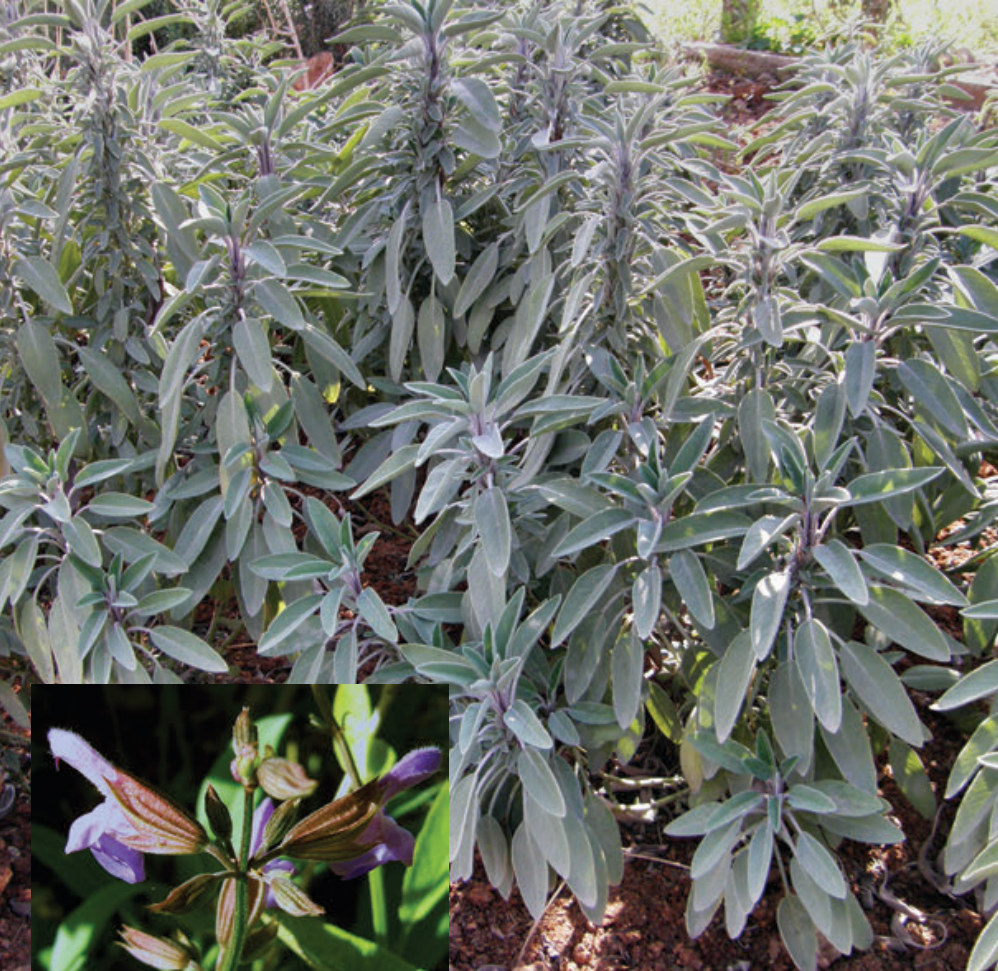
A perennial shrub, vigorously growing, with a herbaceous stem, but its base is woody, erect, highly branched, velvety-hairy, square in cross-section, reaching a length of about 1 meter.
These branches are shed annually.
The leaves are thick, distinctly aromatic, opposite, petiolate at the base of the stem, and pubescent at the top.
They are oblong, elliptical, or ovate, grayish-green due to the abundance of cottony hairs.
The leaf blade is 8 cm wide on its underside, with a rounded or semi-segmented base and an 8-35 cm margin.
The flowers are purple or blue, about 18 cm long, and grow in whorls, each containing one flower, forming spike-like inflorescences.
The upper flower stalks are 18 mm long, ovate, and pointed at the apex.
The flower stalk is about 1 cm long in the fruit, bipinnate, 1.5 cm, and the calyx becomes pubescent towards the lip.
The corolla is bilabial.
The male flowers have two stamens, and the stamens are brown.
The inflorescence is a few buds long, mm long, with equal arms.
The fruit is about 2.5 mm brown, nearly spherical, and about [missing information]. Flowering occurs from April to June.
Used part
The flowers, leaves, and oil extracted from them. Latin name: Salvia officinalis L.
chemical components
The leaves contain a high percentage of the compound (3.3%), which may reach 0.08%.
The volatile oils present include: borneol, camphor, cineole, thujone, rosmarinic acid, cinnamic acid derivatives (hydroxy-cinnamic acid derivatives), chlorigenic acid, rosmanol, carnosolic acid (including carnosolic acid), diterpenes (diterpene compounds), luteolin, apigenin (including apigenin glucosides), flavonoids, lactone, carnosol, salvin, apitan (diterpene compounds from the apitan group, found especially in the dried or preserved plant).
Picrosalvin (picrosalvin): In addition to oleanolic acid and ursolic acid, such as ursolic acid, triterpene compounds, and traces of minerals such as iron, magnesium, and zinc.
Properties and medical uses
Most of the plant's properties are attributed to its volatile oil content, which possesses antibacterial, antifungal, antiviral, antiperspirant, and antihypertensive properties.
It also stimulates bile secretion and relieves smooth muscle spasms.
Furthermore, it has a central tonic effect, antidiabetic activity, and anti-edema properties.
The oil is used topically as a gargle to treat inflammation of the mucous membranes of the mouth, pharynx, and gums (swollen or bleeding gums).
Dalachia is used for loss of appetite, indigestion, excessive sweating, and hyperventilation.
The plant is used traditionally to treat diarrhea, gastritis (inflammation of the stomach lining), excessive or irregular milk flow from the breasts, menstrual pain, and muscle spasms.
It is used to treat microbial infections, diabetes, and cancer, and has antioxidant, antimicrobial, and antibacterial properties.
The essential oil distilled during the flowering stage has shown inhibitory effects on amylase, glucosidase, lipase, and lipoxygenase enzymes, as well as antibacterial activity.
It has also shown antibacterial activity against Staphylococcus aureus and Listeria monocytogenes.
The essential oil has demonstrated bactericidal activity against Salmonella typhimurium, Escherichia coli, Proteus mirabilis, and Bacillus subtilis.
pharmaceutical forms
Sage is available in the form of dried and tender leaves, tender parts of the flowers, and oils extracted from the flowers and stems.
Side effects and precautions
Potential side effects of sage include mouth inflammation, seizures, and skin irritation.
Sage should be avoided when using blood sugar-lowering medications, insulin, antabuses, and medications that affect seizures. It should also be avoided by pregnant or breastfeeding women.
Other uses
It has been used for many years as a food flavoring and fragrance in soaps and perfumes. Side effects and interactions.
the environment
This plant prefers sunny locations and well-drained, moist soils, but is affected by heavy, acidic soils. It is relatively drought-tolerant, but highly susceptible to frost.
Agriculture and productivity
The plant propagates easily by seed when the temperature is 15-21°C.
It can also be propagated by cuttings. (Salvia fruticosa Mill., Salvia triloba L. fil, S. libanotica Boiss. Et Gaill)
History and Heritage
The scientific name for the genus *Salvare* comes from the Greek word meaning "to heal," referring to the medicinal properties attributed to the plant for centuries.
The ancient Greeks called it *herba sacra*, meaning "sacred herb," indicating that the species *Salva officinalis*, which represents the genus, was considered medicinal and constitutional.
This plant has a long history of medicinal use, having been known in Greece since before the Common Era.
The Greeks and Phoenicians introduced it to Spain and the western Mediterranean, and it was also used in birth and marriage rituals in some North African countries.
Medical note
This information is for educational purposes only and does not constitute medical advice.
Poisonous or potent plants should only be used under the supervision of a qualified physician or pharmacist.
Related images