Centaury | A medicinal plant in the Akhdar encyclopedia
The drug possesses antibacterial properties. Centaurea (centaurocyanin) is used in folk medicine for its anti-inflammatory, antipruritic, antitussive, laxative, and astringent properties. The bitter herb is used in folk medicine to treat fever, vaginal discharge, menstrual disorders, as a liver ton…
Plant name
Centaury
Latin name
Centaurea cyanus L
Common names
Centaury, bitter, bitter, centaury of 'Anrab, tranchah, dew of 'Anrab
foreign names
Eng. Cornflower, Fr. Bleuet des champs
The group
Star
Habitat and Geographic Distribution
Its original home is Europe and the Middle East (Syria).
Botanical description
The stem is slender, hard, 60 cm long.
It is a perennial herb, branching from the base, lightly covered with woolly hairs, and its length is uterine.
It is undivided or segmented.
The leaves are simple, 6 mm long, with the basal leaves obovate.
The bracts are linear, narrow, pointed, and pointed, with their base extending onto the stem.
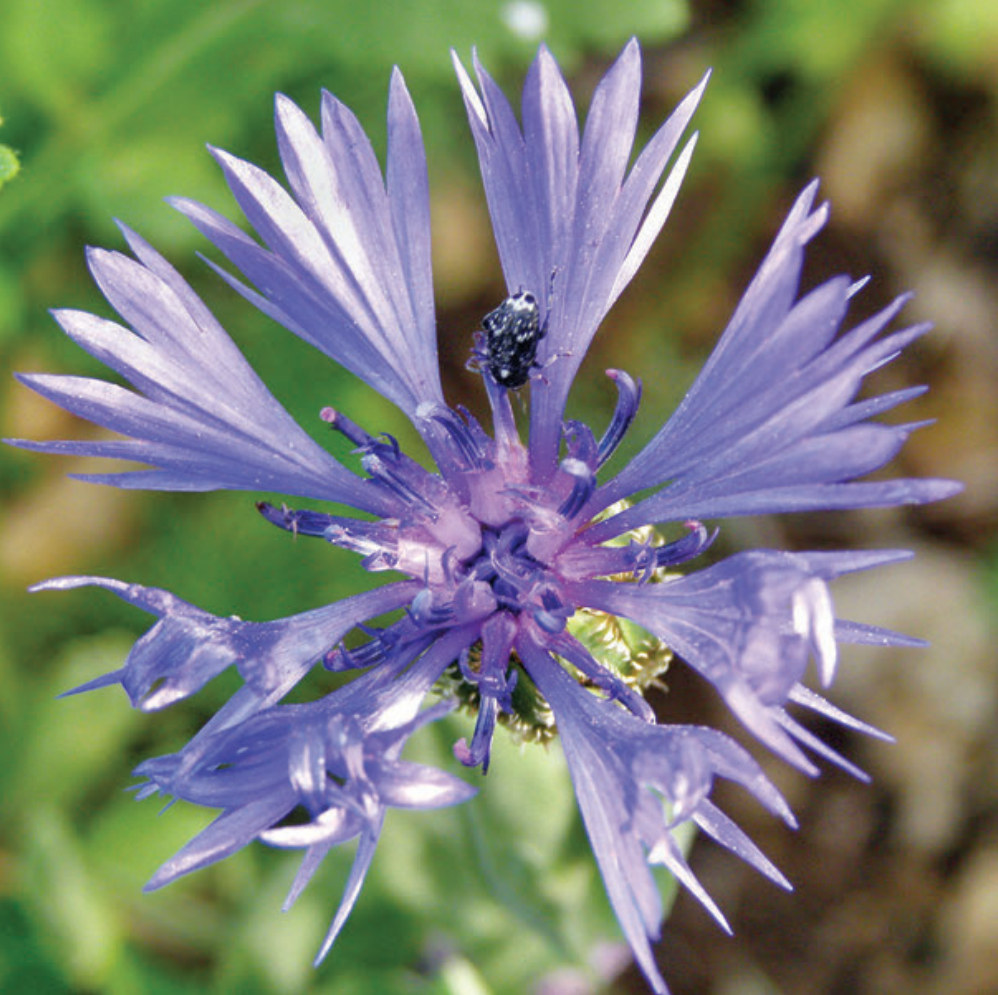
The head is ovate, covered with spider-like hairs, with a membranous margin, ending in sharp, triangular teeth, silvery at the apex, two hairs shorter than the segment itself.
The flowers are blue, the peripheral ones slightly shorter than the central ones, distinctly radial, forming a ring around the central flowers.
The fruit is an acinus, of equal length.
The hairs in the center are slightly shorter than the acinus body, and those in the central one are two hairs shorter than the acinus. Flowering from April to May
Used part
Flowers.
Chemical constituents: The most important are anthocyanins.
Flowers contain anthocyanide pigments, polyenes, bitter compounds, flavonoids, and apigenol derivatives (cyanidine, centaurocyanin, succinylcyanin, apigenol).
Properties and medical uses
The drug possesses antibacterial properties.
Centaury (centaurocyanin) is used in folk medicine for its anti-inflammatory, antipruritic, antitussive, laxative, and astringent properties.
The bitter herb is used in folk medicine to treat fever, vaginal discharge, menstrual disorders, as a liver tonic, to cleanse the body of toxins, to treat headaches of all kinds, as a diuretic, and to dissolve urinary stones.
An infusion of its powdered fresh or dried flowers is used as a topical poultice to treat inflammation of wounds and eyelids, itching, scabies, and eczema, especially chronic eczema.
Its leaves are an appetite stimulant when fresh, raw, or cooked.
Studies indicate that all tested extracts are non-toxic and could be of great importance in combating pathogenic spores of plants and humans.
Side effects and precautions
It is recommended that it not be used in patients with gallstone or tumorous bile duct obstruction.
the environment
It grows wild in wheat fields, as well as along roadsides, irrigation canals, and neglected areas on sandy and stony soils.
It tolerates poor soil conditions and grows in various soil types, provided they are well-drained.
It tolerates high alkalinity and also withstands soil dryness well. It cannot grow in the shade.
Agriculture and productivity
Productivity: The plant is propagated by seeds sown in a cool greenhouse.
When the seedlings grow, they are transplanted individually into pots and then moved to their permanent location in the summer. If there is a sufficient quantity of
History and Heritage
It is the name of a number of kentaurion.
Centaury is an Arabicized name from the Greek Centaure Chiron, of medicinal plants dedicated to Centaureus Chiron, a mythical creature half-man and half-horse, who, according to Greek myth, lived in Tessal and was believed to have discovered the species of these plants.
Medical note
This information is for educational purposes only and does not constitute medical advice.
Poisonous or potent plants should only be used under the supervision of a qualified physician or pharmacist.
Related images


