Marijuana | Medicinal Plant in the Akhdar Encyclopedia
Cannabis possesses psychoactive properties due to its cannabinoid content. It acts as an antiemetic, anticonvulsant, analgesic, antipyretic, bronchodilator, glaucoma reducer, antibacterial, antitumor, and appetite stimulant. Cannaboids severely suppress the immune system. Tetrahydrocannabinol (THC)…
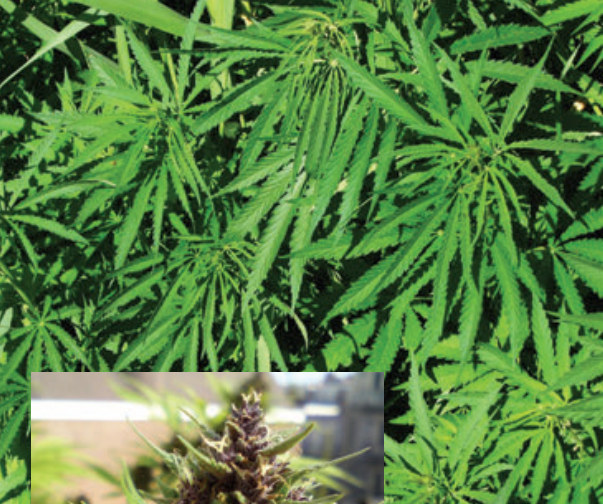
Plant name
marijuana
Latin name
Cannabis sativa L. var. indica
Common names
Marijuana, hashish, how
foreign names
Eng. Indian hemp, Marijuana, Fr. Chanvre indien
The group
Cannabis
Habitat and Geographic Distribution
In Central and Western Asia (the Caucasus, China, Iran, and North India), cannabis is cultivated illicitly for its use as a narcotic.
Fiber cannabis is grown in many countries worldwide, including India, China, Japan, Russia, Korea, the United States, European countries (France, Romania, Bulgaria, Italy, Spain, Ukraine, Yugoslavia, Belgium), North Africa, Iran, Turkey, and others.
Botanical description
cm.
Stem, 200 - perennial herb, erect, angular, covered with layered hairs.
9 - leaves are palmate compound consisting of cm.
Leaflets are sessile, 8 - leaflets, sepals are uterine: narrow, toothed, pointed at the apex, mm long, surface 15 - cm, rough: surface 12 - the underside is hairy and covered with resin glands mm.
6 - sessile.
Studs are unisexual and the plant is dioecious mm, 6 - density.
Male flowers are mm long, gathered in 3 - color, their stalks are mm.
Flowers are 4 - inflorescences, female petals are semi-sessile, surrounded by bracts of mm, covered 13 - leafy nature, their length with small glandular hairs; the sleeve segments are membranous, overlapping the base of the ovary, the female is bicarpel.
(The male plant is taller and stronger than the female plant.
The flesh is finely downy, yellowish, and has a fruit that is almost glabrous in diameter and oval.
Flowering occurs from April to September.
Cannabis sativa L.
There are two varieties of this species, cultivated in the regions of C.
sativa var.
vulgaris.
The first is called mild fiber hemp, cultivated for its fibers and oily seeds, from which the narcotic known as hashish is extracted.
It was known to the ancients as C.
sativa var.
indica.
The second is called Indian hemp, known to the Chinese, Indians, Mongolians, and Greeks, and is mentioned in ancient texts.)
Used part
Female flowering tops.
Latin name: Cannabis sativa L.
var.
indica C.
chinensis Defile, C. indica Lam. Cannabis sativa var. sativa sub var. indica (Lamk. Asch. & Gr.)
chemical components
(Non-active compound), tetracannabinols, including: Cannabinoids: Phenolic compounds.
Cannabinoids (physiologically active compound).
Tetrahydrocannabinol.
Dihydrostilben.
Spiroinane: Phenolic compounds.
Non-cannabinoids: Spiroinane, such as beta-sesquiterpene and sesquiterpenes.
Monoterpenes: Rich in monoterpenes.
0.1-0.3% volatile oil.
α-pinene.
Caryophyllenoxid.
Humulen.
β-caryophyllen.
Trigonelline.
Choline.
Cannabisativin.
Other cannabinoids: Limonene.
β-pinene.
Beta-pinene.
Canniflavones.
The fruits contain flavonoids, including cannabidiol and trigonellin.
They also contain fatty substances (unsaturated fatty acid families), cannabinoids, and quaternary bases.
Properties and medical uses
Cannabis possesses psychoactive properties due to its cannabinoid content.
It acts as an antiemetic, anticonvulsant, analgesic, antipyretic, bronchodilator, glaucoma reducer, antibacterial, antitumor, and appetite stimulant.
Cannabinoids severely suppress the immune system.
Tetrahydrocannabinol (THC) exhibits antibacterial properties against Staphylococcus and Streptococcus bacteria, and it also inhibits the growth of lung cancer.
Cannabis is classified as a controlled substance by the World Health Organization (WHO).
It causes an increase in systolic blood pressure.
Its use can lead to short-term memory impairment, loss of concentration, and a distorted sense of time and place.
Users may also experience negative reactions such as fear, panic, and anxiety.
It has been traditionally used to treat emaciation, constipation, gynecological diseases, gout, malaria, rheumatism, nervous disorders, insomnia, vomiting, tetanus, cough, asthma, epilepsy, and other ailments.
Cannabis compounds have demonstrated therapeutic effects against depression, anxiety, arthritis, musculoskeletal disorders, glaucoma, and exhibit anticancer properties.
Studies have shown antitumor activity, inhibiting the proliferation of cancer cells and inducing apoptosis (programmed cell death) against various cancer cell lines, including lymphomas, lung cancer, breast cancer, colon cancer, and prostate cancer.
Hemp products are used to produce fibers for clothing and rope, and in the cosmetics industry.
A pure CBD compound called cannabidiol (2-Epidiolex C21H30O) recently received FDA and DEA approval for the treatment of two rare forms of epilepsy.
Cannabis components have shown benefits in treating Alzheimer's and Parkinson's diseases, amyotrophic lateral sclerosis (ALS), and multiple sclerosis.
CBD is beneficial in a range of neurological and psychiatric disorders, including autism spectrum disorder, psychosis, neuropathic pain, cancer pain, HIV, migraines, Huntington's disease, and cerebral hypoxia. CBD oils have insecticidal activity. Side effects and
Side effects and precautions
Severe addiction can cause personality disorders, and illegally traded cannabis may be mixed with carcinogens and other highly dangerous compounds.
Side effects of use, in addition to addiction, include dry mouth, skin irritation, headache, allergic reactions, rapid heartbeat, peripheral vasodilation, low blood pressure, vascular disturbances, decreased testosterone, and decreased sperm count. Its use is prohibited during pregnancy and breastfeeding.
the environment
This plant is a summer crop, tolerant of temperature fluctuations, but susceptible to frost.
It is widely cultivated in many environments and thrives in temperate, humid climates. It prefers deep, moist, well-drained, fertile soils with a neutral pH (6.5).
Agriculture and productivity
Fiber hemp is cultivated for its fibers, which are used in a number of industries, and for its energy-rich seeds, which are used in bird feed and in several medical and pharmaceutical applications.
The plant is propagated by seed, at a rate of 80–110 kg/ha.
Hemp is sown in the spring, with early planting preferred when no frost is expected.
Early planting promotes earlier harvesting, weed control, and disease resistance.
Biotechnology research using plant tissue culture as a propagation system for hemp and genetic engineering strategies for exploitation in the herbal medicine industry using medicinal hemp strains has seen significant activity in response to future demands for innovative hemp products.
(Herniaria hirsuta L., Herniaria arenaria var.
hirsuta L.
(Kuntze), Herniaria glabra var.
hirsuta L.
(Kuntze), Herniaria vulgaris subsp.
hirsuta L.
(Bonnier & Layens), Herniaria vulgaris var. hirsuta L.) (Griess., Paronychia hirsuta)L. (E. H. L. Krause
History and Heritage
Sativa means "cultivated" or "cultivated hemp," and the word Kanb is the name of the plant in Greek.
The Persian word kannabis is the scientific name of the plant, derived from the word "cultivated hemp."
Medical note
This information is for educational purposes only and does not constitute medical advice.
Poisonous or potent plants should only be used under the supervision of a qualified physician or pharmacist.
Related images


