Borage | A medicinal plant in the Akhdar encyclopedia
It has been said that borage brings courage, and that an infusion made from its flowers soothes the heart and calms the insane. Modern research has supported this claim, as it is now known that the plant stimulates and activates the adrenal glands, thus boosting the secretion of adrenaline, the "fi…
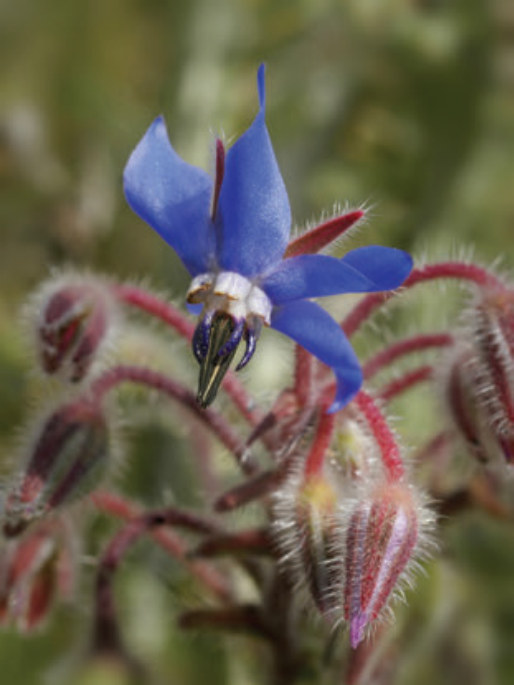
Plant name
ox tongue
Latin name
Borago officinalis L
Common names
Borage, hornwort, bee bread, swede, crocus, wild ass
foreign names
Eng. Borage, Fr. la Bourrache
The group
Hamhamia
Habitat and Geographic Distribution
The Mediterranean region, where it is widespread in Syria, Lebanon, Palestine, Jordan, Iraq, Cyprus, Libya, Tunisia, Algeria, and Morocco.
It is currently cultivated in several Eastern European countries such as Romania, Russia, Bulgaria, and Turkey.
Botanical description
A perennial herb with an erect or ascending, thick stem (100 cm).
The plant is covered in long, stiff, flat hairs.
The leaves are simple, alternate, petiolate, ovate, and the flowering leaves are pedunculated, oblong, sepals fused, and linearly lobed.
The calyx is fused, blue, folded at the base, somewhat velvety, and the tube is very short.
The lobes are ovate, acute, flattened, and appear gnarled.
The scales of the corolla are glabrous and scalloped.
The stamens are five, with short filaments, broad at the base, extending near the apex to form the stamen.
The anthers are stamens, luminous, and collectively form a black stamen in the center of the sac.
The flower is characteristic of this species.
The fruit is somewhat tuberous. The flowers are erect and rough, blooming from March to September.
Used part
seeds and their essential oil
chemical components
The seeds contain glucosinolates that vary depending on the variety.
White mustard (B.
alba) contains the glycoside sinalbin, while black mustard contains the glycoside singrin.
These compounds are hydrolyzed by enzymes, yielding a volatile oil that constitutes up to 1.3%.
Ninety percent of this oil is composed of allyl isothiocyanate.
The seeds also contain 30% protein, mucilage, and 27% fixed oil, which is rich in sterols.
Flavonoids, including Vitin.
It also contains phenylpropan derivatives (cinnabin), which are bitter-tasting amino acid compounds.
The predominant phenolic compounds are gallic acid, ferulic acid, and caffeic acid.
Mustard oil preparation: The medicinally used volatile mustard oil is prepared by distilling mustard seeds.
Mustard oil is clear, colorless or yellowish, and has a pungent, tear-inducing, and irritating odor (it was used in war as a tear gas).
Medicinal properties and uses: The seeds and volatile oil possess antiseptic and antibacterial/fungal properties.
Studies have confirmed its reddening properties for the skin.
Black and white mustard oil is used to treat sinusitis, bronchitis, pleurisy, and sciatica.
A paste made from the ground seeds is applied topically as a poultice to treat pneumonia, respiratory congestion, fluid retention, intestinal gas, bite pain, joint and soft tissue inflammation, rheumatism, and gout.
A decoction of the seeds is used in baths for the body and feet, as a topical poultice to treat bruises, and as a gargle.
It is used to treat inflammation of the mouth and throat.
Mustard oil is also used topically to stimulate blood circulation, and to treat vascular diseases, heart weakness, and poor blood circulation.
Properties and medical uses
It has been said that borage brings courage, and that a syrup made from its flowers soothes the heart and calms the insane.
Modern research has supported this claim, as it is now known that the plant stimulates and activates the adrenal glands, thus enhancing the secretion of adrenaline, the "fight-or-flight" hormone that prepares the body for action and resilience in critical and stressful situations.
Borage oil is used topically in creams, ointments, or capsules.
Its extracts are emollient and soften dry skin, maintain skin vitality, reduce wrinkles, and treat skin inflammations, ulcers, eczema, redness, rheumatism, and arthritis.
A decoction of the leaves, rich in mucilage and tannins, is used traditionally as a laxative to treat chest ailments (expectorant, cough, bronchitis), as a diuretic, and to treat urinary tract infections (kidneys and bladder), rheumatism, and arthritis.
pharmaceutical forms
Mustard is available in the form of mucilage, liniments, tea, ground seeds (mustard flour), and oil. It is sold under names such as Musterole.
Side effects and precautions
Applying mustard oil as a compress causes the evaporation of volatile sulfur compounds, specifically allyl isothiocyanate, which is an eye irritant.
Inhalation may lead to respiratory problems and asthma attacks.
Mustard volatile oils should not be inhaled or tasted.
A doctor should be consulted if allergic reactions or any irritation of the skin or mucous membranes occur as a result of contact with mustard or its oil.
The plant should be avoided by pregnant and breastfeeding women.
Mustard oil should not be used by people suffering from stomach ulcers or kidney inflammation, as it may irritate the mucous membranes of the stomach and kidneys.
Hands should be washed thoroughly, and the eyes should be avoided after preparing medicinal products from mustard. Mustard oil compresses should not be used for more than half an hour.
Other uses
The seeds or pulp are used in spices as an appetite stimulant. The young leaves, buds, and flowers are edible.
the environment
The plant grows in fields and fertile, neglected lands, as well as on the sides of valleys, riverbanks, and marshes.
It is sensitive to wind and therefore grows in sheltered areas.
It prefers dry, semi-dry, and semi-humid environments.
It requires 8 hours of direct light daily, and weak light causes it to grow long and weak.
Agriculture and productivity
Black mustard is cultivated for its edible seeds.
It is propagated by direct sowing in the permanent field or by seedlings 20 cm tall.
Seeds are sown in beds or basins measuring 3 x 6 m after the autumn or early winter rains, and germination takes more than a week.
The seedlings are transplanted to the permanent field in the spring and rarely require watering until immediately after transplanting.
Plants are fertilized and watered according to their needs and soil conditions.
The seeds fall from the pods when they open after full ripening; therefore, it is preferable to begin harvesting when the pods turn yellow and before they open, ideally in the early morning.
One hectare produces approximately 1.5-1 ton of seeds. Capparis spinosa L. C. sandwichiana DC
History and Heritage
It is the name of a coarse fabric with long piles, referring to the plant's rough nature.
The scientific name for the genus is *Borra*, from the Latin *officinalis*, meaning "nature" or "texture." The species name is *Bordon*, a plant known for its medicinal and culinary uses since ancient times.
It has been described as the "herb of happiness." Its leaves and flowers were used in antiquity to improve the psychological state and increase courage in Roman warriors.
Dioscorides mentioned its properties for generating feelings of joy and happiness.
Its flowers were used in the 5th century to soothe the soul and alleviate worries and troubles.
In ancient terms, it was said, "I am borage, I bring..." The great herbalist John Gerard cites it in one of his writings from 1900, "known for its effectiveness in encouraging and cheering up the diligent student." The leaves were used as a vegetable, as mentioned by John Evelini in 1907, and by Ibn al-Baytar.
The Arabs used it to induce sweating, as mentioned by Ibn al-Baytar.
The parts used are the flowering plant and the seeds.
The plant is harvested during the flowering period. (The leaves have the scent and taste of fresh cucumbers.)
Medical note
This information is for educational purposes only and does not constitute medical advice.
Poisonous or potent plants should only be used under the supervision of a qualified physician or pharmacist.
Related images


