Lullaby | Medicinal plant in the Akhdar Encyclopedia
The leaves possess antitussive and antibronchial properties, are expectorant, antiviral, antibacterial, anthelmintic (liver flukes), antiflatulent, cytotoxic, antispasmodic, and diuretic. The plant extract is astringent, digestive stimulant, and sedative, particularly in cases of burns. It is also…
Plant name
Lubab
Latin name
Hedera helix L
Common names
Lablab, climbing lablab, rope of the resident, priest and s, hydra
foreign names
Eng. English ivy, Fr. Lierre grimpant
The group
Aralites
Habitat and Geographic Distribution
Native to Europe, Siberia, and the Mediterranean.
Its cultivation has been introduced to many countries. It grows naturally in the forests of Eastern Mediterranean countries.
Botanical description
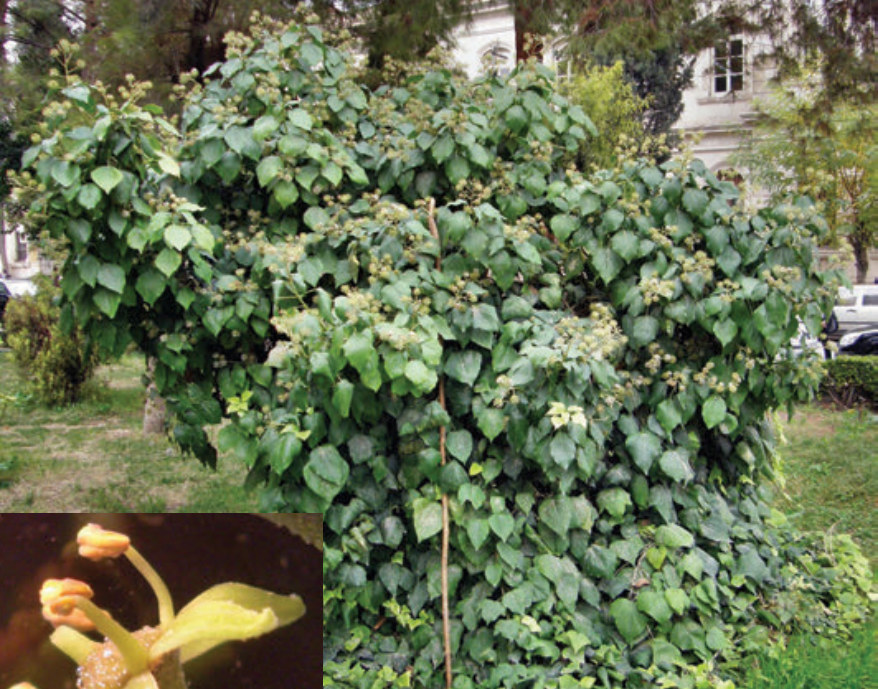
A climbing, evergreen shrub that can reach heights of several meters.
The stem is woody and highly branched.
The branches bear brush-like, finger-like roots that help them attach to the supports they climb (walls, rocks, trees, etc.) and do not serve an absorption function.
The leaves are alternate, long-petioled, leathery, with a wedge, heart, or rounded base.
They are green with triangular and entire lobes, 5-12 cm long.
The upper leaf blade has a 2-6 cm x 12 cm surface.
The upper leaf blade is entire, ovate to rhomboid, and pointed at the apex.
The flowers are in racemes, gathered in spherical umbels.
The corolla has five free petals, triangular lobes about 5 cm long.
The calyx is fused to the ovary, cup-shaped, and ends in an ovate, cap-like shape.
The male flowers have five free stamens.
The female - green, triangular, yellowish-4 mm long, berry-like, inverted to 8 - five carpels, inferior ovary domed, surmounted by a short style.
The fruit is trilobed: ribbed, each containing one seed.
- Oval-5 spherical, dark in color, formed from the flowering from October to February, and fruiting at the end of winter and the beginning of spring.
Used part
Leaves. Latin name: Hedera helix L
chemical components
The leaves contain oleanolic acid (9 triterpene saponins, including falcarinol and polyynes), volatile oil, hydrocarbons, polyene hydrocosides such as hydrocosides, campasterol and campesterol compounds, beta-sitosterol, beta-sitosterol, sterols and steroids such as citriol, vitamins E, C, and A, phenolic flavonoids (coumarin glycosides), organic acids, and flavonoids.
Properties and medical uses
The leaves possess antitussive, antibronchial, expectorant, antiviral, antibacterial, anti-parasitic (liver flukes), and antiflatulent properties.
They also exhibit cytotoxic, antispasmodic, and diuretic activity.
The plant extract is astringent, digestive stimulant, and sedative, particularly in cases of burns.
It is also used to treat respiratory tract infections (colds), for the symptomatic treatment of chronic infectious bronchial diseases, and to treat ringworm, scabies, and worms.
A decoction of the leaves is used systemically to treat liver, gallbladder, and pancreatic ailments.
The leaves are also used topically.
As a cold compress, it is used to treat infections, wounds, burns, parasitic diseases, rheumatic pains, gout, and phlebitis.
The crushed leaves are used externally as a pesticide and insecticide, for example, against scabies and lice.
Pharmaceutical preparations containing juniper leaves are usually available in solid or liquid pharmaceutical forms, taken orally.
Medicinal teas, especially liquid ones, and shampoos are also available.
Precautions: Tender leaves can cause local allergic reactions.
Juniper preparations should not be used in children under two years of age.
Juniper preparations should not be taken by children under two years of age.
People who are severely allergic to juniper leaves or other plants of the Araliaceae family
pharmaceutical forms
Herbal medicines containing the pulp of the leaves are usually available in solid or liquid pharmaceutical forms, taken orally. Medicinal teas, especially liquid ones, and shampoos are also available.
Side effects and precautions
It can happen
the environment
Ichthyia is a temperate plant.
It grows in forests and shady, semi-shady, or sunny locations, climbing trees, walls, and rocks, but it rarely flowers in complete shade.
It grows on various soil types and its presence indicates moderately acidic soils, mostly. It prefers moist soil but is tolerant of drought and pollution.
Agriculture and productivity
The plant is propagated by seeds.
The fleshy pulp of the fruit is removed, as it inhibits germination.
The seeds can be stratified in a cold environment for four weeks, which greatly improves their germination rate.
The seeds are scattered in the spring.
When the seedlings have grown a little, they are transferred to containers placed in temperate locations during the winter, and then transplanted to their permanent location in late spring or early summer.
It can also be propagated by semi-woody cuttings, which are planted in spring or summer in a shaded place, or in a greenhouse, in sandy humus soil, moistened with a fine mist to stimulate root formation, and then transferred to permanent planting grounds with moderate watering.
Woody cuttings 12 cm long can be used and planted in the autumn in a greenhouse.
It can also be propagated by layering, which the plant often does naturally.
(Phoenix dactylifera L., Palma dactylifera L., Mill., Phoenix excelsior Cav., Encephalartos pungens Lehm., Macrozamia tridentata var. pungens, Willd., J.Schust., Palma major Garsault)
History and Heritage
The word "lablab" is of Syriac origin, referring to a type of bean that grows in Egypt and is called *helix* from the Latin *helix*.
The scientific name for the genus is the ancient Latin poison for these species, while the species name is *olichos lablab*. It is a plant resembling a bean.
Medical note
This information is for educational purposes only and does not constitute medical advice.
Poisonous or potent plants should only be used under the supervision of a qualified physician or pharmacist.
Related images


