Cane | Medicinal plant in the Akhdar Encyclopedia
The plant, particularly the leaves, is popularly used as an aphrodisiac. A paste made from the powdered, roasted seeds is used for its antiseptic properties to stop bleeding, heal wounds, and treat eye infections. A decoction of the roots is used as a diuretic and to treat chronic coughs. The dried…
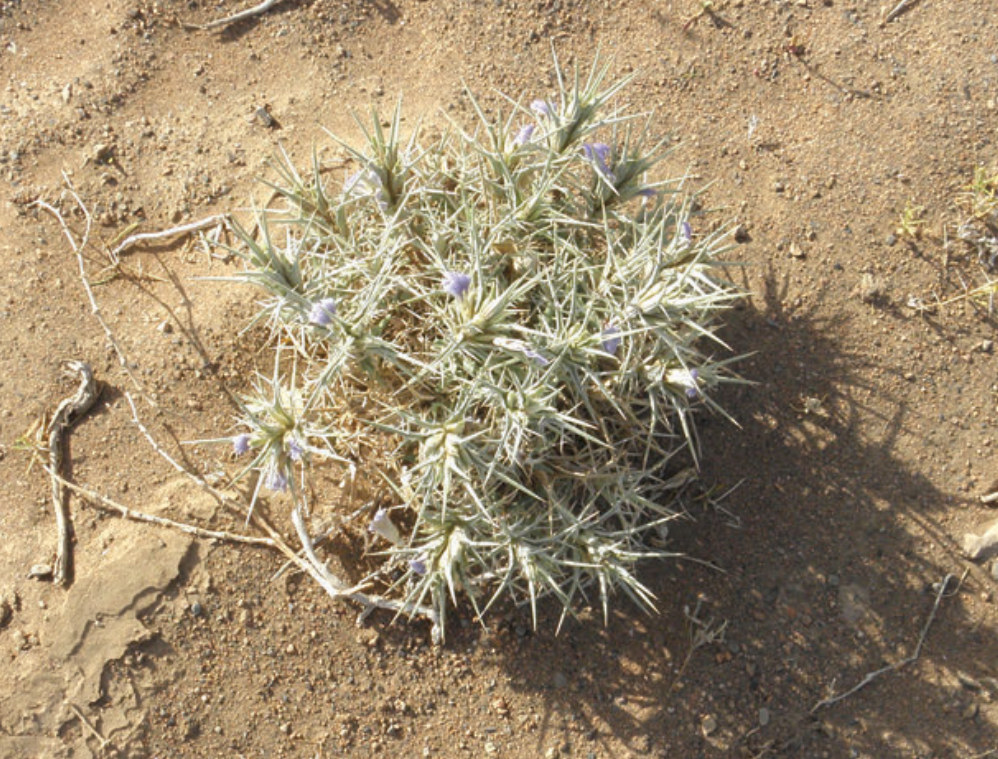
Plant name
callous
Latin name
Blepharis ciliaris (L.) B.L. Burtt
Common names
Canopy, wolf's thorn, poisonous infusion, lizard's thorn, old woman's kohl, naghi
foreign names
Eng. Rohida tree, Fr. Ruellia
The group
Acanthus
Habitat and Geographic Distribution
A desert plant native to Arabia and Sudan, it spreads across the northern part of tropical Africa, from Saudi Arabia and Oman to Mars, India, and Pakistan.
Botanical description
40 cm - A perennial herb, its length covered with short, grayish hairs or nearly hairless, branching profusely from the base.
The stem is rigid.
The stem leaves are oblong to uterine, tapering gradually to form petioles.
The leaves are 5 cm long, smooth, and deciduous.
They appear arranged in whorls of 2-0.8 x 6 cm, or bear slender spines, their dimensions being 5 cm.
The flowers are gathered in dense spikes.
The flower is supported by a bract and several bracts.
The bract is a pair of lateral spines not exceeding 5 cm in length and width.
It is ovate and pointed at the apex, ending in a spine with unequal lobes.
The corolla is 5 cm.
The calyx is membranous, dry, hairy, and neutered, composed of 1.5-1.5 bracts.
The bracts are 28 mm long, divided into thirds.
The thirds fuse into a very short tube that soon splits to form a single lip.
The stamens are thickly threaded.
The fruit is a capsule, purple, bearing erect veins, turning white when withered.
The male lobes are blue, 2 mm long, and glabrous, containing two seeds.
The seeds are covered with a bundle of curled hairs, which later unfold.
The ovules are elliptical, compressed, and become sticky when wet. Flowering occurs from May to December.
Used part
The part used varies depending on the type and preparation; a reliable or competent reference should be consulted before use.
chemical components
The plant contains alkaloids, citronellols, and tannins. (apigenin, naringenin)
Properties and medical uses
The plant, particularly the leaves, is popularly used as an aphrodisiac.
A paste made from the powdered, roasted seeds is used for its antiseptic properties to stop bleeding, heal wounds, and treat eye infections.
A decoction of the roots is used as a diuretic and to treat chronic coughs.
The dried, roasted roots are ground and used as an eye tonic to strengthen eyesight.
Side effects and precautions
Allergic reactions or drug interactions may occur; self-use should be avoided by pregnant and breastfeeding women, children, and patients with chronic diseases.
the environment
The plant grows in deserts on stony and rocky terrain.
It is widespread in the deserts of the Arab world, such as the Arabian Peninsula and Sinai.
Agriculture and productivity
The plant is propagated by seeds collected in summer and autumn and sown in spring.
(Sambucus ebulus L., Ebulum humile Mill.
(Garcke., Sambucus herbacea Gilib., Sambucus humilis Mill., Sambucus ebulus subsp. ebulus., Viburnum ebulus) L. (Martinovský)
History and Heritage
The plant's scientific name is believed to be of Greek origin, meaning "eyelashes" or "eyelashes." The parts used are the fruits, leaves, and roots.
Medical note
This information is for educational purposes only and does not constitute medical advice.
Poisonous or potent plants should only be used under the supervision of a qualified physician or pharmacist.
Related images


