Mary's Hand | A medicinal plant in the Akhdar encyclopedia
The plant does not contain any hormones, but it exerts anti-estrogenic and anti-androgenic effects through chemical activity on the hypothalamic-pituitary axis, leading to the restoration of the estrogen/progesterone hormonal balance to its normal state by increasing progesterone production, as wel…
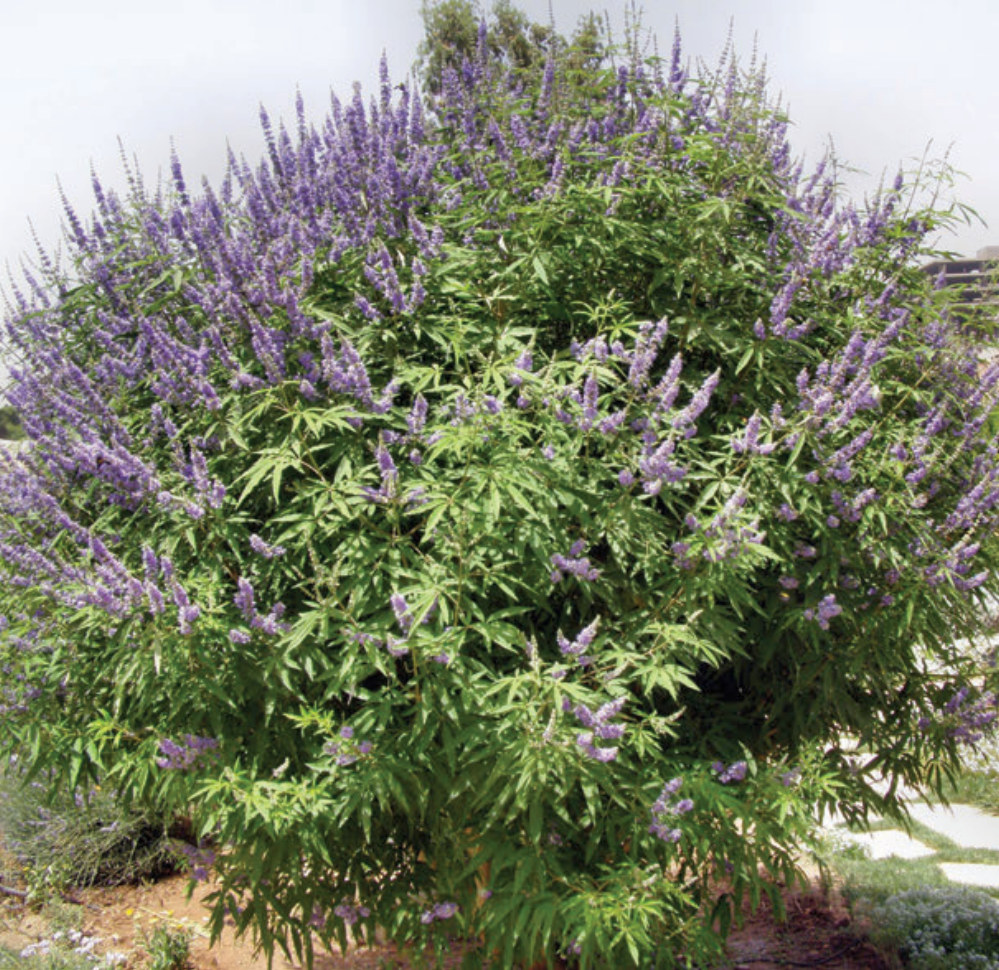
Plant name
Mary's palm
Latin name
Vitex agnus - chaste L
Common names
Mary's palm, the artemisia, wild laurel, the chaste tree, Abraham's tree, the pure artemisia
foreign names
Eng. Chaste tree, Fr. Le gattilier
The group
Arthides (Lamiaceae)
Habitat and Geographic Distribution
Countries bordering the Mediterranean and extending to the Turanian region. It is cultivated for ornamental purposes in many countries.
Botanical description
Its young branches are quadrangular, gray, and downy.
The leaves are palmately compound, arranged in leaflets or shrubberies, opposite, deciduous, and long-petioled.
The leaflets are uterine, acuminate, and gradually tapering at the base, reaching up to 5 cm in length.
Their upper surface is Akhdar, and their lower surface is gray and downy.
The flowers are entire, with short petals, and can reach 10 cm in length.
They are pale violet (sometimes pink or white), gathered in terminal, branched, spike-like inflorescences.
The petals are fused to a length of 1 mm, are very downy, and their sepals are fused into a tube ending in five short teeth.
The corolla consists of a calyx that is a semi-dipole-shaped tube, about three times the length of the calyx.
The stamens are of two different lengths.
The male ovary is four-chambered, with each lobe containing a single ovule.
The fruit is a drupe, spherical to oblong in shape, 3 mm in diameter, reddish-black when ripe, surrounded up to two-thirds by a cup-shaped calyx.
The outer pericarp bears short, glandular hairs. Flowering occurs from June to September, and fruiting takes place in autumn.
Used part
Dried ripe fruits and dried leaves
chemical components
The fruits contain iridoide glycosides, α-β pinene, α-β pinene, and cineole, and are rich in cineole (1.6%).
They also contain volatile oils such as cetoseteroides, homoorientine, chrysosplenol, casticine, luteoline, and luteoline 7-glucosides, including bornyl acetate and flavonoids.
Properties and medical uses
The plant does not contain any hormone, but it has an anti-estrogenic and anti-androgenic effect through a chemical activity it exerts on the hypothalamic-pituitary axis, which leads to restoring the estrogen/progesterone hormonal balance to its normal state by increasing the production of progesterone, and it also limits the increase of prolactin and restores it to its normal level.
This plant is primarily used to treat premenstrual disorders resulting from low progesterone levels in the days leading up to menstruation, menstrual irregularities and pain (absence of menstruation, headaches, fatigue, breast tenderness and swelling, anxiety, irritability, sensitivity, and anger), menopausal symptoms, and to regulate milk production in mothers with hormonal problems.
It is also traditionally used to increase the chances of pregnancy in women experiencing infertility.
It results from an increase in prolactin levels and a decrease in progesterone levels.
It is also used to treat acne caused by hormonal imbalances, prostatitis, and testicular tumors, in addition to its well-known ability to reduce and control excessive sexual urges in men.
Side effects and precautions
There are some side effects to taking this medication if it is used for more than three months.
These side effects may include stomach upset, fatigue, and difficulty sleeping.
The medication is potentially unsafe for pregnant women and may worsen pregnancy and harm the fetus.
It can affect estrogen levels.
This drug should not be used in cases of hormone sensitivity.
It contains chemicals that affect the brain similarly to some medications used for Parkinson's disease and may interfere with Parkinson's treatment.
It also affects a brain chemical called dopamine, which may reduce the effects of metoclopramide.
the environment
The plant thrives in humid environments and along the banks of brackish or inland waterways.
It tolerates fluctuating climatic conditions, resists drought, and is largely arid.
It can be successfully cultivated in all bioclimatic zones, from mild to warm, and sometimes even fresh, as it can withstand prolonged periods of low winter temperatures, potentially exhibiting deciduous behavior.
It tolerates high sunlight and exceptionally high temperatures, such as 48°C in summer, provided sufficient irrigation is supplied.
It does not tolerate shade, even light shade, which results in a significant slowdown in its growth rate.
The plant thrives in all soil types, including clay soils with temporary seasonal waterlogging, and tolerates salinity up to parts per million.
It has recently been used in the initial afforestation of saline-tolerant regions in Central Asia.
Agriculture and productivity
It is propagated by seeds soaked in ordinary water for 24 hours.
It also responds well to vegetative propagation by semi-hardwood cuttings without the need for rooting hormone. (Ziziphus tenuior L., Faldermannia tenuior L.) Ter-Chatsch
History and Heritage
The scientific name of the genus is the ancient Latin and Greek name for this shrub, derived from the Latin word *vieo*, meaning "twist" or "net," referring to its flexible branches, which were used in ancient Greece for basket weaving.
*Agnus* comes from the Greek word meaning "chaste," and *castus* is from the Latin word with the same meaning, referring to the use of this species in ancient monastic rituals of chastity, due to the aphrodisiac effect of its fruit. The fruit has been used since ancient times to reduce sexual desire.
Medical note
This information is for educational purposes only and does not constitute medical advice.
Poisonous or potent plants should only be used under the supervision of a qualified physician or pharmacist.
Related images


