Caraway | A medicinal plant in the Akhdar encyclopedia
Caraway seeds, with their volatile oil, possess digestive properties, relieving gas and stomach cramps, and exhibiting antidepressant and anxiolytic effects, in addition to their antioxidant properties. The volatile oil and coumarin compounds also possess antimicrobial properties, killing bacteria…
Plant name
Caraway
Latin name
Carum carvi L
Common names
Caraway
foreign names
Eng. Caraway, Fr. Carvi
The group
celery
Habitat and Geographic Distribution
It is widespread in central and northern Europe and parts of the Mediterranean basin, and is also found in Asia in the Himalayas and Mongolia. The most important Arab producing countries are Morocco and Egypt.
Botanical description
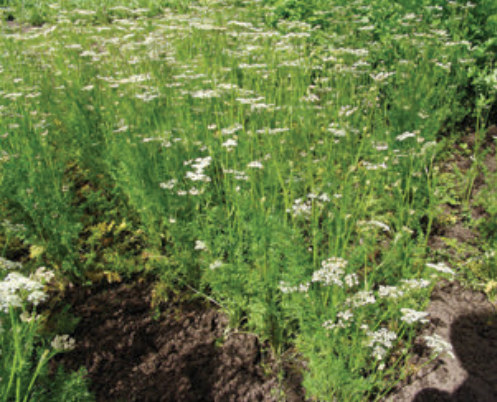
M, a perennial or biennial plant, reaching a length of stubby, hairless.
The stem is simple, often branching from the top.
The leaves are pale green, bipinnately compound, highly divided, with fine thread-like terminal lobes, the lower ones being sessile (2-5 mm long) and the upper ones being flat, with a broad, white-edged sheath that forms the stubby part of the blade.
The compound umbel (9-9 cm long) is composed of linear bracts, which may be entirely absent.
The bracts are composed of bracts at the level of the simple umbel, which are fine or absent.
The flowers are small, white to pale pink.
The teeth of the calyx are distinctive.
The corolla has blunt petals.
The fruit is a dichotomous acinus, ovate to oblong, with pointed ends, 5 mm long, brown, hairless, yellowish, with prominent ribs. 2-1. Flowering from May to July
Used part
The dry, ripe fruit, and the essential oil extracted from the fruit.
chemical components
Carob fruits contain furocoumarins (4-7%) (antiviral compounds) and volatile oils, primarily carvone (40-60%), including carvone A-B pinene, alpha- and beta pinene, proteins, and polysaccharides.
The pulp remaining after extraction of the volatile oil also contains fatty oils and polysaccharides.
Properties and medical uses
Caraway seeds, with their volatile oil, possess digestive properties, are anti-carminative and antispasmodic, and have antidepressant and anxiolytic effects, in addition to their antioxidant properties.
The volatile oil and coumarin compounds also have antimicrobial properties, effective against bacteria such as Pseudomonas, Bacillus, and some types of Candida fungi.
The volatile oil is used topically to treat fungal skin infections and is an ingredient in mouthwashes and antiseptics.
The aqueous extract and essential oil of caraway have anti-inflammatory and diuretic properties.
Caraway seeds are used as a flavoring in foods and beverages, and have various traditional uses in folk medicine.
A decoction of the seeds is used to treat bloating, colic, and stomach cramps in children.
It is also believed to strengthen the body and increase milk production in nursing mothers, as well as to induce menstruation.
Caraway extracts are sometimes mixed with other medications to enhance their flavor, such as when combined with laxatives.
However, excessive consumption of caraway seeds or the use of caraway oil in large quantities and for extended periods may lead to kidney and liver dysfunction.
Its essential oil should not be used by pregnant women.
In food, caraway is used as an appetite stimulant; a nutritious hot drink is prepared from its fruit, and its powder is used in confectionery.
It can also be frequently used as a preservative in the food, cosmetic, and pharmaceutical industries.
Side effects and precautions
Allergic reactions or drug interactions may occur; self-use should be avoided by pregnant and breastfeeding women, children, and patients with chronic diseases.
the environment
The plant grows in dry meadows, along roadsides, and in mountainous regions.
The optimal temperature for vegetative growth is between 22°C and 20°C, while the optimal temperature for flowering and fruit formation is between 20°C and 20°C.
Dry weather reduces the amount of volatile oil, while cool, humid weather increases it.
The plant grows well in highly alkaline calcareous soils and prefers well-drained silty soils.
Heavy, fertile soils encourage vegetative growth at the expense of fruit development.
Caraway can be successfully cultivated in saline soils, provided they are well-drained.
Agriculture and productivity
The plant is propagated by seeds sown in autumn in temperate regions, and after the last frost in colder regions.
Sowing is done in rows or in beds measuring 5 x 4 meters, spaced 75 x 30 centimeters apart, with several seeds placed in each hole if the goal is fruit production.
One hectare requires 10-15 kg of fresh, healthy seeds.
It is essential to irrigate the plants moderately, ceasing irrigation once the fruit ripens.
Fertilizing with essential nutrients increases fruit production and the percentage of essential oils.
One hectare yields approximately 1.5-2 tons of dried fruit.
(Conium maculatum L., Cicuta maculata L., Cicuta major L., Cicuta officinalis Crantz., Conium maculatum var. barceloi O. Bolòs & Vigo)
History and Heritage
The scientific name is of Greek and Latin origin, and was formerly used to refer to an unspecified aromatic plant from the Apiaceae family.
This name applies to C.
carvi, as the word carvi comes from the Greek karon, which is derived from the Arabic "karawiya".
References indicate that the name of this genus originates from the Arabic word for "pumpkin" or "head," referring to the shape of the seed.
It was cultivated in Asia Minor before the Common Era, and its medicinal benefits have been known since the time of the ancient Egyptians.
Ancient manuscripts mention Emperor Julius Caesar's use of caraway and the rich diet of his soldiers.
The renowned physician Dioscorides advised young women with pale complexions to take caraway oil.
Caraway was cultivated in Europe in the 9th century AD and enjoyed widespread popularity.
Two large ones.
Arabs used them to expel gas and treat colds and flu.
In Germany, bakers flavor cheeses, cabbage, soups, and bread with them. In Norway and Sweden, black bread mixed with caraway is eaten in rural areas.
Medical note
This information is for educational purposes only and does not constitute medical advice.
Poisonous or potent plants should only be used under the supervision of a qualified physician or pharmacist.
Related images


