Black Horehound | Medicinal Plant in Akhdar Encyclopedia
Staphylococcus aureus, Escherichia coli, and Pseudomonas aeruginosa are among the bacteria that the plant contains. Its glycosidic compounds possess antioxidant properties. A decoction of the plant is traditionally used to treat skin allergies. The effects of plant extracts against two human cancer…
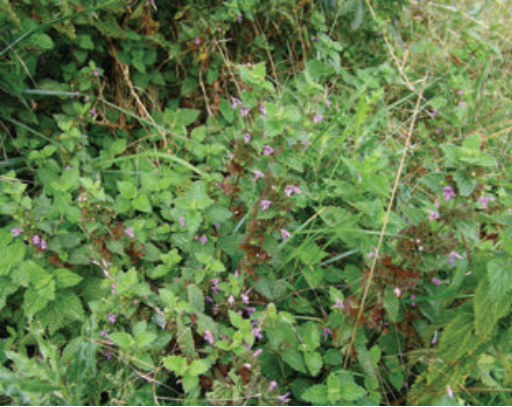
Plant name
Black phasion
Latin name
Ballota nigra L
Common names
Black horehound, ground oak, calyx, rashma
foreign names
Eng. orehound, Fr. Ballote noire
The group
oral
Habitat and Geographic Distribution
Eastern Mediterranean, extending to the western Iranian-Turanian and eastern Arabian desert regions
Botanical description
80 cm, milk-like rhizome - a perennial plant, its height resulting from strong, erect, angular stems.
The plant is downy and becomes brown to purple in autumn.
The leaves are opposite, petiolate, the lower ones being larger, ovate to rounded, with a crest to toothed margin.
Both surfaces are initially downy, then the upper surface becomes glabrous and smooth.
The flowers are 10 mm long, gathered in widely spaced cymes of 15 in the leaf axils.
The bracts are reddish-brown.
The calyx is lobed, five-lobed, and hard, with teeth ending in a spadix.
The corolla is purple, varying in length.
The fruit is a bilipped nutlet. The stamens are smooth and ovate. Flowering occurs from June to July.
Used part
Flowering tops. Latin name: Ballota nigra L. Ballota foetida Lam.
chemical components
These include: marrubiin (bitter principles), diterpenes, lactones (di-articulose lactones), 7-ahpha-acetoxymarrubiin, ballonigrin, ballotenone, ballotenol, acetoxymarrubiin, chlorogenic acid, ferrulic acid, caffeic acid (phenolic acids: caffeic acid), germacrene (a volatile oil with an unpleasant odor rich in sesquiterpene compounds, the most important of which are tannins and their derivatives), and tannins.
Properties and medical uses
Staphylococcus aureus, Escherichia coli, and Pseudomonas aeruginosa are among the bacteria that the plant contains.
The glycosidic compounds have antioxidant properties.
A decoction of the plant is traditionally used to treat skin allergies.
The effects of plant extracts against two human cancer cell lines—a hepatic HepG2 cell line and an MCF-7 breast cancer cell line—were studied, as well as their antioxidant effects.
The oil was found to have an antiproliferative effect against HepG2 hepatic cancer cells.
The plant has antioxidant effects by scavenging free radicals in the body.
In a study of the plant's effects on body lipids, the use of the plant extract led to a significant reduction in cholesterol, phospholipid, and triglyceride levels in rabbit blood.
Side effects and precautions
Allergic reactions or drug interactions may occur; self-use should be avoided by pregnant and breastfeeding women, children, and patients with chronic diseases.
the environment
It grows in neglected areas, along roadsides, and in shady spots.
It thrives in moist, well-drained, nitrogen-rich soils.
It prefers sunny or partially shaded locations. It is rarely found in acidic soils.
Agriculture and productivity
Grows wild. Lamium album L. Lamium vulgatum Benth., Lamium vulgatum var. album (L.) Benth
History and Heritage
The name ballôté comes from the Greek *ballota*, the scientific name for the genus.
The poison used for these plants in Greece is *gre*, meaning black.
*Nigra* is of known origin, and the poison is the descriptive name for the species.
The plant was used in ancient times to treat respiratory disorders and vomiting.
Dioscorides mentioned that a paste of the plant's leaves with salt was beneficial for treating dog bites, and a paste of dried leaves with honey was used to treat infected wounds.
Medical note
This information is for educational purposes only and does not constitute medical advice.
Poisonous or potent plants should only be used under the supervision of a qualified physician or pharmacist.
Related images


