Strawberry | Medicinal plant in the Akhdar Encyclopedia
Arbutin possesses diuretic and urinary antiseptic properties. A decoction of the leaves is traditionally used to treat kidney and bladder inflammation, but caution should be exercised due to the irritating effect of the tannins on mucous membranes. The plant also has antioxidant, antibacterial, ant…
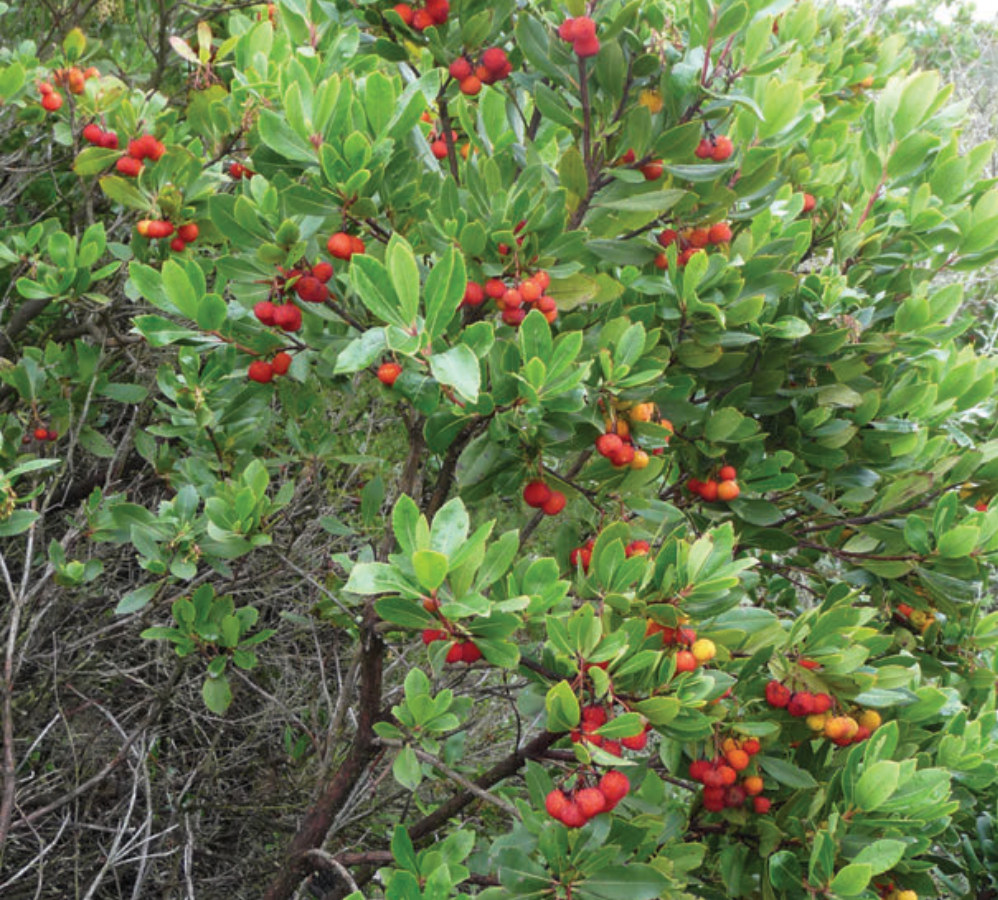
Plant name
Qatlab
Latin name
Arbutus unedo L
Common names
Qatlab, Qatlab Yunidi, Asri al-Dub, Henna Ahmar, Qatil Abihi, Sisnu, al-Lanj
foreign names
Eng. Common arbutus, Fr. Arbousier
The group
Khalanjiya
Habitat and Geographic Distribution
It thrives in the warm and temperate regions of the Eastern Mediterranean.
It is widespread in Greece, Turkey, and Western Europe, and also grows in the area stretching from Albania to the Crimean Peninsula, passing through the Black Sea coast to northern Iraq, Syria, and Lebanon, as well as in Morocco, Tunisia, Spain, Malta, Cyprus, and southern Italy.
Botanical description
Granular when it is - M.
The branches are erect, the bark is brown, rough.
4 - Small trees or evergreen shrubs, 6 cm long.
- Young.
The leaves are simple, alternate, petiolate, leathery, ovate, toothed, short-petioled, the flowers are five-segmented, gathered in terminal drooping inflorescences, the bracts are very small, scaly.
The calyx is very small, 7 mm, narrow at the apex, disc-shaped, with triangular lobes, deeply lobed.
The corolla is near-inset, white, with stamens, the filaments are hairy, their bases are slightly widened.
The ovary is superior, with five lobes, fringed, backward-curved.
The male is 1 cm, with many seeds, edible.
2 - 1.5 Stone fruits.
The fruit is a berry, spherical, bearing warts, red or purple, its diameter is [missing information]. Flowering is from December to March.
Used part
The leaves contain tannins, arbutin (3-8%), and methyl arbutin.
The main volatile compounds are α-terpineol, decenal, and palmitic acid. This species is an inhibitor of α-amylase, α-glucosidase, and lipase enzymes.
chemical components
Methyl arbutine, 8-3% arbutine. The leaves contain tannins, hydroquinoline glycosides: arbutin.
Properties and medical uses
Arbutin has diuretic and urinary antiseptic properties.
A decoction of the leaves is used traditionally to treat kidney and bladder inflammation, but care should be taken to avoid the irritating effect of the tannins on mucous membranes.
The plant possesses antioxidant, antibacterial, anti-inflammatory, anticholinesterase, and hypoglycemic properties.
Extracts of the plant can inhibit the growth of most microorganisms, thus making it a promising source of natural medicines.
Precautions: Its use is not recommended during pregnancy and breastfeeding. It may cause nausea and vomiting.
Side effects and precautions
It is not recommended for use during pregnancy and breastfeeding. Its use may cause nausea and vomiting.
the environment
This plant is widespread in forests.
It is resistant to drought, thrives in siliceous soils, and its roots contain mycorrhizae, which help it survive in rocky, poor soils.
It is relatively tolerant of calcareous soils and requires little irrigation, as it can grow in a rainfed manner.
It is a fire-resistant species, regenerating vigorously from the root system after a fire, but it does not produce shoots originating from the root system. Due to its resistance, it often occupies areas prone to frequent fires.
Agriculture and productivity
It reproduces naturally, but only to a limited extent, by seeds dispersed by birds that eat its fruit, or by suckers that can be planted from autumn until early spring.
It can be propagated from seed in a nursery, but the seedlings are highly susceptible to wilting.
(Ricinus communis L., Ricinus communis var. genuinus Müll.Arg., Ricinus communis var. typicus Fiori)
History and Heritage
Arbutus is the ancient Latin name for this tree, the genus name.
Some say it has a Phoenician origin and means "trunk." The ancient Latin name for this species is *Unedo*, referring to the red or brown trunk, a name derived from the tree's distinctive shape.
The descriptive term for the species refers to its individual fruits.
The word "Qutub" is of a known foreign origin but is commonly used in the Levant.
In Europe, Antiochus mentioned that the fruit of the *Qutub* is beneficial against corrosive poisons and all types of catarrh when applied topically, and that its leaves resolve tumors when applied topically.
Medical note
This information is for educational purposes only and does not constitute medical advice.
Poisonous or potent plants should only be used under the supervision of a qualified physician or pharmacist.
Related images


