Nettle | A medicinal plant in the Akhdar encyclopedia
Research on laboratory mice has shown that extracts of the aerial parts and roots (saponins) possess antinociceptive and anti-inflammatory properties. A decoction of the plant's roots is used traditionally for its expectorant, antispasmodic, and anti-inflammatory properties, as well as for treating…
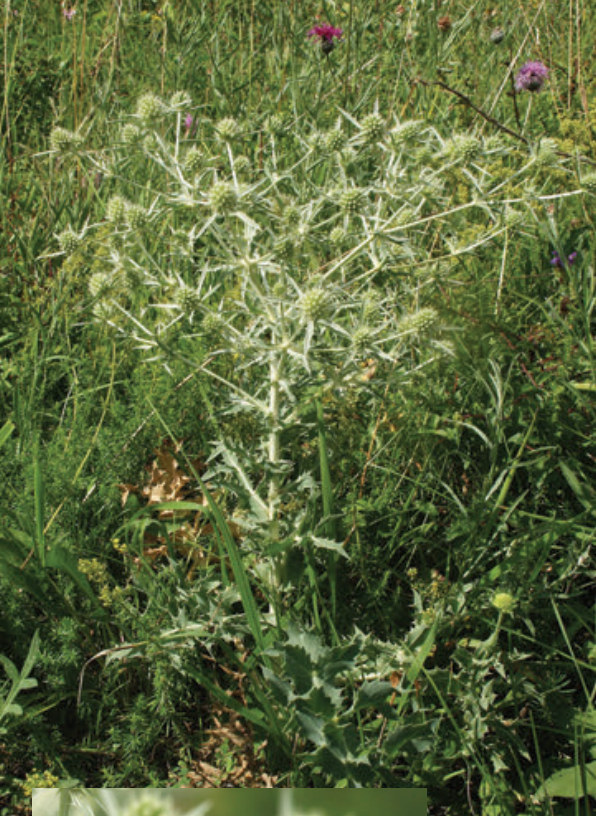
Plant name
Pinching
Latin name
Eryngium campestre L
Common names
Qarsa'na, Shaqaqil Marsi, Fatanji', Haliyat al-Ma'zi, Sh Nadab, White thorn
foreign names
Eng. Eryngo, Fr. Chardon Rolland
The group
tent
Habitat and Geographic Distribution
The plant grows wild in central and southern Europe, North Africa, and the Mediterranean region, and its range extends eastward as far as Afghanistan.
Botanical description
A perennial, spiny herb, bluish-white, succulent, with numerous branches forming a comb-like inflorescence.
The basal leaves are broadly ovate, trifoliate, with pinnate, toothed, and spiny lobes.
The inflorescence is a simple, semi-capital umbel, surrounded by bracts of uterine bracts, bearing a 7-flowered head composed of one or two spines at its base, two barbs longer than the head.
The flowers are hermaphroditic, bluish-white, and succulent, surrounded by simple, spiny bracts, longer than the calyx but much shorter than the bracts surrounding the head.
The teeth of the calyx are prominent, hard, and sharp.
The petals are erect, lobed, notched, with a long, downward-pointing tip.
The style foot is broad, with a high margin surrounded by thread-like styles.
The fruit is obovate or cylindrical, covered with scales or tubercles.
The fruiting segment is not distinctive. Flowering occurs from June to September.
Used part
Dry leaves, flowers, and roots are collected in spring and autumn.
chemical components
The most important components are pyranocoumarins and triterpene saponins.
The plant's roots contain triterpene saponins, monoterpenes, and monoterpene glycosides such as egelinol, egelinol benzoate, benzyl esters, agasyllin, grandivetin, oligosaccharides, and sugars including chlorogenic acid, rosmarinic acid, caffeic acid ester, caffeic acid esters, glycosides, kestose, flavonoids, and triterpene saponins.
The leaves and flowers also contain triterpene saponins, chlorogenic acid, rosmarinic acid, caffeic acid ester, and caffeic acid esters, in addition to pectins (A, B, and C), minerals such as potassium, calcium, manganese, and magnesium, and vitamins such as vitamins A, B, and C.
Properties and medical uses
Research on laboratory mice has shown that extracts of the aerial parts and roots (saponins) possess antinociceptive and anti-inflammatory properties.
A decoction of the plant's roots is used traditionally for its expectorant, antispasmodic, and anti-inflammatory properties, as well as for respiratory tract infections and coughs.
It is also used for urinary retention, urinary tract infections, and to treat kidney and bladder stones and renal colic.
The methanolic extract of the plant has demonstrated antitumor activity (86% tumor inhibition).
The roots are used topically in the form of tinctures to treat wounds and other ailments.
The leaves and flowers are used to treat urinary tract infections, prostatitis, and chest colds.
Another species, called Eryngium maritimum (sea crocus), is found on the shores of the Baltic, Black, and Mediterranean Seas, and is used in the same way as this species.
Side effects and precautions
Allergic reactions or drug interactions may occur; self-use should be avoided by pregnant and breastfeeding women, children, and patients with chronic diseases.
the environment
This plant grows in dry, grassy areas and field edges.
It requires well-drained soil and sunny locations.
It prefers medium-light soils and tolerates most soil types, including stony and calcareous soils.
Agriculture and productivity
It is propagated by seeds sown in nursery beds after ripening in early autumn or spring.
The seeds usually germinate after 5-90 days at a temperature of 20°C.
The seedlings are then transferred to plastic bags or containers to spend the first year in the nursery, and then transplanted to their permanent location at the end of the following spring.
The plant can also be propagated by division in early spring or autumn, and by root cuttings in autumn or winter.
The plant has deep, widespread roots, which help it spread rapidly, making it difficult to eradicate once it has spread. Ferula hermonis Boiss
History and Heritage
The name êryggion or êryggos is a genus name from Greek meaning "field plant." The species *Eryngium campestre* has long been used in food and medicine for various ailments such as coughs, bladder stones, and snakebites.
It was mentioned by Ibn al-Baytar, al-Antaki, and Ibn Sina.
The parts used are the leaves, dried flowers, and roots, which are harvested in spring and autumn. Its Latin name is *Eryngium campestre* L.
Medical note
This information is for educational purposes only and does not constitute medical advice.
Poisonous or potent plants should only be used under the supervision of a qualified physician or pharmacist.
Related images


