Squirting cucumber | A medicinal plant in the Akhdar encyclopedia
The drug possesses antioxidant, hepatoprotective, cholagogueic, anti-inflammatory, and antiviral properties. It is traditionally used for liver and biliary diseases, for the prevention of cirrhosis or liver necrosis, and for colds and flu. The seed oil is a potent inhibitor of cancer cell growth. T…
Plant name
squirting cucumber
Latin name
Ecballium elaterium (L.) A. Rich
Common names
Squirting cucumber, red cucumber
foreign names
Eng.Squirting cucumber, Fr.Cocombre d,âne
The group
The lottery
Habitat and Geographic Distribution
Mediterranean and Iranian-Turanian. It spread to many other parts of the world.
Botanical description
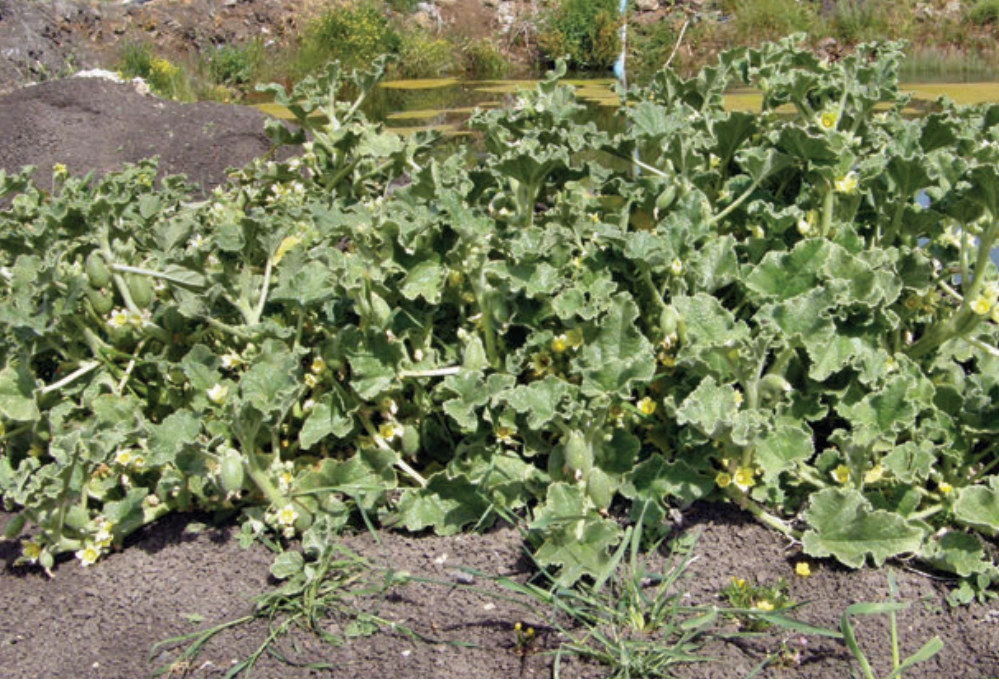
A perennial herb, branching from the base.
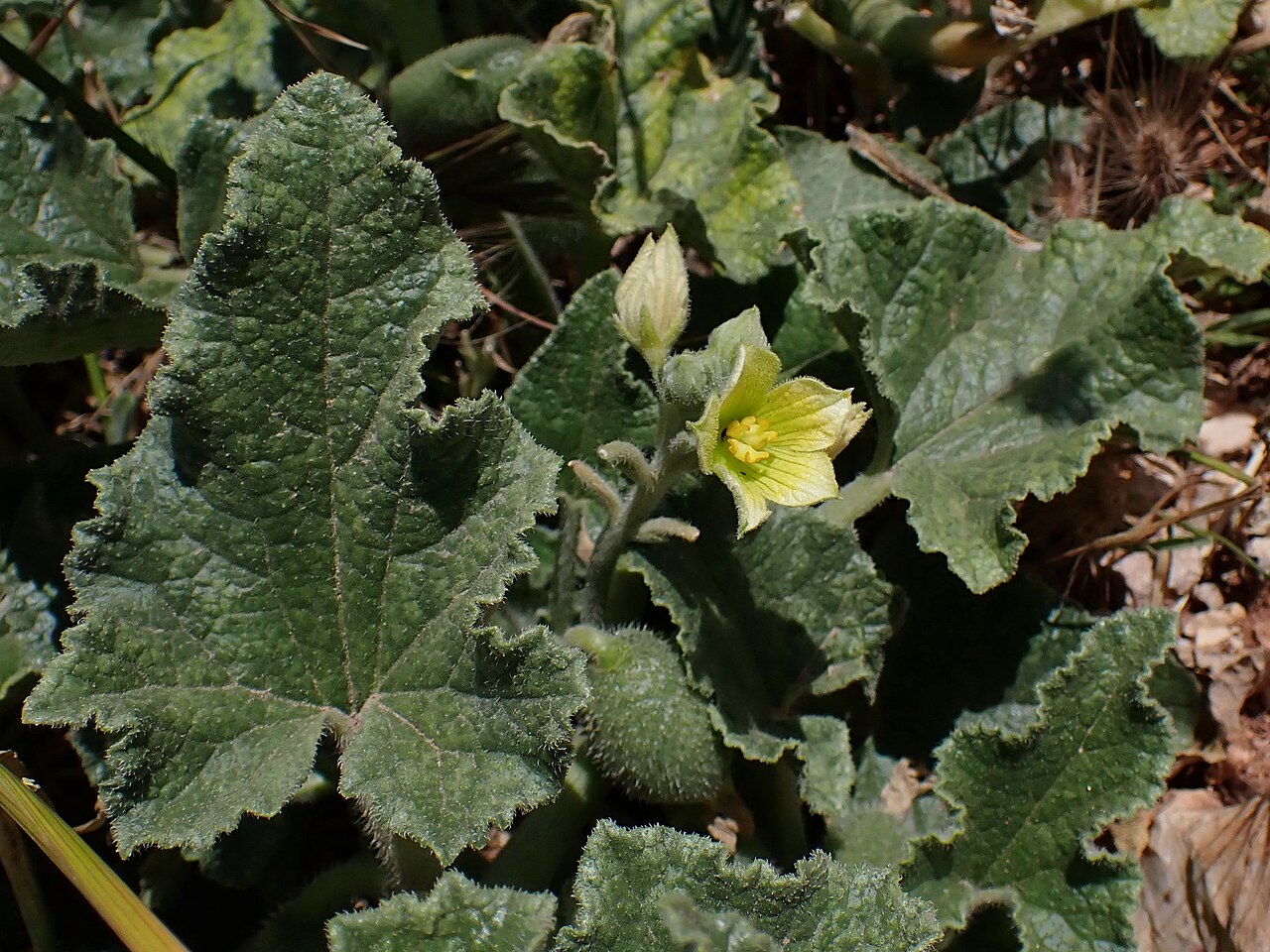
The stem is thick, somewhat hairy, rough and hairy, spreading to the ground, and lacking tendrils.
The leaves are simple, petiolate, heart-ovate, dull-tipped, cristate, and wavy-edged.
The flowers are unisexual, and the plant is monoecious.
The male flowers are gathered in racemes whose buds are narrower than the petioles and covered with fused, bell-shaped, uterine hairs.
The corolla is yellow, composed of rough, linear sepals.
The calyx terminates in five oblong, ovate lobes, acutely apex.
The male flowers have five free, sclerotized stamens.
The female flowers are sedates (sterile, lacking stamens; the female flowers are solitary, with a calyx similar to the male ones, and anthers are present).
The female flowers have three carpels, an inferior, oblong ovary covered with hairy hairs, and a sclerotized style.
Elliptical, covered with bristly, spiny hairs, green, and filled with juicy sap that oozes out the seeds.
The fruit hangs down, elongated to a considerable distance (several meters) when it detaches at maturity through a basal opening (the area where the fruit joins the hyphae).
The seeds are oblong, compressed, smooth, and dark brown. Flowering occurs from April to December.
Used part
fruits
chemical components
Cucurbitacins, resin, carbohydrates, mucilage, and a juice called "elaterium".
It also contains proteins, lipids, cucurbitacins (B, I, D, E, L) and their derivatives (glycosylcucurbitacins), and triterpenoid glycosides.
The seeds are high in carotenoids.
E.
elaterium seed oil exhibits a high iodine value (0.14 ± 160.12 g/100 g of oil).
The high saponification value (0.034 ± 191.57 mg KOH/g of oil) of E.
elaterium seed oil indicates high levels of low molecular weight fatty acids.
E.
elaterium seed oil is characterized by its high content of...
High in unsaturated fatty acids: linoleic acid (48.64%), punicic acid (22.38%), and oleic acid (15.58%), in addition to β-sitosterol and γ-tocopherol.
Properties and medical uses
The drug possesses antioxidant, hepatoprotective, cholagogueic, anti-inflammatory, and antiviral properties.
It is traditionally used for liver and biliary diseases, for the prevention of cirrhosis or liver necrosis, and for colds and flu.
The seed oil is a potent inhibitor of cancer cell growth.
The seeds contain a protease inhibitor polypeptide, which acts specifically against trypsin, being one of the most effective trypsin inhibitors.
The juice is antimicrobial, anti-inflammatory, and antirheumatic.
Dalkhia is used to treat edema associated with kidney, heart, and rheumatic ailments.
The plant is traditionally used to treat otitis, sinusitis, malaria, headaches, and rheumatism.
Side effects and precautions
Allergic reactions or drug interactions may occur; self-use should be avoided by pregnant and breastfeeding women, children, and patients with chronic diseases.
Other uses
The seed oil can be used in shampoo, shoe polish, and skin cream.
Side effects and precautions for the fruit extract include an irritant effect on mucous membranes and skin allergies.
Its use may cause nasal irritation and coughing.
It should not be used during pregnancy or breastfeeding. Excessive doses can cause gastroenteritis and may lead to death.
the environment
The plant grows along roadsides, in fallow fields, and in plowed areas.
The foliage is sensitive to frost, but the root system can tolerate cold winter conditions.
It prefers moist, well-drained, sunny soils and thrives in fertile soils, but it can also grow in sparse soils. In some areas, it can become a weed.
Agriculture and productivity
The seeds are sown in early spring in fertile compost in a greenhouse or nursery.
Two to three seeds are placed in pots or plastic bags and thinned later to the strongest seedling.
Germination takes 10-21 days at 25°C.
Transplant the seedlings to their permanent location when temperatures rise in spring.
(Cupressus sempervirens L., Cupressus elongata Salisb., Cupressus pyramidalis O.Targ.Tozz., Cupressus sempervirens subvar. pyramidalis Hayek, Cupressus sempervirens var. pyramidalis Nyman)
History and Heritage
The scientific name of the genus Ecbalium comes from the Greek ekballein, meaning "thrown out," referring to the fact that when the fruit ripens, it suddenly detaches from the stem, forcefully ejecting its contents of juice and seeds from the resulting cavity, propelling them several meters.
The descriptive name for the species elaterium comes from the Greek elatêrion, meaning "laxative." Its medicinal benefits have been known for a long time; it lowers blood pressure and acts as a laxative. It was mentioned by Ibn al-Baytar, al-Antaki, and Ibn Sina.
Medical note
This information is for educational purposes only and does not constitute medical advice.
Poisonous or potent plants should only be used under the supervision of a qualified physician or pharmacist.
Related images