Veronica | Medicinal plant in the Akhdar Encyclopedia
The aerial parts of Veronica species were used in traditional Roman medicine to treat various conditions such as kidney ailments, coughs, and catarrh. Known for its wound-healing properties, the plant possesses anti-ulcer properties and accelerates healing. It is used as a gargle to treat inflammat…
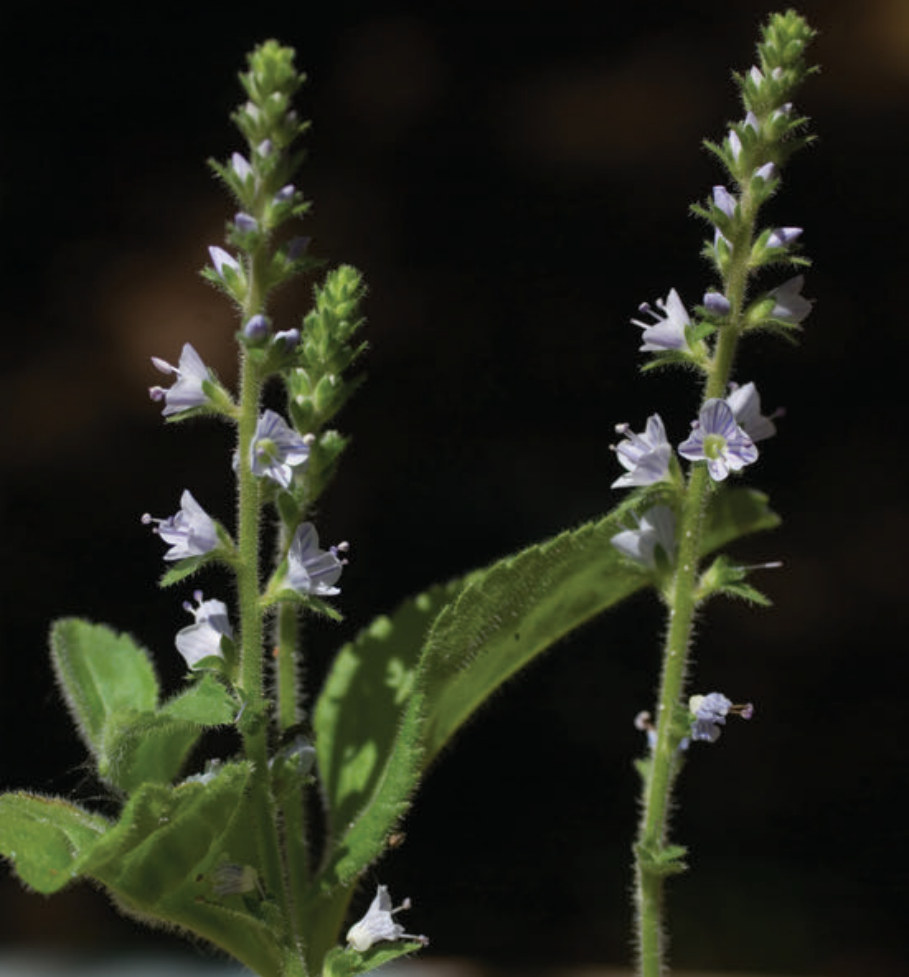
Plant name
Veronica
Latin name
Veronica officinalis L
Common names
Veronica, the flower of the margins
foreign names
Eng.Speedwell, Fr. Veronique
The group
swine
Habitat and Geographic Distribution
Most species of the genus are naturally distributed in Europe, western Asia, the Caucasus, and the Mediterranean basin in degraded forests and mountains.
Botanical description
The plant has creeping, trailing stems and erect stems that terminate in flowers.
The leaves are simple, 20 - a perennial herb, downy, ovate or elliptical, the lower ones opposite and the flowering leaves usually alternate, pedunculated, toothed margin.
The lobes are arranged in equal proportions.
The corolla is blue, with flowers in racemose, spike-like, axillary inflorescences.
The calyx is deeply divided into flattened, equal lobes, where the lobes are observed to be lilac, their petals fused into a pedunculated tube that splits into the upper ones.
The males have two stamens with long filaments.
The ovary is superior, bisectoral, surmounted by a permanent style.
The fruit is a seed.
10 - a triangular capsule, narrow at the base, bisectoral, each containing 1 mm, ovate, flattened, smooth seeds, lengthwise towards the posterior.
The plant flowers in spring.
Its native habitat is V.
syriaca. Other species include the Mediterranean. It resembles the constitution.
Used part
The flowering aerial parts (aromatic, weak aroma, slightly bitter and astringent taste).
Chemical constituents: 0.5-1% iridoide monoterpenes, including aucubin, catalpol, catalpol esters, mussoenoside, and laroside; 10% triterpene saponins; 0.7% flavonoids, the most important of which is luteolin glucoside; and derivatives of caffeic acid, the most important of which is chlorogenic acid, coumaric acid, ferulic acid, luteolin, hispidulin, and beta-sitosterol. In addition to eu-.patorin
chemical components
Catalpol, including: Aucubin (0.5-1%), iridoide monoterpenes, laroside, mussoenoside, catalpol esters (primarily luteolin glycoside, 0.7%), flavonoids (10%), triterpene saponins, luteolin glucoside, and chlorogenic acid and caffeic acid derivatives (primarily chlorogenic acid).
Properties and medical uses
The aerial parts of Veronica species were used in traditional Roman medicine to treat various conditions such as kidney ailments, coughs, and catarrh.
Known for its wound-healing properties, the plant possesses anti-ulcer properties and accelerates healing.
It is used as a gargle to treat inflammation of the mouth and throat.
A decoction of the plant is used traditionally to treat disorders of the respiratory system, the digestive system and liver, the urinary system and kidneys, some skin diseases, arthritis, and rheumatism.
It is also used in blood purification.
Studies have demonstrated its anti-inflammatory, antioxidant, and antimicrobial activity against Staphylococcus aureus, Listeria monocytogenes, and Listeria ivanovii, the most susceptible strains, with MIC values between 3.9 and 15.62 mg/ml.
It has expectorant, astringent, and appetite-stimulating properties during illness and convalescence.
The genus prefers well-drained soils and sunny or shady locations. It is found in marshes and grassy areas with dry soil. It prefers cool summers.
Side effects and precautions
Allergic reactions or drug interactions may occur; self-use should be avoided by pregnant and breastfeeding women, children, and patients with chronic diseases.
the environment
The species prefers well-drained, sunny or shady locations.
Agriculture and productivity
These species can be propagated by seeds and cuttings in summer, or by division in autumn or spring. Elytrigia repens (L.) (Nevski) Elymus repens (L.) Gould
History and Heritage
Veronica, the scientific name for the genus, is attributed to Saint Veronica, who, according to Christian tradition, wiped the face of Jesus Christ as he carried his cross, causing his image to appear on the cloth.
This image is called the true image.
In the Levant, the plant is known as Veronicon in Latin as "flower of the margins," and it is used especially in garden borders due to its light growth and beautiful flowers.
It was so important that the physician V.
officinalis, a well-known medicinal herb, dedicated a page to it, but it has almost been forgotten in recent times.
Medical note
This information is for educational purposes only and does not constitute medical advice.
Poisonous or potent plants should only be used under the supervision of a qualified physician or pharmacist.
Related images


