Madder root | A medicinal plant in the Akhdar encyclopedia
Research has shown that the roots have properties that reduce the formation of calcium oxalate in the kidneys. A decoction of the roots is traditionally used to break up kidney and urinary tract stones. It is also used as an antibacterial, anti-inflammatory, antioxidant, and anticancer agent, and i…
Plant name
Fuwa Al-Sabbaghni
Latin name
Rubia tinctorum L
Common names
Fuwa Al-Sabbaghni
foreign names
Eng. yer's madder, Fr. Dyer's madder
The group
Foya
Habitat and Geographic Distribution
Mediterranean and Iranian-Turanian.
It is found in Southern Europe, the Eastern Mediterranean, Turkey, Iraq, Iran, the Caucasus, and Central Asia.
Botanical description
A herbaceous, four-lobed stem with red roots.
The young branches are 80 cm long.
It is a perennial, climbing herb, with leaflets up to 6 cm long.
The leaflets are glabrous and bear short spines at widely spaced intervals.
The leaves are arranged in whorls of up to 1 cm long, oblong or uterine, sessile, tapering at the base, with reticulate veins on the underside.
They bear spines on the margins and on the midrib dorsally.
The inflorescence is cymose, exceeding the length of the supporting leaves.
The flowers are hermaphroditic, five-segmented.
The calyx lobes are vestigial.
The corolla is cyclic, honey-colored, and oblong.
The lobes are bilobed.
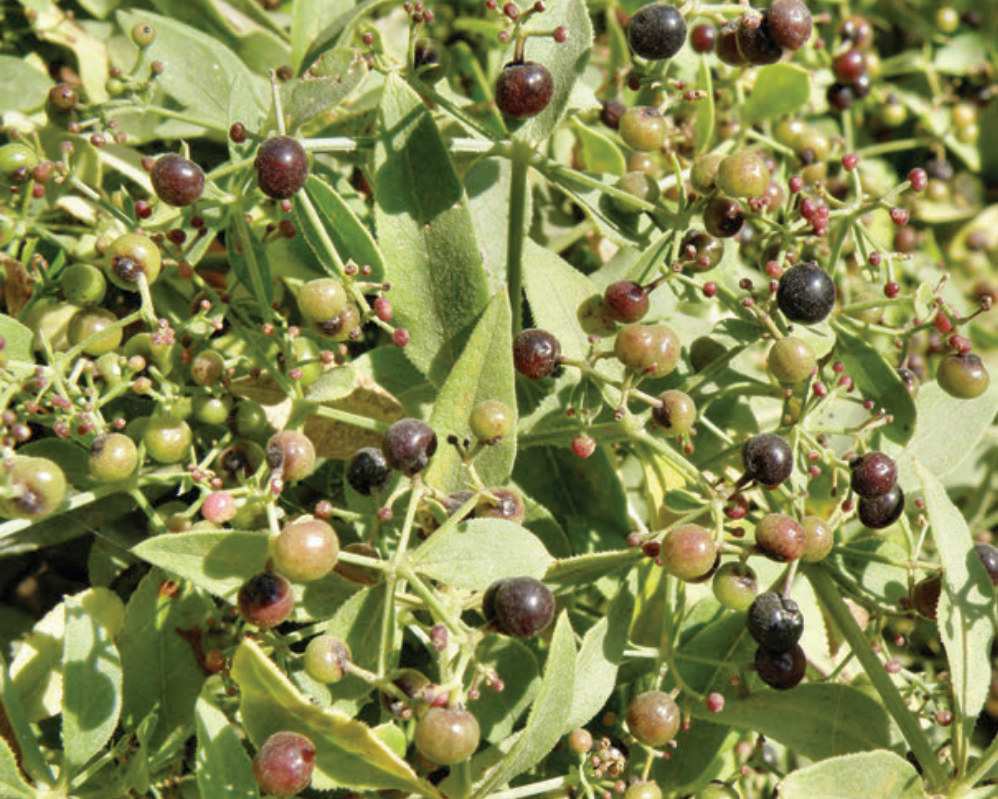
The fruit is a berry, monoecious, with uterine lobes tapering at the apex.
The anthers are usually linear (resulting from the abortion of the second stone), monoecious, and spherical.
Sometimes, a biecious berry is observed when the second stone develops, but the two do not separate at maturity. Flowering occurs from May to July.
Used part
Dried roots are red in color
chemical components
The roots contain 2-4% anthraquinone glycosides and their derivatives, the most important of which are alizarin, purpurin (reddish compounds), and lucidin (toxic), among others.
They also contain resins, tannins, sugars, pectin, calcium, and organic acids.
The roots contain phenols, alkaloids, coumarins, flavonoids, tannins, and alizarin (representing 60%) (2,1-dihydroxyanthraquinone, 1,2,4-trihydroxyanthraquinone).
It is decomposed into compounds such as ruberythric acid, rubiadine, purpurin, and the compound porpurine lucidin, lucidin-ω-ethyl-ether, munjistin, munjistin ethyl ether, nordamnacanth, pseudopurin, quinizarin, ruberythric acid, and xanthopurpurin.
Dihydroxyanthraquinone glycosides are present at a rate of 2% of the dry matter of the roots.
The content of these components reaches its maximum in October compared to May and June, as the composition varies between summer and autumn.
These components contain exochrome groups.
Extraction The roots are powdered in water, then the water is evaporated, leaving a residue.
Various colors were observed, including red, yellow, green, brown, crimson, and gray.
The volatile oil, extracted from the aerial parts of the plant, constitutes 1% w/w, and 43 compounds were identified, representing 96.4%.
Among the most important components are pentadecanal and globulol.
The methanolic extract of madder showed significant results in reducing body weight, improving lipid levels, and regulating cholesterol.
Hyperglycemia, insulin resistance, and hyperinsulinemia.
It also showed enhancement of liver tissue structure and function.
Quantitative analysis indicates that the root extracts are rich in phenolic compounds (118.38 mg GAE/g) and flavonoids (0.04 ± 45.29 mg GAE/g).
The aerial parts extract contains the highest levels of tannins (0.1 ± 134.1 mg GAE/g).
The aerial parts extracts also demonstrated the highest antioxidant activity.
The plant contains It contains various active compounds for the prevention of diseases related to oxidative stress.
The rhizome of madder contains 5-6% anthracene compounds (alizarin, ruberythric acid, haliosin, purpurin, xanthopurpurin, pseudopurpurin, rubiadin, lucidin, and iprecin).
The organic acids in the roots of the plant contain up to 15% sugars, proteins, pectins, ascorbic acid, citric, malic, and tartaric acids, carbohydrates, phenolic acids and their derivatives, coumarin, anthraquinone, triterpenoids, and favonoids (quercetin, apigenin, kaempferol, quercetin).
Properties and medical uses
Research has shown that the roots have properties that reduce the formation of calcium oxalate in the kidneys.
A decoction of the roots is used traditionally to break up kidney and urinary tract stones.
It is also used as an antibacterial, anti-inflammatory, antioxidant, and anticancer agent, and is used to treat gallstones and gout.
Madder stimulates vasoconstrictive activity.
Extracts of madder have shown antidiarrheal activity by inhibiting intestinal motility, an activity consistent with its use in traditional medicine.
Research has shown the inhibitory and selective activity of purpurine against melanoma cells and its potential use as an anticancer agent.
Caution should be exercised when using the roots, as they contain the toxic compound lucidin. The roots should not be used by pregnant women.
Side effects and precautions
Allergic reactions or drug interactions may occur; self-use should be avoided by pregnant and breastfeeding women, children, and patients with chronic diseases.
Other uses
Some countries still use the roots to obtain a strong, natural red dye used to color fabrics.
It has also been used in cosmetics to color products. The foliage can be used as livestock feed.
the environment
The plant grows in grassy areas and around hedges.
It prefers sunny locations with light, sandy soils and produces more pigment in fertile, calcareous soils.
It grows mainly on stream banks, among shrubs, and along irrigation ditches, in fields and gardens.
For cultivation and productivity, it is propagated by seeds, which are sown as soon as they ripen in containers in a nursery or greenhouse.
The seedlings are left for a year before being transplanted to their permanent location.
Stored seeds germinate very slowly.
The plant can also be propagated by division in the nursery during the growing season, provided the soil is kept consistently moist.
The divided plants can then be planted directly in their permanent location if they are large enough.
Cultivation of the plant has declined significantly since the chemical production of the dye it produces.
(Ruta graveolens L., Ruta divaricata Ten., Ruta hortensis Mill., Ruta ciliata Mill., Ruta altera Mill., Ruta diversifolia Wender)
Agriculture and productivity
It is propagated by seeds which are scattered as soon as they ripen in containers in the nursery or greenhouse, and the seedlings are left for a year before being transferred to the permanent ground.
History and Heritage
The scientific name of the genus is the Latin name for these plants.
It is derived from rubber, meaning "red," and the species name, tinctorium, means "dyeing plant." The plant's rhizomes have been used since the Middle Ages to obtain alizarin dye, which was used to dye fabrics red.
Dyes from madder were used by all ancient civilizations, including the ancient Egyptians, Persians, Indians, Greeks, Romans, and Vikings.
During the Crusades, force was introduced to Italy and France, and later planted by the Maghrebis in Spain.
Medical note
This information is for educational purposes only and does not constitute medical advice.
Poisonous or potent plants should only be used under the supervision of a qualified physician or pharmacist.
Related images


