Cultivated alfalfa | Medicinal plant in the Akhdar encyclopedia
The saponin content affects the cardiovascular, nervous, and digestive systems. The drug is used traditionally to treat diabetes, thyroid dysfunction, kidney, bladder, and prostate problems, and to increase urine flow. It is also beneficial in treating menstrual and menopausal disorders due to its…
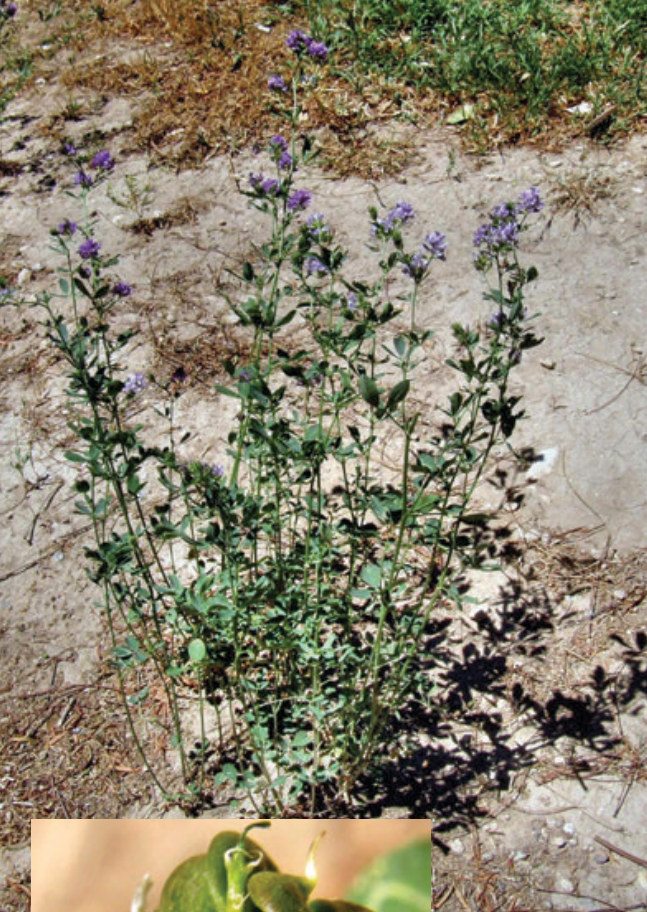
Plant name
planted alfalfa
Latin name
Medicago sativa L
Common names
Cultivated alfalfa, clover, moist, green.
foreign names
Eng. Alfalfa, Fr. Lucerne
The group
Pea beans
Habitat and Geographic Distribution
Mediterranean, European, Siberian, and western Iranian-Turanian regions. It is cultivated in many countries worldwide.
Botanical description
A perennial herb, woody at the base, glabrous or bearing overlapping hairs, 1 cm long.
Stems are numerous, prostrate, branching, and leafy.
The leaves are tertiary and septate.
The stipules are ovate, 1.5 cm, acuminate, and complete.
The leaflets are 3-6 x mm long, oblong, becoming obovate in the lower leaves.
The upper leaves are septate, rounded or lobed, and apical, with toothed margins only at the apex.
The inflorescence is racemose, bearing a flower.
The peduncles are 10 mm longer than the leaves, with a peduncle length of 10 mm.
The flower stalk is equal to the length of the calyx tube, or twice its length.
The calyx is hairy, with the tube length equal to the length of the teeth.
The corolla is blue or yellow.
The pod is spiral, composed of widely spaced or linear or sickle leaves, hairy, grayish, and spiny. The seeds are straight or slightly curved. Flowering occurs from April to May.
Used part
Leaves and seeds: Latin name: Medicago sativa L
chemical components
The leaves contain carotenoids, including lutein and others; triterpene saponins, sojasapogenols A-E, hederagenin aglycones, and medicagenic acid; isofanoides, including formononetin, gentistein, and daidzein glycosides; coumestans, the most important of which are coumestrol, lucernol, sativol, and trifoliol; steroids, including stigmasterol and spinasterol, and other compounds; and cyanogenic glycosides.
Vitamins, especially vitamin K.
The seeds contain L-canavaine, betaine, homostachydrine, stachydrine, trigonelline, and zeta-disma.
They also contain proteins, carbohydrates, saponins, lignin, phenolic compounds, tannins, alkaloids, carotenes, sterols, phytoestrogens, flavones, and isovavonoids.
The alkaloids are asparagine, trigonelline, stachydrine, and L-homostachydrine.
Amino acids: medicanine, lysine, arginine, histidine, tyrosine, phenylalanine, methionine, aspartic acid, glutamic acid, serine, alanine, coumarin, myrcimenol, scopoletin, esculentin, digestive enzymes, other enzymes such as isofonide reductase, fesitone reductase, immunopeptides, and aminopeptides.
Favonoids: quercetin, myricetin, luteolin, apigenin, querceriol, trisine, medicarbin, coumestrol, sativan, fesitol, and formonitin.
Phenolic compounds: hydroxybenzoic acid, vanillic acid, coumaric acid, ferulic acids, salicylic acid, cinnamic acid, caffeic acid, hesperidin, chlorogenic acid, tannic acid, and heterosides.
Phytoestrogens: coumestrol, genistein, formometin, diazene, bucanin, beta-acetosterol, stigmasterol.
Polyamines: norspermidine, norspermin, esculetin, scopoletin, myrsellinol, stigmasterol, β-sitosterol, α-spinasterol, sterols, dihydrospinasterol, ferritin protein, protein phosphatase 2A, beta-amylase.
Saponins: soy saponins, hydraginin, medicaginin acid, pyogenin.
Minerals: Na, Si, Se, Mo, Mn, Co, Cr, B, Al, Cu, Zn, Fe, Mg, P, K, Ca.
Non-protein amino acids such as L-canaverin.
Organic acids: citrates, malate, malonates, succinates, fumarates, lactates, benzoates.
Vitamins K, E, D, C, B12, B6, B1, A, niacin, pantothenic acid, biotin, and folic acid.
Volatile components: terpenes, limonene, linalool, trans-ocimene, furanoids, benzaldehyde, ethyl benzaldehyde, and butanol.
Properties and medical uses
The saponin content affects the cardiovascular, nervous, and digestive systems.
The plant is used traditionally to treat diabetes, thyroid dysfunction, kidney, bladder, and prostate problems, and to increase urine flow.
It is also beneficial in treating menstrual and menopausal disorders due to its estrogenic properties.
The seeds are used to lower high cholesterol levels and treat rheumatoid arthritis.
They are also a source of vitamins A, E, and K, and some minerals.
The leaves and tender branches are used in salads.
Powdered leaves or seeds are used in capsules and tablets as dietary supplements (vitamins A, E, K, C).
Alfalfa consumption reduces cholesterol absorption and arteriosclerosis in animals.
Saponins contribute to reducing cholesterol concentration in plasma without changing the concentration of high-density lipoprotein cholesterol, reduce intestinal cholesterol absorption, increase bile acid secretion, prevent arteriosclerosis, and contribute to its regression.
Cholestaid™, a product available in the United States, contains 900 mg of alfalfa extract with 100 mg of citric acid, facilitating the elimination of cholesterol from the body without any side effects.
The plant is important in lowering blood sugar levels caused by streptozotocin.
The manganese content is a key factor in alfalfa's role in managing diabetes.
The methanol extract of alfalfa has shown estrogenic activity against breast cancer cells, where the purified anti-estrogen (ICI 182, 780) suppressed cell proliferation.
Alfalfa leaf extract is used to treat symptoms of neuroleptic malignant menopause.
Hot flashes and night sweats completely disappeared with treatment, and the plant product caused a significant increase in prolactin and thyroid hormone levels.
Purified polysaccharide components of alfalfa have been shown to inhibit the activities of...
Reverse transcription of the human immunodeficiency virus (HIV).
Alfalfa-based drinks are beneficial in maintaining normal digestive function, nutritional balance in the human body, and preventing osteoporosis, arteriosclerosis, and aging.
Precautions: No adverse health events or side effects have been reported with the appropriate administration of the specified dose.
It is preferable to avoid it during pregnancy, due to its believed effect on estrogen levels.
Caution is advised against feeding it to animals.
Ruminants, especially sheep, should avoid eating the young growths of alfalfa that have emerged after harvesting, as this leads to bloating in those animals.
Side effects and precautions
No adverse health events or side effects have been reported with the appropriate administration of the specified ivory dose.
It is best avoided during pregnancy due to its suspected effect on estrogen levels.
Feeding young alfalfa sprouts after harvesting is discouraged, as it can lead to bloating in ruminants, particularly sheep.
the environment
Alfalfa grows wild on the edges of fields and neglected lands.
It germinates quickly and is a long-day, light-loving plant.
Alfalfa tolerates high temperatures up to 3°C, especially in the early stages of growth.
The seeds can germinate in warm temperatures.
Alfalfa requires a sufficient amount of water, but it is drought-resistant thanks to its deep root system.
It also tolerates low temperatures in the basal branching area, down to 40°C.
Alfalfa is a salt-tolerant crop.
It requires a suitable pH level and a lime content. High acidity is unsuitable for it.
Agriculture and productivity
Alfalfa is propagated by seeds and is sown in autumn or spring.
Sowing alfalfa requires deep plowing of the land, followed by several shallow plowings to soften the soil.
Then, rectangular beds or basins are prepared with dimensions of 10-20 x 2-3 m if irrigation is to be done by surface watering, or without basins if irrigation is to be done by sprinkler watering.
The seeds are then scattered in two stages and in opposite directions.
The soil surface is then loosened with a rake, plant branches (such as pomegranate), or burlap to cover the seeds in the soil.
Finally, the area is irrigated by misting or by gently watering with a slow flow.
Alfalfa responds well to phosphorus and potassium fertilization, and to a lesser extent, nitrogen fertilization.
It grows in various types of agricultural soil, but prefers deep, loose, and well-aerated soil.
The most important cultivation practices are weed control and regular irrigation in the early stages.
Special.
Seed yield per hectare reaches up to 360 kg.
Melilotus officinalis (L.) Lam., Trifolium melilotus officinalis L, Brachylobus officinalis (L.) Dulac, Medicago officinalis (L.) E.H.L.
Krause, Sertula maior Lunell, Sertula officinalis (L.) Kuntze, Trifolium officinale L., Trigonella officinalis (L.) Coulot & Rabaute
History and Heritage
Medica, the scientific name for the genus, is derived from the plant's altinium, meaning cultivated. Sativa refers to the herb Medica, and is the species name.
Medical note
This information is for educational purposes only and does not constitute medical advice.
Poisonous or potent plants should only be used under the supervision of a qualified physician or pharmacist.
Related images


