Horehound | A medicinal plant in the Akhdar encyclopedia
The plant, with its bitter compounds marrubinic acid, volatile oil, tannins, and flavonoids, possesses appetite-stimulating, liver-stimulating, and digestive juice-enhancing properties, as well as carminative and gas-relieving effects. Research indicates the antioxidant properties of the plant's aq…
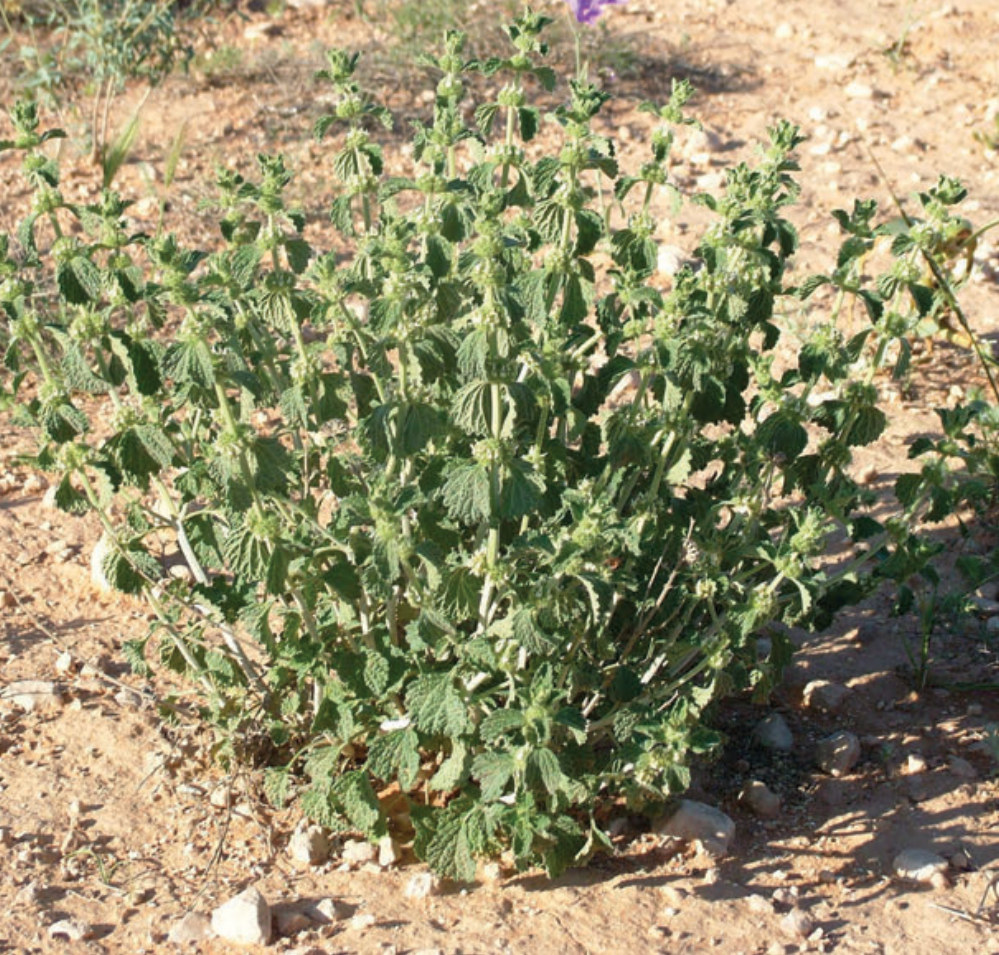
Plant name
France
Latin name
Marrubium vulgare L
Common names
Phrasion, the common goddess
foreign names
Eng. White horehound, Fr. Marrube blanc
The group
oral
Habitat and Geographic Distribution
Mediterranean and Iranian-Turanian
Botanical description
The stem is sturdy, ascending, and 60 cm long.
It is a perennial herb with a square cross-section.
The leaves are simple, petiolate, rough, and covered with soft, woolly hairs, grayish or whitish on the surface.
The flowering leaves are pedunculated, ovate to rounded, heart-shaped at the base, cristulate to toothed at the margin, oblong in length, drooping downwards, longer than the flowering carpels.
The petioles are pedicel-shaped.
The flowers are gathered in cymes, forming numerous widely spaced, spherical carpels.
The bracts are reddish-brown, hooked at the apex, and flatter than the calyx.
The calyx is covered with geniole hairs, ending in woolly, with even, flat teeth, and is flatter than the tube.
Each tooth ends in a glabrous, hooked spine.
The calyx tube is 7 mm long, and its opening is blocked by woolly hairs.
The corolla is white, labial; the upper lip is erect and bilobed, the lower lip is flat.
The stamens are embedded in the corolla tube.
The style is also embedded in the corolla tube.
The fruit is a nutlet, ovoid, rounded at the apex, smooth, and black.
Flowering occurs from April to June. Habitat and geographic region: Taurine, Mediterranean, and Iran.
Used part
The flowering plant (its leaves, when rubbed, emit a pungent odor and have a bitter, spicy taste) contains diterpene lactones (bitter compounds), the most important of which are marrubiin (0.1-1%), marrubenol (0.1%), premarrubiin, caryophyllene, fenchone, p-cymene, paracymene, camphene, and traces of volatile oil, the most important of which are camphene (monoterpene hydrocarbons), α-copaene, α-humulene, germacrene, and lene.
It contains sesquiterpene hydrocarbons, including marrubiin, a characteristic labdanum diterpene of this genus, in addition to a mixture of A complex of phenolic compounds, primarily caffeic acid derivatives (phenolic acids), flavonoids (including apigenin, luteolin, vicenin, and chrysoeriol), tannins, traces of saponins, choline, and mineral salts, especially potassium salts.
chemical components
0.1-1% marrubiin (bitter compounds), the most important of which is marrubenol, a diterpene lactone; 0.1% premarrubiin derived from the compound fenchone, p-cymene, and para-cymene; traces of volatile oil, the most important of which is camphene; caffeic acid derivatives (phenolic acids), the most important of which are caffeic acid derivatives; apigenin, luteolin, chrysoeriol, and vicenin (including flavonoids); tannins; traces of saponins; choline; and mineral salts, especially potassium salts.
Properties and medical uses
The plant, with its bitter compounds marrubinic acid, volatile oil, tannins, and flavonoids, possesses appetite-stimulating, liver-stimulating, and digestive juice-enhancing properties, as well as carminative and gas-relieving effects.
Research indicates that the plant's aqueous extract, marrubenol and marrubiin, possess antioxidant properties, in addition to its ability to relax and dilate blood vessels, and its effect on lowering cholesterol levels, thus making it effective in reducing high blood pressure.
The plant, due to its marrubiin content, possesses pain-relieving properties, in addition to its anti-edema and blood sugar-lowering properties.
The plant's decoction is used as a general remedy, expectorant, and to treat respiratory tract infections (bronchitis, laryngitis, colds, coughs, and asthma), diarrhea, jaundice, and menstrual cramps.
Topically, the decoction is used to treat wounds and skin ulcers and as a gargle for sore throats.
The sap of the fresh plant has antiseptic, diaphoretic, and diuretic properties, aids in wound healing, and is an anthelmintic (expels worms).
The plant is also considered an antioxidant and a treatment for cancer, diabetes, and liver diseases.
Furthermore, it is anti-inflammatory, hypotensive, lipid-lowering, and sedative.
It also possesses antimicrobial activity, particularly against bacteria, fungi, and viruses.
It is effective against herpes simplex and parasites such as Toxoplasma gondii, Trichomonas vaginalis, and Plasmodium berghei-berghei.
It can also be used as a chicken louse repellent, herbicide, natural insecticide against mosquito larvae, and natural molluscicide.
In veterinary medicine, it can be used as an oocysticide and larvicidal agent against bovine parasites, and as an antibiotic for bacterial mastitis in cattle.
Side effects and precautions
It has been observed that consuming large quantities of the plant causes diarrhea and vomiting.
It should not be used by pregnant women or those suffering from stomach ulcers, as the increased digestive juices can worsen their ulcer pain.
Other uses
The leaves or the essential oil extracted from them are used as a flavoring for some beverages (beer, tea).
Precautions: It has been observed that consuming large quantities of the plant causes diarrhea and vomiting.
It should not be used by pregnant women or those suffering from stomach ulcers, as the increased digestive juices can worsen their ulcer pain.
the environment
Gravelly sandy soils suit it – the plant grows on roadsides and slopes, and in well-drained, dry, calcareous steppes.
It prefers neutral or slightly alkaline soils. Overgrazing is a sign of its growth.
Agriculture and productivity
It is propagated by seed.
Seeds are sown in a nursery either at the beginning of spring or at the beginning of autumn, and germination is irregular.
Seedlings are transferred individually to bags or pots after they reach a suitable size.
The plants are transferred to the permanent ground the following spring.
The plant can also be propagated by division in late spring, where branches are cut along with parts of the underground stem when they reach a length of 10-8 cm.
The plants are placed in bags or containers and left in a shaded place until they are well rooted, then transplanted to their permanent location.
(Melissa officinalis L., Faucibarba officinalis L., Dulac, Mutelia officinalis L., Gren. ex Mutel, Thymus melissa E.H.L. Krause)
History and Heritage
The scientific name comes from Arabic, where "rob" means bitter, and "mar" means common.
The word "horehound" itself is of Greek origin, "vulgare," meaning a plant with bitter sap.
Ancient peoples used horehound to treat chest ailments such as coughs, asthma, lung ulcers, and liver obstruction. It was mentioned by Ibn al-Baytar.
Medical note
This information is for educational purposes only and does not constitute medical advice.
Poisonous or potent plants should only be used under the supervision of a qualified physician or pharmacist.
Related images


