Awaina | A medicinal plant in the Akhdar encyclopedia
Experiments on laboratory animals have demonstrated the plant's antifungal, antiviral, anti-tapeworm, spermicidal, hemolytic, and antipolio properties (saponin compounds). Research has also shown the plant's estrogenic and gestational properties. The plant's juice or leaves are used traditionally t…
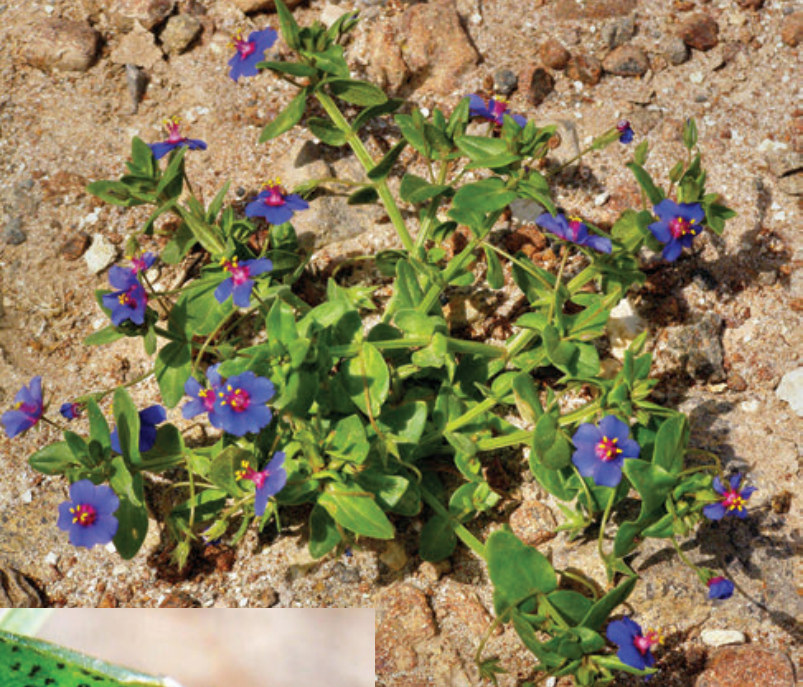
Plant name
Awaina
Latin name
Anagallis arvensis L
Common names
Eyebrow, cat's eye, blue mouse ears, soapwort
foreign names
Eng. Scarlet pimpernel, Poorman's barometer, Fr. Mouron rouge
The group
Spring
Habitat and Geographic Distribution
Siberian.
- Turanian and European - Widespread, especially in Mediterranean and Iranian regions
Botanical description
The market is spreading.
30 - a perennial herb, glabrous, long and ascending, four-ribbed, four-winged.
The leaves are opposite, rarely lobed, arranged in trifoliate rows, entire, ovate, often dotted with black glands on their underside.
The flowers are solitary in the leaf axils, their stalks slender and longer than the supporting leaf; the fruit stalks are drooping.
The calyx is sepal, fused at its base, its lobes acuminate, membranous, fused into a volute, the margin.
The corolla is 1 mm long, blue or crimson, rarely white, its diameter about equal to the length of the calyx, its lobes obovate, rounded or truncated at the apex, toothed and bearing fine glandular cilia; the glands are numerous, tricellular, terminating in a spherical cell.
The male is 6 mm long.
The stamens are fused at their bases, their filaments are hairy.
The ovary is superior.
The fruit is a spherical capsule.
Flowering occurs from March to April.
Note: This species includes several varieties that differ in petal color and leaf shape, including: Phoenician Mouse Ears, which shares the same characteristics as Blue Mouse Ears; Anagallis arvensis var.
phaenicea (L.) Gouan, also known as Red Fox Coriander, although some consider it a separate species; its flowers are a deep, glossy blue; some botanists consider it a species, Anagallis arvensis var. foemina, and it is a subspecies, Anagallis foemina.
Used part
The dried flowering plant (has no smell, its taste is bitter and slightly astringent)
chemical components
Cucurbitacin, including anagalloside (anagalline), triterpene saponins, caffeic acid derivatives (highly toxic compounds), valphenic compounds, and caffeic acid derivatives.
Properties and medical uses
Experiments on laboratory animals have demonstrated the plant's antifungal, antiviral, anti-tapeworm, spermicidal, hemolytic, and antipolio properties (saponin compounds).
Research has also shown the plant's estrogenic and gestational properties.
The plant's juice or leaves are used traditionally to treat liver and kidney disorders, promote urination and sweating, and expel phlegm and mucus by thinning and increasing their fluidity, thus facilitating their removal.
The juice is also used topically to treat herpes simplex virus (HSV) infections.
It is used for hemorrhoids and rheumatism.
In Syria, it is called soapwort due to the soapy lather it produces when rubbed with water, and some use it as a substitute for soap.
In Italy, it is used to treat skin diseases and heal wounds in humans and animals.
Precautions: The plant contains toxic compounds that can be eliminated by drying or boiling; therefore, it is advised not to use it fresh.
Prolonged use or taking high doses can lead to inflammation of the stomach, intestines, and kidneys due to its compound content.
Cucurbitacin.
Environment: This plant grows along roadsides and at the edges of fields.
It thrives in dry, sandy, sunny soils.
One of its characteristics is that its flowers open in the morning and close in the evening, closing early in case of rain; therefore, their appearance can be used to predict humidity levels.
Side effects and precautions
The plant contains toxic compounds that can be eliminated by drying or boiling; therefore, it is advised against using it fresh.
Prolonged use or high doses can lead to gastroenteritis and kidney inflammation due to its cucurbitacin content.
Habitat: The plant grows along roadsides and at the edges of fields.
It thrives in dry, sandy, sunny soils.
A distinctive feature is that its flowers open in the morning and close in the evening, closing early if it rains; thus, they can be used to predict humidity.
the environment
The plant grows along roadsides and field edges.
It thrives in dry, sandy, sunny locations.
A distinctive feature is that its flowers open in the morning and close in the evening, closing early if it rains; therefore, they can be used to predict the humidity.
Agriculture and productivity
It reproduces by seeds sown directly in the permanent ground in spring.
Adiantum capillus-veneris L., Adiantum capillus Sw., Adiantum coriandrifolium Lam., Adiantum fontanum Salisb. (formerly Adiantaceae), Pteridaceae
History and Heritage
It means my field.
The scientific name for the genus *Arvensis* is the ancient Greek and Latin name for the plant, while the term describing the species was used in ancient times to treat gout and some mental illnesses.
It was mentioned by Dioscorides, Ibn al-Baytar, Ibn Sina, and al-Antaki. The Indians used it to treat gout and dropsy.
Medical note
This information is for educational purposes only and does not constitute medical advice.
Poisonous or potent plants should only be used under the supervision of a qualified physician or pharmacist.
Related images


