Alanda | A medicinal plant in the Akhdar encyclopedia
Ephedrine alkaloid possesses sympathomimetic activity and antagonistic properties against alpha-1, alpha-2, and beta-2 receptors. It also causes vasoconstrictive and cardiac stimulant activity (tachycardia), a sharp increase in blood pressure, insomnia, dizziness, headache, and nervousness. Pseudoe…
Plant name
Alanda
Latin name
Ephedra alata Decaisne
Common names
Ephedra, winged ephedra
foreign names
Eng. Joint pine, Fr. Ephedra
The group
Federalism
Habitat and Geographic Distribution
The Arabian Peninsula, the Levant, and North Africa.
It is widespread in Saudi Arabia, Kuwait, Iraq, Jordan, Syria, Mars, and Palestine, and has become rare in many Arab countries.
The most important species are: The Ephedra genus includes *E.
sinica* Stapf, *E.
distachya* L., *E.
vulgaris* Rich, *E.
equisetina Bunge*, *E. intermedia* Shrenk ex Meyer, and *E. geradiana* Wallich ex Meyer.
Botanical description
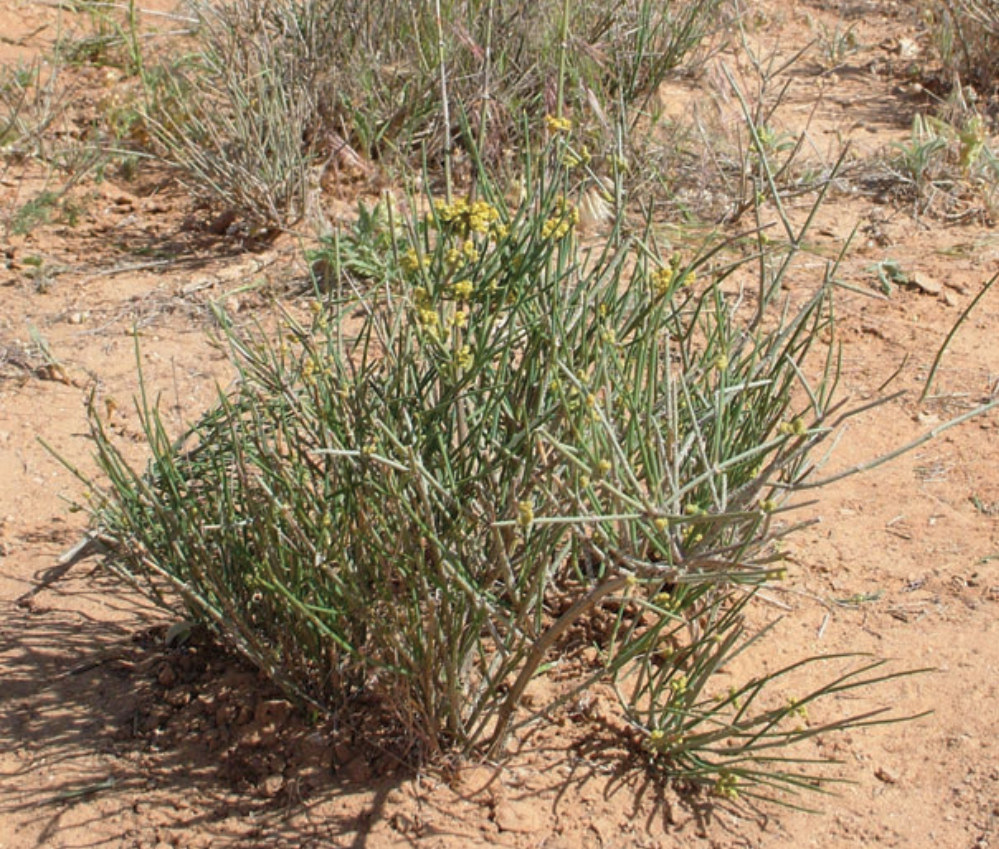
A small shrub of the Coleoptera, dioecious, grayish-red in color, 2-mm tall, with a rough, 4-knotted top.
The leaves are reduced to a simple, short sheath.
The stems are rigid, rough, and jointed.
The flowers are unisexual, with the male flowers arranged in spherical clusters, emerging from the leaf axils at the tips of branching filaments.
The cones are 1-1 cm long, resembling those of conifers.
There are 3 anthers at the tips of minor branches, about 1 cm long.
The bracts are fused to the middle, either axillary or apical at the ends of minor branches, about 5 x 7 mm long.
The female bracts are small calyces, the inner ones becoming hyphae at the end of their development.
The seeds are oblong, blunt at the apex, 5-1 mm wide, forming a 5-1 mm thick, and about 2.5 mm long. Spores are released in mid-March. The fruits appear in May.
Used part
The aerial parts, particularly the internodes of the branches, are harvested.
The tender shoots and terminal tips of Ephedra are collected in autumn because the alkaloids in the aerial parts multiply from spring to autumn, and the highest concentration of alkaloids is found in four-year-old plants.
chemical components
Ephedra species are generally similar in their composition, although the proportions of these compounds vary.
Ephedra species contain 30-90% alkaloids, particularly L-ephedrine, and especially 0.2-0.5% myristic ephedrine, which belongs to the group of non-traditional amino alkaloids.
They also contain a volatile oil composed mainly of terpenoids (alpha-terpineol, limonene, trimethylpyrazine), tannins, lacenin, kaempferol (terpineol, linalool), and various secondary compounds such as flavonoids, organic acids, and glycans.
Properties and medical uses
Ephedrine alkaloid possesses sympathomimetic activity and antagonistic properties against alpha-1, alpha-2, and beta-2 receptors.
It also causes vasoconstrictive, cardiac stimulant (tachycardia), hypertensive effects, insomnia, dizziness, headache, and nervousness.
Pseudoephedrine possesses beta-2 antagonistic properties, including bronchodilation, and also has nasopharyngeal vasoconstrictive properties.
The Ephedra plant in general has effects It is antiviral, hypotensive, aphrodisiac in males, enzyme inhibitory, anti-vertigo, bronchodilator, alpha- and beta-adrenergic receptor stimulant, and weight-loss agent.
Ephedrine is used to treat asthma and allergies, nasal congestion, upper respiratory symptoms, and neurological disorders in diabetic patients.
Ephedra is used topically to treat asthma (oral sprays or nasal drops to dilate the bronchi), whooping cough, hay fever, and the common cold.
It treats fever, hives, low blood pressure, rheumatism, joint diseases, edema, and bone pain, and is a stimulant for the cardiovascular system.
The polysaccharides extracted from the plant have antihypertensive and antioxidant properties. It is considered a promising natural source for food supplements.
pharmaceutical forms
Ephedra is available as a herbal powder, pure form, or tincture.
Side effects, interactions, and precautions include: irregular heartbeat, tachycardia, insomnia, anxiety, and nervousness.
Tremors, dry mouth, circulatory disturbances, hypertension, skin rash, eczema, and urinary retention may also occur.
Hallucinogenic effects have been observed in children.
Ephedra should not be used in cases of coronary hemorrhage, diabetes, glaucoma, thyroid disorders, prostatic hypertrophy, melanoma, or renal impairment.
Ephedra and its derivatives should be avoided with monoamine oxidase inhibitors (MAOIs) and should not be administered to patients undergoing anesthesia with cyclopropane, halothane, or other volatile surgical anesthetics.
Administering ephedrine in combination with phlebsiella glycosides, quinidine, or tricyclic antidepressants can cause cardiac arrhythmias, and the risk of angina is increased in those taking ergot alkaloids (from the rye spurs). It should be avoided during pregnancy and breastfeeding.
Side effects and precautions
Side effects may include irregular and rapid heartbeat, insomnia, anxiety, and nervousness.
Tremors, dry mouth, dizziness, high blood pressure, skin rash, eczema, and urinary retention may also be observed.
Hallucinogenic effects have been reported in children.
Ephedra should not be used in cases of coronary hemorrhage, diabetes, glaucoma, thyroid disease, prostate enlargement, melanoma, or impaired kidney function.
Ephedra and its preparations should be avoided with monoamine oxidase inhibitors (MAOIs) and should not be given to patients undergoing anesthesia with cyclopropane, halothane, or other volatile surgical anesthetics.
Administering ephedrine in combination with cardiac glucosidases, quinidine, or tricyclic antidepressants may cause tachycardia, and the risk of vasoconstriction may be increased in those taking ergot alkaloids (such as rye spurs). It should be avoided during pregnancy and breastfeeding.
the environment
Ephedra is a plant of dry, sunny, and very dry regions.
It thrives in harsh environmental conditions.
It is found in solitary clumps, and sometimes alongside other plant communities, on gypsum, pale brown, or skeletal soils.
It is also found on fixed or shifting calcareous sand dunes.
It grows on Cynonic and Turonian limestone of the Upper Cretaceous period in mid-altitude mountainous regions.
Agriculture and productivity
The plant reproduces by seeds.
Equisetum arvense L. Allostelites arvensis (L.) Börner, Presla arvensis (L.) Dulac
History and Heritage
The scientific name of the genus *Ephedra* comes from the Greek words *epi* meaning "on" and *hedra* meaning "chair" or "seat," thus "on a seat." This name was given by ancient Europeans to a leafless, vine-like plant.
The word *alata* means "winged," and the name derives from the plant's shape and the position of the wings resting on the branches.
As for the name *al-ʿalanda*, it appears in *Taj al-ʿArus* by al-Zubaydi as referring to a large, tall, and strong camel, as well as a horse.
The Chinese have known about the effectiveness of ephedra in treating asthma for 5000 years.
A Chinese chemist studied ephedrine in 1924, and it was synthesized synthetically in 1929.
The aerial parts are used, particularly the internodes of the branches.
The tender branches and terminal tips of the ephedra plant are harvested in autumn because the alkaloids contained in the aerial parts are concentrated from spring to autumn, and the highest concentration of alkaloids is found in plants that are four years old.
Medical note
This information is for educational purposes only and does not constitute medical advice.
Poisonous or potent plants should only be used under the supervision of a qualified physician or pharmacist.
Related images


