Arshak | A medicinal plant in the Akhdar encyclopedia
Laxative and laxative
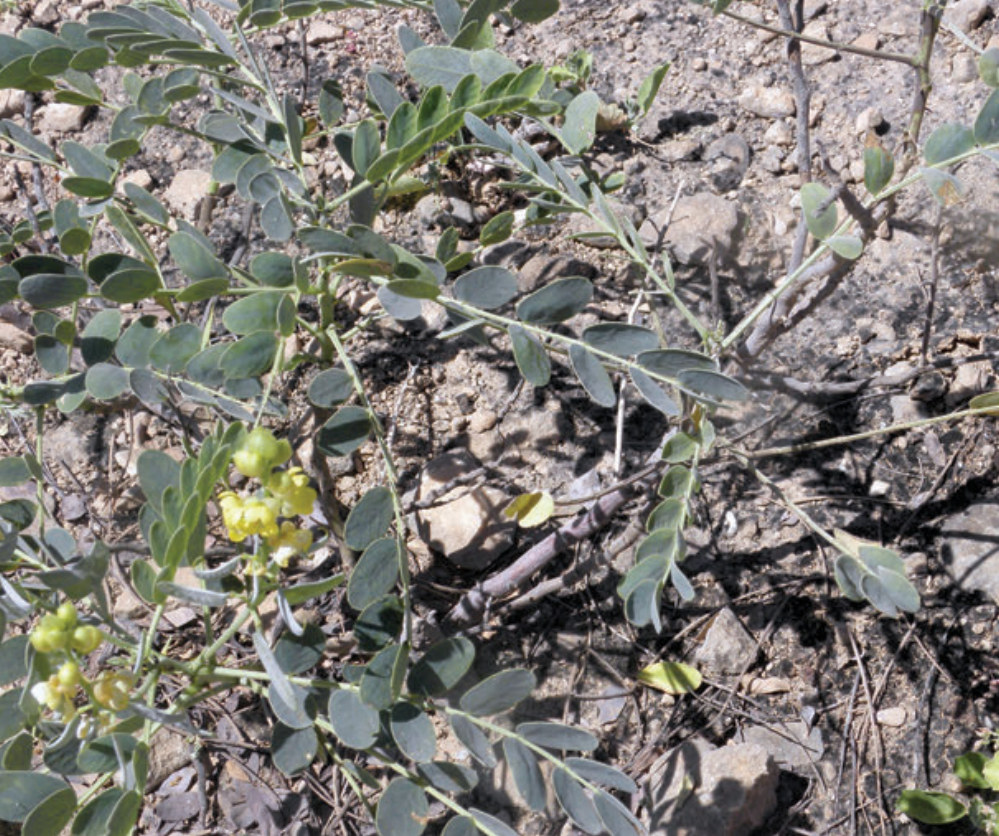
Plant name
Arshaq
Latin name
Cassia italica (Mill) Lam
Common names
Arshaq
foreign names
Eng. Italian senna, Fr. Sene
The group
Sesalpinia (Fabaceae)
Habitat and Geographic Distribution
Native to Sudan, and extending into the eastern part of the African region, it is found in Egypt, Libya, Algeria, Nigeria and Somalia.
Botanical description
The stem is branched from the base, bluish-green, and almost hairless.
70 - A perennial herb, woody at the base, mm long, uterine.
5 - cm or more.
The stipules are 10 pairs, alternate, about 7 cm long.
The leaves are compound pinnately paired, consisting of 1 cm, obovate-ovate, rarely oblong, dull apex (sometimes umbel-shaped).
2 - 0.7×3 - The leaflets are inflorescences, axillary, erect, with flowers not tightly packed, exceeding the length of the supporting leaves.
The bracts are deciduous, petiolate, compound, sepals, free, compound in the rib.
The corolla is 5 ovate.
The peduncles are squamar.
The calyx is rounded, with free stamens, and the anthers are unequal, with the stamens yellowish-striped with purple veins, and the posterior is smaller.
The male anther is 1 mm long and 4 cm long.
The other anthers are progressively smaller, one about 1 mm long, the two anterior ones being larger and about 1 mm long.
The ovary is 2 mm long and 5 cm long, borne on a peduncle 1.5 x 6 cm.
The pods are short, arching, flattened, rounded at the ends, and divided transversely by a membranous septum.
The valves are leathery, bearing a network of dark veins, and a wavy crest along the 4 x 6 cm midrib.
The seeds are small, 1 mm in size, compressed, obovate, and pinnately apex. Flowering occurs from September to April.
Used part
Papers
chemical components
Loamodine.
A, B, C.
The leaves contain anthraquinone compounds and their derivatives, including sennosides.
Properties and medical uses
Laxative and laxative
Side effects and precautions
Allergic reactions or drug interactions may occur; self-use should be avoided by pregnant and breastfeeding women, children, and patients with chronic diseases.
the environment
Senna species are widespread in valleys in desert and semi-desert regions, and generally thrive in dry, sandy environments. The light sandy variety is considered the best.
Agriculture and productivity
Senna is planted at the beginning of spring, when temperatures start to rise, and ideally no later than April.
It is propagated by seed; one hectare requires 8-10 kg of healthy seeds, and this may increase to 13-16 kg.
Soaking the seeds in water for 12 hours before planting increases the germination rate.
Watering is recommended every 5 days after the plants begin to grow and are established in the soil, but watering should be reduced after flowering.
Excessive irrigation causes yellowing of the plants, which is clearly visible on the leaves.
It is recommended to fertilize the plants with essential nutrients, and foliar fertilization can be used.
The harvesting time depends on the specific product used, whether leaves, pods, or both.
If the desired harvest is for the leaves, two or three harvests may be necessary, depending on the irrigation and fertilization practices.
If small amounts of fertilizer are applied, the number of harvests will decrease to two instead of three during the growing season.
As for harvesting the pods, this begins in July on a regular basis.
One hectare produces 1.5-2.5 tons of fruit.
Ceratonia siliqua L., Ceratonia coriacea Salisb., Ceratonia inermis Stokes, Ceratonia siliqua var.
latissima Risso, Ceratonia siliqua var.
siccata Risso, Ceratonia siliqua var. sterilis Risso, Ceratonia siliqua var. vulgaris Risso
History and Heritage
The source of the poison is perhaps the local name, originally linguistically known, and it is mentioned that the poison is found in the genus Cassia, meaning italica in India, while the species name is [not provided in the original text].
Medical note
This information is for educational purposes only and does not constitute medical advice.
Poisonous or potent plants should only be used under the supervision of a qualified physician or pharmacist.
Related images


