Frog | Medicinal plant in the Akhdar Encyclopedia
A diuretic and laxative, a decoction of its leaves and flowers is beneficial in treating bronchitis and cystitis. Studies have demonstrated the benefits of the essential and tannin compounds found in the leaves and roots of the plant in treating wounds, burns, skin inflammations, and arthritis (as…
Plant name
frog
Latin name
Acanthus mollis L
Common names
frog, flabby acanthus, bear's foot, Jewish thorn
foreign names
Eng. Acanthus, Bear's Breeches, Fr. A canthe molle
The group
Acanthus
Habitat and Geographic Distribution
It is widespread in countries around the Mediterranean Sea, particularly in its northern part, and is rare in its natural state.
A.
syriacus, one of its species, is distinguished from other species by the texture and shape of its leaves.
Native to the eastern Mediterranean, it is valued for its ornamental properties.
Botanical description
(The length of the flower).
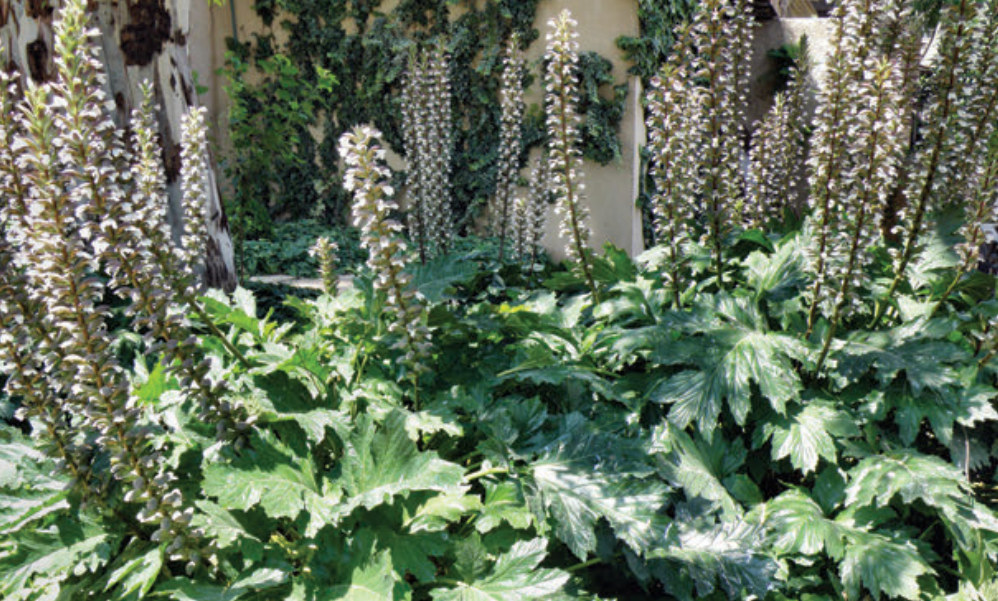
The leaves are basal, long-stemmed, 6 cm (can reach 80 cm).
A perennial herb, tall, green and glossy, soft to the touch, not thorny, very large-lobed, which can reach a length of 6 cm including the stipe.
Each flower is surrounded by a large bract, 60 cm long, toothed-edged.
The inflorescence is a terminal spike, 6 cm long, with oblong, sinusoidal lobes.
The calyx is 6 cm long, thorny, toothed, slightly flattened from the calyx, and two smaller bracts with a linear shape.
The sepals are unequal in size.
The calyx is composed of 6 cm long.
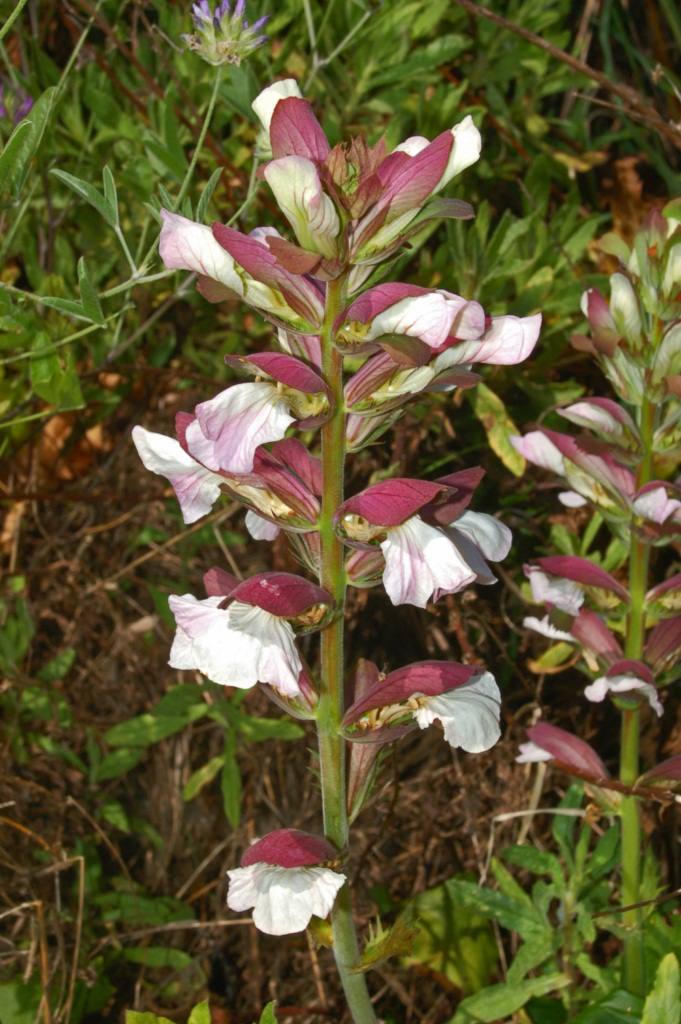
The flowers are white, tinged with purple, and the upper and lower sepals are broad and oblong, bearing nerves.
The upper sepal terminates in three teeth and the lower in two, both tinged with purple.
The upper sepal forms a helmet-like structure above the corolla, while the lateral sepals are short and rounded or obovate.
The corolla segments are fused in The stamen tube soon splits to form a squamous lip (7 long and 2 short stamens), one of which is broad and terminates in three lobes.
The male stamen is covered with dense hairs and is toothbrush-shaped.
The female stamen is bicarpel-bound, with a superior bisectoral ovary containing 4 large seeds, each containing two ovules.
The fruit is a capsule, oval, smooth, leathery, and ossicular, containing black flesh when ripe. Flowering occurs from late spring to early summer.
Used part
Flowers, leaves and roots
chemical components
Tannins, mucilage, gelatinous or salivary substances, pectins, sugars, the most important of which is glucose
Properties and medical uses
It is a diuretic and laxative.
A decoction of its leaves and flowers is beneficial in treating bronchitis and cystitis.
Studies have demonstrated the benefits of the essential and tannin compounds found in the leaves and roots of this plant in treating wounds, burns, skin inflammations, and arthritis (as compresses).
A decoction of the flowers is used as an appetite stimulant and to promote bile secretion.
Its composition and uses are similar to those of A.
syriaca.
The Greek physician Dioscorides, in the first century AD, recommended using the roots to prepare plasters for treating burns and compresses for joint pain.
Its infusion was used as a diuretic, carminative, antispasmodic, and to soothe the nerves.
The gum and tannins present in the plant allow for its use.
Externally, it is used to relieve skin irritation and redness.
A decoction of the leaves is beneficial for soothing the abdomen and improving blood flow.
Compresses made from the decoction have been used to set broken bones and strengthen joints.
The plant's emollient properties are useful in treating irritation of the mucous membranes of the digestive and urinary systems.
In traditional African medicine, it is used for urinary and reproductive tract infections.
Side effects and precautions
Allergic reactions or drug interactions may occur; self-use should be avoided by pregnant and breastfeeding women, children, and patients with chronic diseases.
the environment
This species prefers deep, sheltered loamy soils in full sun and can tolerate partial shade.
It grows well in heavy clay soils if well-drained, but dislikes waterlogged, heavy soils.
Young plants are sensitive to frost.
Mature plants tolerate drought and low temperatures, so the leaves may wilt on hot summer days when the plant is in direct sunlight.
Due to its deep root system, the plant can become invasive and difficult to eradicate.
Agriculture and productivity
The plant is propagated by seed in spring in a cool greenhouse or directly in the permanent field as soon as the seeds mature.
Germination occurs within 3-4 weeks at 10°C.
Seedlings are transplanted to the permanent field after the emergence of true leaves, when the plant is about 7-8 cm tall, at a spacing of 90 cm.
The plant can also be easily propagated by division in autumn, in which case the divisions are planted directly in the permanent field.
Root cuttings are also a possible propagation method.
The plant is collected in the fall.
Blepharis ciliaris (L.) B.L.
Burtt.
Ruellia ciliaris L., B.
edulis (Forssk.) Pers., B.
persica (Burm.
fil.) O.
Kuntze., Acanthus pectinatus Willd.
ex Nees., Ruellia persica Burm.f., Acanthus tetragonus R.Br., Acanthus edulis Forssk
History and Heritage
The scientific name for the genus is the ancient Greek name for these species, akantha, derived from the Greek word akanthos, meaning thorn, referring to spiny bracts.
The species name means tender or soft.
The symmetrical form and elegant division of the plant's leaves inspired artistic ideas embodied in metalwork and architecture by the Greeks.
This form inspired the Greek sculptor Callimachus in decorating the capital of the Corinthian column, a well-known architectural masterpiece.
Medical note
This information is for educational purposes only and does not constitute medical advice.
Poisonous or potent plants should only be used under the supervision of a qualified physician or pharmacist.
Related images