Gum of the sage | Medicinal plant in the Akhdar Encyclopedia
Tragacanth gum has laxative properties and is used as a laxative and laxative, increasing the peristaltic movement of the intestines. Studies indicate that tragacanth gum stimulates red blood cell production. It is used as an adhesive for pills and tablets, and in the preparation of medicinal suspe…
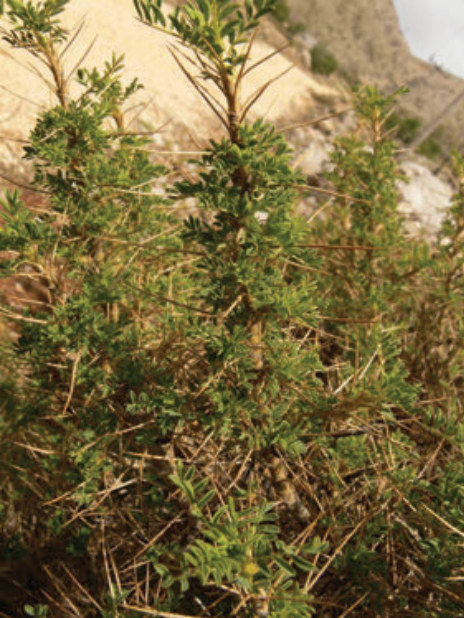
Plant name
gushing gum
Latin name
Astragalus gummifer Labill
Common names
Astragalus gum, Astragalus resin
foreign names
Eng. Gum Tragacanth, Fr. Rubber adragant
The group
Pea beans
Habitat and Geographic Distribution
It grows naturally in southern and eastern Europe, the highlands of Syria, Lebanon, Palestine, Jordan, Turkey, and Iran. Türkiye is one of the largest producers.
Botanical description
cm, branching from the base, 60 - a small shrub, bare, with brown scales.
The bases of the stems and branches are sessile, with whitish leaflets.
The leaves are pinnately compound, consisting of pairs of bare leaflets that are 7 cm long, 3 mm long, with leaflets that are 8 cm long, ending in a pricking spine.
The stipules are bare, 3 mm long.
The flowers are sessile, gathered in head-like racemes, emerging from the leaf axils and surrounding the stipules of adjacent leaves.
The bracts are ovate, obliquely apex, membranous, longer than the calyx.
The calyx is hairy and dense, with teeth narrower than the tube.
The corolla is yellowish-white, with a notched flag.
The fruits are pods, round to ovoid, about 1 mm long, hairy, and single-seeded.
This species produces gum only when the plant is healthy. Flowering occurs from May to August.
Used part
Tragacanth gum.
Tragacanth gum is valuable and is considered one of the best types of gums that help to give a stable giantine consistency for a long period of time, even in acidic environments or when exposed to heat.
The gum is extracted from the layer directly beneath the bark of the plant's stem and branches between May and September, by making a cut at the base of the trunk.
The gum flows immediately after the cut and hardens upon contact with air, turning into thin, brittle, ivory-white strips or pieces.
The strips (2.5 cm) are collected manually.
The best types are white or very light yellow, transparent, keratinized, odorless, and light. The taste, pure and free from impurities
chemical components
The gum of the succulent consists of a complex of several sugars, the most important of which are: 40% tragacanthin (water-soluble), 60% tragacanthic a (water-insoluble), and 60% bassorin (alcohol-insoluble).
The mechanism is as follows: when the gum of the succulent is placed in water, tragacanthin dissolves to form gelatin, and the insoluble bassorin swells to form gelatin.
Properties and medical uses
Tragacanth gum has laxative properties and is used as a laxative and massage oil, increasing the peristaltic movement of the intestines.
Studies indicate that tragacanth gum stimulates red blood cell production.
It is used as an adhesive for pills and tablets, and in the preparation of medicinal suspensions.
Cosmetic, food, and industrial uses: Tragacanth gum is used in the manufacture of many cosmetics (as an absorbent for powders), lotions, creams, and toothpastes.
It is also used in the production of many food products (jelly), vinegar, plain or flavored beverages, creams, mayonnaise, candies, and ice creams.
Tragacanth gum is also used in marble carving; the gum is soaked in distilled water for three days to dissolve, then filtered to produce a liquid.
Thick, used for painting on marble.
Precautions: No health problems or side effects are associated with its use.
Using large quantities without drinking plenty of fluids can lead to intestinal obstruction and esophageal atresia.
Side effects and precautions
There are no health problems or side effects associated with its use.
However, consuming large quantities without drinking plenty of fluids can lead to intestinal obstruction and esophageal atresia.
the environment
The astragalus lives on well-drained, light sandy and clayey soils, and is also found on neutral and slightly alkaline soils, and grows on highly acidic soils.
Agriculture and productivity
The plant is propagated by seeds collected in summer and sown in spring.
Cold stratification can increase the germination of stored seeds.
Stored seeds (and sometimes fresh seeds) need to be soaked in warm water for 24 hours before sowing.
Germination can be slow or uneven, but it usually occurs within 4–9 weeks or longer at 13°C if the seed is treated or broadcast soft. Cassia italica (Mill.) Spring, Cassia obovata Collad., Senna obovata Link
History and Heritage
The word "gum" comes from the Greek "gummifer," meaning "small bone" in the wrist.
The species name Astragalus, the scientific name for the genus, refers to the gummy substance (wormwood) secreted by the plant.
Astragalus gum is one of the oldest known medicinal substances. Arab physicians used it to treat coughs.
Medical note
This information is for educational purposes only and does not constitute medical advice.
Poisonous or potent plants should only be used under the supervision of a qualified physician or pharmacist.
Related images


