Snoring | Medicinal plant in the Akhdar encyclopedia
The plant is poisonous, and its milky sap is so potent that it was once used to poison spears. Research has shown that the compound *Rhinopharynx* has anti-tumor activity, specifically in epidermoid carcinoma cells. A decoction of the flowers is used in traditional Saudi medicine to treat asthma, i…
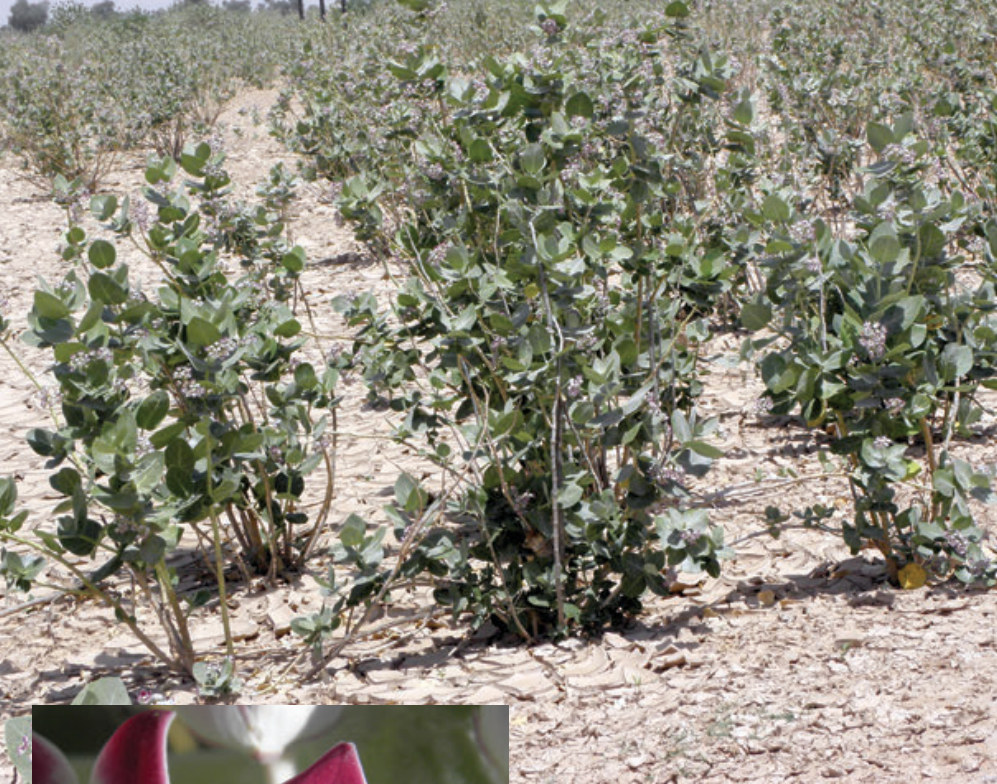
Plant name
snort
Latin name
Calotropis procera (Ait.) Aiton f
Common names
Shakhr, al-Ashkhar, al-Ashar, al-Arsh, Ashur, Ashri, Bayd al-Arsh, Bayd al-Jamal
foreign names
Eng.Calotropis, Apple of Sodom, Fr.CALtrope
The group
The Scylpi
Habitat and Geographic Distribution
Sudanese, extending into the Arabian desert region of Saudi Arabia, Egypt, Libya, Palestine, Oman, Sudan, all desert countries, India, Afghanistan, and Pakistan
Botanical description
M.
6 - A shrub with a white, deciduous stem.
The young branches are white, woolly to about 1 cm long, simple, 15-5 x 30 cm, and glabrous.
The leaves are opposite, entire, semi-piled, broadly ovate, ellipsoid, or obovate, bearing two auricles at their bases.
They are somewhat hairy when young, and the underside is pubescent.
The inflorescence is semi-cymose and axillary.
The flowers are radially symmetrical, five-lobed, and hermaphroditic.
The calyx is nematocyst, with its segments fused at their bases.
The corolla is pinnate with five lobes, about 1/2 cm in diameter.
The lobes are broad, ovate, flat, purplish, erect at the apex, whitish in the middle, and reddish on the outside.
The corolla bears a corolla composed of five laterally compressed segments, fused to the special structure formed by the fusion of the anthers with the tip of the style.
The male has five stamens whose anthers fuse with the tip of the style to form a distinctive structure.
The female consists of two free carpels, with a superior ovary.
The two styles fuse at their upper part and widen to form a five-sided stigma.
The five stigma surfaces are exposed on the underside of the anthers.
The fruit consists of two follicles (or one follicle resulting from the abortion of the other), nearly spherical or obliquely ellipsoidal or semi-spherical, and smooth to the touch.
The seeds are numerous and compressed. 12 - Oval, green, flowering from May to November
Used part
The plant's bark, root bark, and milky sap ooze when the stem is scratched or wounded.
The chemical constituents of the plant include toxic cardiac glycosides (cardio-active steroids), the most important of which are calotropin, calactin, and uscharidin.
It also contains alkaloids such as oxalin and furocharein, as well as bitter substances.
All parts of the plant contain milky sap, the main components of which are resinous substances such as trypsin, alpha- and beta-calotropiol, digestive enzymes similar to papain, and trypsin, which is responsible for cell lysis.
Several flavonoid compounds have been isolated from the methanolic extract of the plant's leaves, such as rutin, kaempferol, and isorhamnetin.
The plant contains many substances such as glycosides (mostly cardenoides), flavonoids, triterpenes, alkaloids, saponins, proteins, and enzymes.
chemical components
The most important of these are: Cardioactive steroids (cardenolids).
The plant's sap and roots contain toxic cardiac glycosides and others.
It also contains alkaloids, including: estersin, furocharin, and others, in addition to uscharidin, calactin, and calotropin.
Bitter substances.
All parts of the plant contain a milky sap, the most important components of which are resinous substances: trypsin, alpha- and beta-calotropiol, digestive enzymes similar to papilla, and the arbutin enzyme responsible for the lytic action of cells.
Properties and medical uses
The plant is poisonous, and its milky sap is so potent that it was once used to poison spears.
Research has shown that the compound *Rhinopharynx* has anti-tumor activity in the nasopharynx, specifically in epidermoid carcinoma cells.
In Saudi Arabian folk medicine, a decoction of the flowers is used to treat asthma and indigestion.
A mixture of roasted leaf powder and honey is used to treat bronchial asthma and coughs.
The milky sap is used as a strong laxative.
The plant is also used topically in the form of emulsions or tinctures to treat chronic eczema, boils, skin ulcers, rheumatism, and joint pain.
Extracts from the root bark are used as diaphoretics, emetics, and expectorants.
Side effects and precautions
The fruit of the Calotropis procera plant is to be avoided, as the sodium it contains can cause allergic reactions in the eyes and chest.
The plant is highly toxic and should only be used under strict medical supervision.
Ingesting the sap or any part of the plant causes gastrointestinal irritation, stomach pain accompanied by nausea, vomiting, severe diarrhea, and a slow pulse.
It can also cause pulmonary and liver damage, potentially leading to death.
It should be noted that small doses of Calotropis procera are diaphoretic and expectorant, while excessive doses cause severe vomiting and diarrhea, muscle spasms, and cardiac arrhythmias.
Very large doses are toxic and can be fatal; in such cases, the stomach should be pumped immediately, and the appropriate antidote administered.
Other uses
The Calotropis procera plant is commercially important, yielding strong, white, silky fibers similar in properties to flax fibers, which are resistant to both fresh and salt water.
These fibers are used in the manufacture of yarns for clothing, carpets, fishing nets, and bird nets.
Calotropis procera rubber is 80% effective in inhibiting the activity of the tobacco mosaic virus. Bark extract can be used for hair removal and leather tanning.
the environment
A widespread plant that grows in desert areas on sandy plains.
Agriculture and productivity
A wild plant that reproduces by seed and can sometimes be invasive.
Nerium oleander L., Nerium indicum Mill., Nerium latifolium Mill., Oleander vulgaris Medic., Nerion oleander andrum St.-Lag., Nerium odoratum Lam., Nerium odorum Salisb., Nerium grandiflorum Desf.
History and Heritage
The name means boat and rumba.
The poison is attributed to tropis, meaning beautiful and wonderful, and kalos, from the Greek, where Calotropis is a genus name meaning high.
Procera refers to the coronary lobes.
As for the species name, the plant was used medicinally, as it was mentioned in ancient Egyptian medicine in the Erythraean Papyrus, in a prescription related to vascular diseases.
The Arabs knew it in ancient times, and Al-Asma'i mentioned it (the fruit has a skin which, when split open, reveals something like cotton, similar to the mucus of the camel).
Abu Hanifa al-Dinawari described it in his book on plants (as a large tree with a sweet gum, broad leaves, and a sugar that comes out of its flower, called "sweet of the truffle," which has a bitter taste).
The tree was mentioned in ancient Arab medical tradition, where it was used as a laxative, ulcer remedy, vermifuge, and urinary tract stimulant.
The leaves were applied hot to the abdomen to heal stomach aches.
The flowers were tonic, and its ash was an expectorant and appetite stimulant.
It was also used to treat asthma.
The tree was known in ancient India to the point of being revered.
The Indians incorporated it into their medical prescriptions, using the sap of the root to treat certain skin diseases, and the flowers to improve digestion and stimulate appetite. The parts used are the plant's sap, the root sap, and the milky sap.
Medical note
This information is for educational purposes only and does not constitute medical advice.
Poisonous or potent plants should only be used under the supervision of a qualified physician or pharmacist.
Related images


