Aloe barbadensis | A medicinal plant in the Akhdar encyclopedia
Extracts of the juice of *Salvia officinalis* (also known as *Salvia officinalis*) and *Salvia officinalis* are widely used to improve digestion and cleanse the digestive tract. If taken in small doses (0.06-0.02 g), the effect can be increased to 0.1 g. *Salvia officinalis* is one of the most impo…
Plant name
Barbados patience
Latin name
Aloe vera (L.) N. L. Burman
Common names
Barbados, Serbia, polish, burnish
foreign names
Eng. Bitter aloe, Barbados Aloe, Fr. Aloes
The group
Al-Aisaliyah
Habitat and Geographic Distribution
Barbados aloe is native to East Africa and the Red Sea coast (the Asir Mountains south of Jazan) and North Africa.
Its cultivation was introduced to the West Indies and the Antilles in the 17th century.
Botanical description
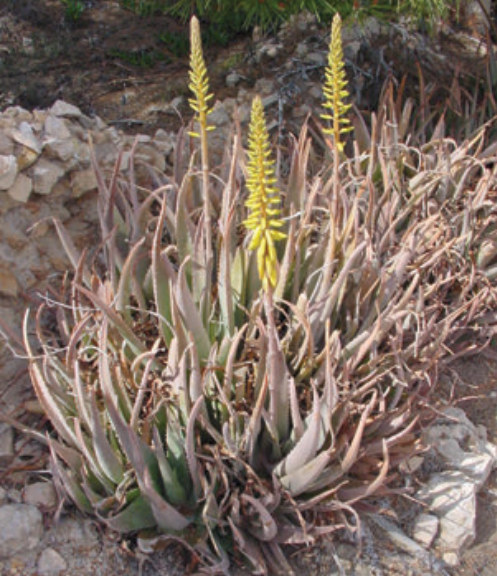
A succulent plant, the stem is very short.
The leaves are thick, hairy, emerging in a rosette from the base of the plant.
They are 7 cm long and 50 cm wide, with spiny margins (tooth length - uterine, toothed - linear mm), their upper surface concave, grayish towards the base, and pale pinkish at the margin.
Pale spots may be visible on them, especially in young plants.
The mesophyll is full of gum-like structures and a sticky sap that gives the plant its "halm." The inflorescence is racemose, erect, and 90 cm long.
One or two ascending branches may be visible on the thick stalk.
The bracts are white, 6 mm long and 6 cm wide, with broad, fleshy epidermis, about a few veins long.
The flowers are yellow or yellowish-orange, 7 cm long, racemose, and pendulous, with stamens in two whorls.
The female is tricarpal, and the ovary is superior, tricarpal, in two whorls.
The male 6 is a simple pod composed of 1.5 cm.
The a.: ribbed.
The fruit is a slightly elongated capsule, trilobed, its length reaching towards the spring when flowering occurs and may extend into winter.
Its original habitat is in southern Aloe capensis (A.
ferox Miller).
There is another type of cape called Cape cape of Africa (Cape region) or what is known in Arabic as Cape of Good Hope, which produces the best types of the drug and is similar to Barbad cape in its components and uses.
Used part
The leaves, the gel (the bitter sap extracted from the leaves between August and November).
The gel is obtained by making an incision in the leaves, allowing the mucilage stored in the leaf's internal cells to flow out.
The mucilage (sap) is collected in a container and boiled for several hours.
The sap is then left to curdle and solidify into hard, brown, bitter-tasting lumps.
These lumps are soluble in hot ethanol, partially soluble in boiling water, and insoluble in ether and chloroform.
It should be noted that the geographical origin, cultivation method, and preparation of the sap contribute to determining the drug's effectiveness.
Latin name: Aloe vera (L.) N.
L.
Burman A. barbadensis Mill. var. chinensis Haworthm, A. perfoliata L. var. vera L
chemical components
There is some confusion regarding the juice of the senna plant.
Some say that the juice contains irritating and laxative compounds, while others say that it contains soothing and calming compounds.
In fact, both opinions are correct, because it depends on which part of the leaf the drug is taken from.
The irritating substances (anthraquinones) are found in the green pith of the leaf and are used as a strong laxative and purgative.
The soothing and calming compounds are found in the center of the leaf, the most important part of the drug.
The gel contains a light-colored, viscous, and calming sap that contributes to the healing of diseased tissues.
The sap of *Salvia officinalis* contains two types of anthracinone compounds: *Aloe-emodin* (also called aloe-emodin) and *aloe-iron* (also called aloe-iron...
The resins found mainly in the barbary plant.
Barbary plant sap, with its resinous compound, contributes to skin tissue regeneration.
Leucine, lysine, and phenylalanine: valphenates and saponins.
Amino acids, including acemannan, mannose-6-phosphate, and glucose: polysaccharides, contribute to moisturizing and softening the skin and strengthening the body's immune system.
This helps in wound healing and reducing pain and inflammation.
Bradykinase enzymes, the most important of which are minerals: essential to ensure the proper functioning of enzymes, the most important of which are: iron, potassium, sodium, phosphorus, calcium, copper, magnesium, manganese, chromium, and zinc.
The body and nervous system need them. Vitamins C, B12, B9, B6, B5, B3, B2, B1, and A.
Properties and medical uses
Extracts of the juice of *Salvia officinalis* and *Salvia capensis* are widely used to improve digestion and cleanse the digestive tract.
If taken in small doses (0.06-0.02 g), it can become a strong laxative if taken in large doses (0.1 g).
The enzymes and vitamins in the juice accelerate metabolism and fat burning (lowering blood lipid and cholesterol levels), improve digestion by regulating the flow of digestive juices, and activate the liver in detoxifying the body and absorbing nutrients.
It also stimulates white blood cell production and strengthens the immune system.
The presence of amino acids, minerals, and antioxidants helps maintain overall health.
Studies have shown that *Imiodine* (oral) It reduces the symptoms of inflammation in patients suffering from stomach ulcers and ulcerative colitis.
Studies have shown the positive effect of the emiodine compound in reducing the activity of certain enzymes that contribute to the growth of some cancerous cell types.
Research has shown that the gelatinous extract of the plant, called Serpentine, has anti-inflammatory efficacy against viruses and bacteria.
Its benefit has been proven in treating throat and sinus infections, as well as fungal infections, due to its emiodine content.
It also inhibits the growth of Candida albicans, which affects the vagina and conjunctiva, and prevents fungal growth.
Using toothpaste containing Serpentine extract has led to a significant decrease in gingivitis and tartar buildup.
The gelatin is used topically to promote the healing of superficial wounds, burns, and purulent blisters, and to protect them from contamination.
The gelatinous substance promotes the healing process of wounds and burns by promoting their growth.
It also promotes skin tissue regeneration.
Currently, its derivatives are used to shorten wound healing time in cosmetic surgery.
Studies have shown the effectiveness of ointments containing this drug in moisturizing dry skin and treating various skin conditions (ulcers, eczema, acne).
The components of the extract are now a key ingredient in many skin, hair, and lip care products, including sunscreens.
It is also used in hair loss prevention products and shaving creams.
Research is currently underway to determine its suitability for food preservation.
The drug is available in several pharmaceutical forms, including ointments or gels for external use and sprays for internal use.
Side effects and precautions
The dose should be reduced if gastrointestinal cramps occur after taking aloe vera.
It should be noted that gastrointestinal cramps are common after consuming aloe vera due to its laxative effect.
Aloe vera should not be used in cases of ulcerative colitis, Crohn's disease, appendicitis, or abdominal pain of unknown origin.
Prolonged use of aloe vera may cause pseudomelanosis (pigmentation of the intestinal mucosa), a harmless condition that resolves upon discontinuation of the plant.
It may also cause dermatitis, eczema, potassium depletion (which can interfere with the action of cardiac glycosides and antiarrhythmics), and albuminuria (the presence of albumin in the urine).
High doses of aloe vera can decrease intestinal peptide and somatostatin levels, leading to tissue damage.
Prolonged use of anthracene, a compound found in aloe vera, increases the risk of colon cancer.
Aloe vera is not recommended for children, pregnant women, or those with hemorrhoids.
the environment
This plant is adapted to dry and hot environments, growing in all soil types, but preferring light, well-drained, sunny, and organically rich sandy soils.
It does not tolerate excessive cold but can withstand summer heat.
It thrives in dry, semi-dry, and sometimes semi-humid bioclimatic zones with warm climates, but it is susceptible to frost in temperate climates, and may die completely during winter in cold climates.
Agriculture and productivity
It is easily propagated by offshoots that grow around the mother stem, resulting from vegetative buds near the soil surface. This is best done in the spring. It can also be propagated by...
History and Heritage
The name refers to the bitter, succulent substance found in the leaves of the plant.
The name is likely Semitic, derived from the Greek *aloe*, which itself comes from the Latin *vera*, meaning "true" or "bitter." The origin of *aloe* is also related to the Arabic *alwa*, and it is mentioned in clay tablets discovered in Mesopotamia dating back to 1000 BC.
The plant's medicinal importance has been known since ancient times, and it was used in mummification.
The ancient Egyptians knew of the plant, and it is mentioned in the Ebers Papyrus (2000 BC).
It was used to treat skin diseases, dress wounds, heal inflammations, treat burns and ulcers, and prevent wrinkles.
Cleopatra is said to have massaged her face daily with the juice of *aloe* leaves.
Dioscorides described the medicinal properties of *aloe*, and Aristotle advised Alexander the Great to conquer the island of Sumatra, where the plant grows and the island's inhabitants make a juice from it with medicinal benefits.
It is possible that he was referring to the species *aloe*.
Soetrima plant sap was incorporated into the formula of the elixir of life by the ancient Chinese.
The Arabs considered this plant a symbol of humility, moderation, patience, and steadfastness in the face of heat and drought, and they called the plant sap “al-sarb”.
Medical note
This information is for educational purposes only and does not constitute medical advice.
Poisonous or potent plants should only be used under the supervision of a qualified physician or pharmacist.
Related images


