Chaste tree | Medicinal plant in the Akhdar encyclopedia
The plant has been shown to possess anticancer properties (cervical, liver, and lung cancer), as well as to stimulate milk production, promote neurotoxicity, and maintain immune system balance. Studies indicate that silybinin is a potential treatment for Parkinson's disease. The plant's seeds posse…
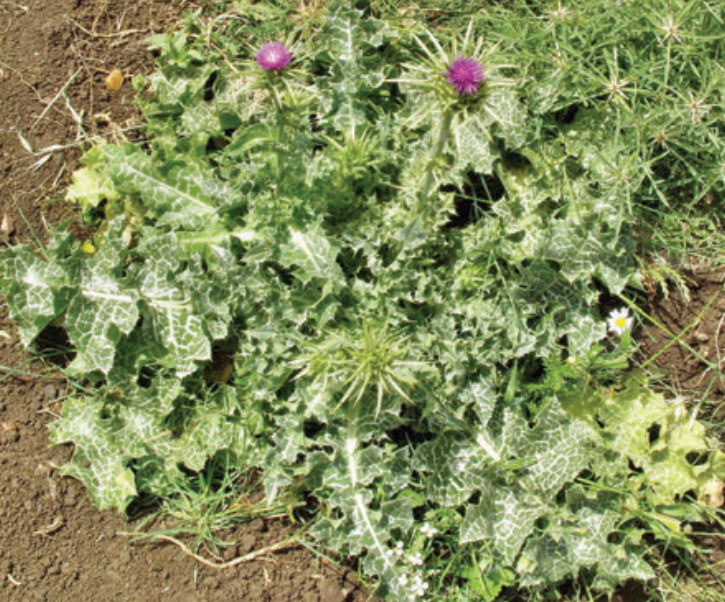
Plant name
Mary's thorn
Latin name
Silybum marianum Gaertn
Common names
Mary's thorn, beauty thorn, milk thistle, Abu Ka'ib
foreign names
Eng. St Mary's thistle, Milk thistle, Fr. Chardon-marie
The group
Star
Habitat and Geographic Distribution
Turin, extending into southern Europe and the northern Mediterranean and Siberian regions. - Africa and the Eurozone
Botanical description
200 - A perennial herb, 1 cm long, almost hairless, spiny.
The stem is cylindrical, lobed, strong, simple or sparsely branched.
The leaves are large, greenish-white, especially at the tips of the veins, glossy, lobed, triangular - the lobes are ovate with sharply toothed tips.
The basal leaves are very large, tapering gradually at the base, and the upper leaves are auricular, attached to the stem.
The flower heads are solitary, 1 cm long, with bracts 10 cm in diameter, ending in a triangular appendage with a strong, downward-curved, spiny tip.
All flowers are tubular, purple or lilac, black mottled with yellow, white.
The fruit is an acinus, 1 cm long, with a white, powdery sheath. Flowering occurs from March to May.
Used part
The Akhdar plant and its mature seeds: Latin name: Pulicaria arabica (L.) Cass. Inula arabica L
chemical components
Its compounds include luteolin, kaempferol, apigenin.
The plant Akhdar contains flavonoids: apigenin and its glycosides.
beta-sitosterol: beta-sitosterol, glycosidic steroids, and sterols.
3.3% fumaric acid, organic acids such as formic acid, polyynes, polyene compounds, silybin A, B, silybin (1.5-3% flavonolignan mixture), silymarin.
Mature seeds contain: silymarin, silydianin, silychristin, isosilybin A, B, isosilybin (silybin), silybin (silybin), apigenin, chrysoeriol, eriodictyol, naringenin, quercetin, taxifolin: flavonoids, proteins, and sugars. 20-30% fatty oil, fixed oil.
Properties and medical uses
The plant has been shown to possess anticancer properties (cervical, liver, and lung cancer), as well as to stimulate milk production, promote neurotoxicity, and maintain immune system balance.
Studies suggest that silybinin is a potential treatment for Parkinson's disease.
The plant's seeds possess liver-protective properties due to the presence of the compounds silymarin and silychristin.
Silymarin encourages the liver to produce glutathione, which helps eliminate toxins from liver cells and inhibits the production of leukotrienes, thus possessing anti-inflammatory properties.
Silymarin activates the synthesis of ribosomal proteins, stimulates liver cell regeneration, and treats liver cirrhosis.
Research has shown that silymarin contributes to reducing liver fibrosis in individuals suffering from inflammatory liver conditions resulting from chronic viral hepatitis (B and C) or cancer patients undergoing chemotherapy.
It is also considered a blood sugar, blood pressure, and cholesterol reducer, and is anti-obesity and anti-atherosclerotic.
Silibinin inhibits the production of superoxide, nitric oxide, and free radicals, and the process of The plant produces leukotriene and glutathione, which protects against hepatic and mitochondrial oxidation.
It also possesses kidney-protective properties against damage caused by acetaminophen, cisplatin, and vincristine.
The seeds of the sulphin plant are used to protect the liver from alcohol-related diseases, gallbladder disorders and stones, and kidney inflammation.
They are also used to reduce the growth of cancerous cells in the breast, cervix, and prostate.
The plant is currently used...
Widely used in Europe and the United States for treating liver diseases, the plant is the source of silymarin, a drug prescribed for patients with viral hepatitis.
Precautions: Consult a doctor before use, especially for children, pregnant women, and breastfeeding mothers, as diarrhea may occur in rare cases.
Therefore, use should be under medical supervision and at specific doses, due to the high concentrations of nitrates, which are converted in the body to nitrite, leading to nitrite poisoning. Difficulty breathing and cramps
Side effects and precautions
A doctor should be consulted before use in children, pregnant women, and breastfeeding mothers, as diarrhea may occur in rare cases.
Therefore, it should be used under medical supervision and at specific doses, due to the presence of high concentrations of nitrates which are converted in the body to nitrites, leading to nitrite poisoning, the symptoms of which include difficulty breathing and cramps.
the environment
The plant thrives in neglected areas and along the edges of fields, roads, and railways.
It flourishes in sunny, well-drained calcareous soils. It tolerates low temperatures up to [insert temperature range here].
Agriculture and productivity
It is cultivated as a vegetable in many countries worldwide.
It is propagated by seeds sown in early spring.
The plant can flower in the summer and complete its life cycle in a single growing season.
Delaying sowing is possible, but in this case, the plant behaves as a biennial and does not flower until the following spring. Tanacetum densum (Labill.) Sch.Bip. Pyrethrum densum Labill
History and Heritage
It is the name of one of the sillybon or silybon, the scientific name for the genus of edible thorny plants, and was later used to name the genus after the Virgin Mary. The descriptive name for the species is marianum.
Medical note
This information is for educational purposes only and does not constitute medical advice.
Poisonous or potent plants should only be used under the supervision of a qualified physician or pharmacist.
Related images


