Blessed thistle (Vitex agnus-castus) | Medicinal plant in the Akhdar Encyclopedia
The bitter substances stimulate the salivary glands to secrete saliva, as well as gastric (bile-stimulating) and intestinal juices, thus improving appetite and relieving indigestion. The plant possesses antiseptic and antimicrobial properties due to its bitter compounds, particularly cnicin. Experi…
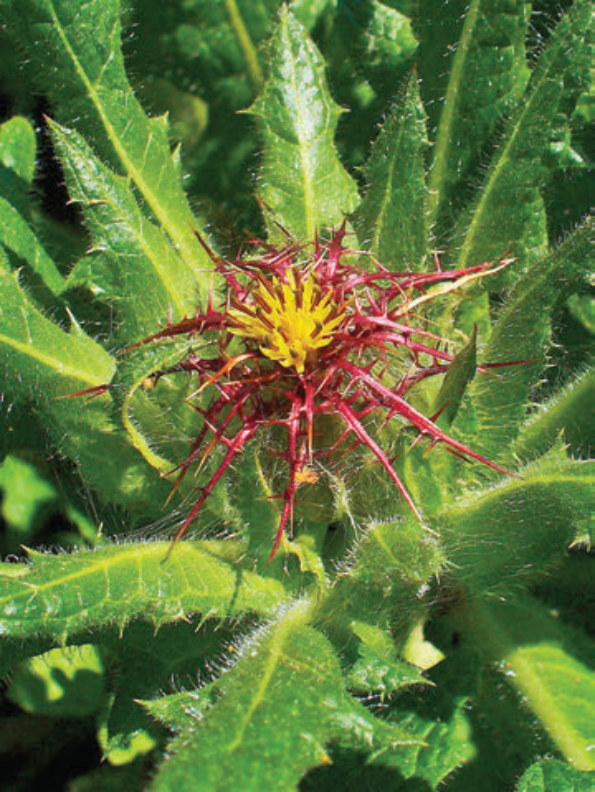
Plant name
Mary's thorn (Blessed thorn)
Latin name
Cnicus benedictus L
Common names
Mary's thorn (Blessed thistle), Holy thistle, Spotted thistle, Flowering thistle
foreign names
Eng. Holy thistle, Fr. Chardon beni
The group
Star
Habitat and Geographic Distribution
Turanium, which grows in large parts of the world, including North America, is cultivated in the Mediterranean and Iranian regions, as well as in many countries (especially European ones), both as a medicinal plant and for the oil extracted from its seeds.
Botanical description
30 cm, downy to 30 cm - a perennial herb, its length covered with spider-like hairs.
The stem is short and erect, bearing a terminal head: sessile, dichotomous from the base, the branches prostrate.
The leaves are pale green, leathery, oblong to uterine in general shape, with prominent veins on the underside, and oblong-triangular lobes with toothed, spiny margins.
The basal leaves have short petioles; the stem leaves are attached to the stem, oblong-lobed, and sparse.
The flowering leaves are broadly ovate, spiny, surrounding and covering the head.
The flowering head is solitary and ovate.
The outer bracts are membranous, folded, and terminate in a long needle with spines at both ends, as do the inner bracts.
The flowers are tubular, yellowish with purple veins, and more delicate than the bract spines.
The fruit is an acinus, oblong-cylindrical, glabrous, with a prominent, ribbed apex ending in a toothed margin.
Its length is greater than that of the acinus (20 mm), and its lobes are 10 + 10 mm.
The scales vary in length and width (10-7 mm). Flowering occurs from March to April.
Used part
The aerial parts of the plant.
Chemical constituents: Monoterpene and sesquiterpene lactones, bitter in taste, including cnicin, salonitenolide, and artemisiifolin; lignans (bitter compounds), including trachelogenin, arctigenin, and nortracheloside; volatile oil, the main components of which are nonane, undecane, tridecane, p-cymene, fenchone, citral, and cinnamaldehyde; apigenin, luteolin, and astragalin; alpha-amyrin triterpenes and multiflorenol; minerals (potassium, magnesium, calcium) and tannins.
Properties and medical uses
The bitter substances stimulate the salivary glands to secrete saliva, as well as gastric (bile-stimulating) and intestinal juices, thus improving appetite and relieving indigestion.
The plant possesses antiseptic and antimicrobial properties due to its bitter compounds, particularly cnicin.
Experiments on laboratory animals have shown the plant's antitumor and potentially cytotoxic effects on cancer cells through the compound cnicin.
A decoction of the plant is used traditionally as an expectorant, appetite stimulant, tonic, digestive aid, cholagogue, and diuretic.
The preparation is used topically as a tincture or ointment to treat rheumatism, hemorrhoids, and to disinfect various types of bacterial infections, ulcerated wounds, boils, breast inflammations, and abscesses associated with lactation.
Side effects and precautions
Overdoses can cause vomiting.
It should be used with caution in patients taking antacids such as Maalox, aluminum hydroxide-containing medications, ulcer medications such as H2 blockers like ranitidine, and other proton pump inhibitors like omeprazole and its family, as the plant increases gastric acid secretion and thus reduces the effectiveness of these medications.
It is not prescribed for pregnant women, as it is a uterine stimulant and may cause miscarriage.
It should not be used by people with Crohn's disease or chronic inflammatory bowel disease, as it may cause irritation and inflammation of the stomach and intestines.
Other uses
The plant's roots, flowers, and stem are eaten raw or cooked, and its sap is widely used in tanning. (Drug interactions and)
the environment
The plant grows in agricultural, quarry, and neglected lands. It prefers dry, sunny soils and grows best in fertile, well-fertilized soils.
Agriculture and productivity
The plant is propagated by seeds, which are sown directly in the permanent ground in early autumn or spring in beds or in rows spaced 50 cm apart. They germinate.
History and Heritage
A medicinal and edible plant, known for a long time.
In folk medicine, it was used as a hot poultice to treat digestive and liver disorders in particular.
Monks in Europe cultivated it for use as a remedy for various ailments, and early herbalists believed it cured "all diseases," prescribing it for headaches, strengthening the heart and stomach, and treating external tumors.
In the 9th century, the plant was described as a tea or a sour infusion made from its growing tips to treat fever, liver problems, and respiratory issues.
Medical note
This information is for educational purposes only and does not constitute medical advice.
Poisonous or potent plants should only be used under the supervision of a qualified physician or pharmacist.
Related images


