Shankura | Medicinal plant in the Akhdar encyclopedia
The plant has a sharp, pungent taste and was historically used to treat nervous tremors, rheumatism, wounds, jaundice, and dropsy. A decoction of the leaves is popularly used as an emmenagogue and diuretic, and to treat urinary tract diseases, gout, and rheumatism.
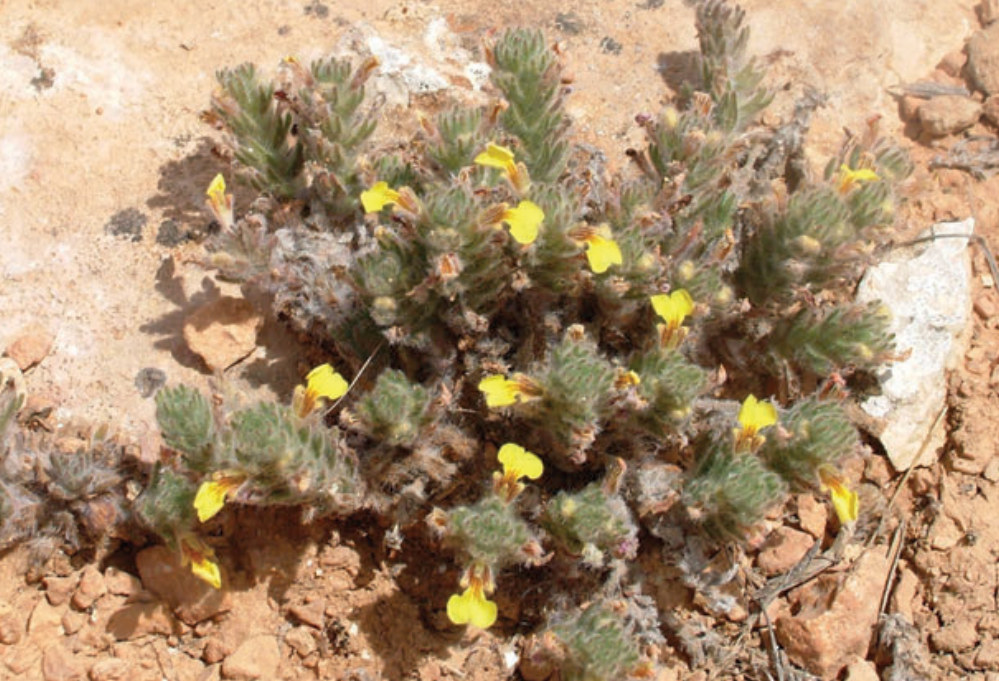
Plant name
Shanqoura
Latin name
Ajuga chamaepitys (L.) Schreber
Common names
Shanfoura, Musk of the Graves, Earth Oak
foreign names
Eng. Yellow bugle, Fr. Bugle jaune
The group
oral
Habitat and Geographic Distribution
Taurine - Mediterranean and Western Iran.
Part used: Flowering plant.
Latin name: Ajuga chamaepitys (L.) Schreber Teucrium chamaepitys L., Chamaepitys trifida Dumort
Botanical description
A perennial herb with a semi-woody base, branching from the bottom, densely covered with long, flat, white hairs, about 1 cm long.
The stems are initially prostrate, then ascending or erect.
The leaves taper at the base to form spathes.
The stem leaves are generally spathe-like, with their apex divided into three complete lobes.
The flowering leaves are usually pinnate.
The flowers are gathered in sparsely flowered corymbs (usually two flowers per corymb), axillary, forming a semi-raccoonous inflorescence.
The flowers are tubular, white-haired, and terminate in five sharp, hermaphroditic, biconvex, ovate uterine teeth.
The calyx is about 1 mm long, white-haired, yellowish-red, and speckled with purple.
The apex is fused, with its length slightly shorter than the tube.
The corolla, with its five petals, is in a tube longer than the calyx and then splits into two lips of unequal size, appearing solitary.
The upper lip is very small, straight, and notched at the apex.
The lower lip is composed of three flattened lobes, biconvex, and prominent.
The female is biconvex, the largest in size, with a notched apex, appearing to be composed of two lobes.
The stamens are small, brown, rough, and 1.5 x 3 mm in size.
The carpels are superior.
The ovary is divided into four stones. The fruit is a four-lobed drupe. Flowering occurs from January to May.
Used part
flowering plant
chemical components
The essential oil, whose main components are germacrene B (20%), limonene (40%), muurolene (8%), and bitter diterpene compounds, tannins, mineral salts, glycosides, saponins, and caffeic acid derivatives, is present.
Chemical analysis of the essential oil using GC-FID and GC-MS revealed the following compounds: ethyl linoleate, corine, beta-pinene, and phytol.
The plant contains polyphenols and iridoids as its main components, along with ajugoside, asperulosidic acid, deacetyl-asperulosidic acid, 5-O-β-d-glucopyranosyl-harpagide, harpagide, 8-O-acetylharpagide, and reptoside. 5-O-β-d-glucopyranosyl-8-O-acetylharpagide
Properties and medical uses
The plant has a sharp, pungent taste and was historically used to treat nervous tremors, rheumatism, wounds, jaundice, and dropsy.
A decoction of the leaves is popularly used as an emmenagogue and diuretic, and to treat urinary tract diseases, gout, and rheumatism.
Side effects and precautions
Allergic reactions or drug interactions may occur; self-use should be avoided by pregnant and breastfeeding women, children, and patients with chronic diseases.
the environment
This plant thrives in semi-arid and humid environments on sunny hillsides and slopes with varying soil types, preferring acidic soils. It is considered a suitable species for ornamental gardens.
Agriculture and productivity
The plant is propagated by seeds scattered in the spring.
Ajuga iva (L.) Schreb, Ajuga humilis Porta, A.
pseudoiva Robill & Castagne ex DC., Bulga iva)L. (Kuntze, Chamaepitys iva)L. (Fourr., Teucrium iva L
History and Heritage
The plant is also called *Shanqura*, or earth oak.
Edward Ghalib, in his encyclopedia, calls it *Al-`Arsaf al-Ja`diyya*, while Ibn al-`Attar refers to it as *Kamafitus*.
This is because the *Ja`da*, according to Dioscorides (who calls it *Teucrium polium*), is *Ajuga chamaepitys*, which some call *Khamafitus*.
This agrees with what al-Antaki states, mentioning in Berber as *Polyum*, that the *Ja`da* in Greek is *Artalis*.
Ibn al-Baytar describes *Ja`da* as a small, white, delicate plant, about the length of a *shabr* (a unit of length), full of seeds.
Ibn Sina describes *Ja`da* as a type of wormwood with a burning, pungent, and irritating quality.
The smaller variety is more intense and bitter, with stems and downy white or yellowish flowers filled with seeds.
Its head is spherical, with white hairs, and a heavy odor with a slight pleasantness.
The larger variety is weaker, also bitter and pungent, and the mountain variety is the smallest.
A study of germander in the works of al-Antaki, Ibn al-Baytar, and Ibn Sina reveals that it corresponds to a herb known as creeping or hairy germander.
Ajuga, also known as windwort or genus's musk, is another example. As for the plant *Shanqura*, it is a variety of *Teucrium polium*.
Medical note
This information is for educational purposes only and does not constitute medical advice.
Poisonous or potent plants should only be used under the supervision of a qualified physician or pharmacist.
Related images


