Chandkora | A medicinal plant in the Akhdar encyclopedia
Research conducted on laboratory mice has demonstrated the antioxidant properties of the plant's aqueous extract. Studies have also shown antibacterial, anti-ulcer, and hypoglycemic properties. A decoction of the plant is traditionally used for its purifying and vermifuge properties, and to treat d…
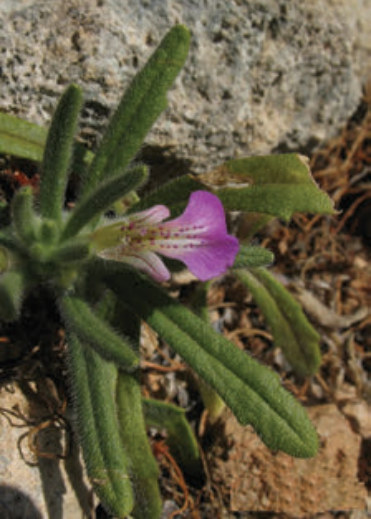
Plant name
Shandoura
Latin name
Ajuga iva (L.) Schreb
Common names
Shandoura
foreign names
Eng. Yellow bugle, Fr. Bugle jaune
The group
oral
Habitat and Geographic Distribution
Mediterranean
Botanical description
A perennial herb with a semi-woody base, branching from the bottom, hairy, 1 cm.
The stems are prostrate or ascending, dense, 30 cm long, grayish in color, and the leaves are long.
The leaves are linear to oblong, with downward-curving margins and teeth on each side.
The flowering leaves are usually 1-3 cm long, complete, or bearing 2-4 flowers (the flowers are grouped in corymbs of few flowers per corymb), axillary, forming a semi-raccoonous inflorescence.
The flowers are tubular, white, hermaphroditic, bi-symmetrical, and squamous.
The calyx is hairy, ending in five ovate to uterine teeth, 1 mm long, purple to the length of the tube or slightly shorter.
The corolla is 1 mm long, pink, or yellow, its five petals fused into a tube longer than the calyx, then split into two lips of unequal size, so that it appears uniliped.
The upper lip is very small, straight, and notched at the apex.
The lower lip is composed of three flattened lobes, the middle lobe being the smallest, with a notched apex, appearing to be composed of two lobes.
It is bicarpal and prominent.
The female is bicarpal, and the ovary is superior and four-lobed.
The fruit is four-lobed, with black, pitted stamens. It measures 1.5 x 3 meters and flowering occurs from February to June.
Used part
The aerial parts (harvested during flowering) contain chemical constituents such as tannins, volatile oil, cyanosterols, makisterone, phytoestrogens, polyhydroxylated sterols, polypodine, and asterone. The plant is primarily composed of potassium and magnesium.
chemical components
polypodine, cyasterone, phytoecdysteroids, makisterone, polyhydroxylated-sterols, tannins, volatile oil, sterol
Properties and medical uses
Research conducted on laboratory mice has demonstrated the antioxidant properties of the plant's aqueous extract.
Studies have also shown antibacterial, anti-ulcer, and hypoglycemic properties.
A decoction of the plant is traditionally used for its purifying and anthelmintic properties, and to treat digestive disorders, enteritis, asthma, sinusitis, and diarrhea.
It is also used topically to treat mouth ulcers, wounds, hemorrhoids, and rheumatism.
Extracts and isolated compounds from the plant have exhibited pharmacological, anticholesterol, insecticidal, and nephrolithotomy activities.
The results confirm the plant's potential as an antihypertensive treatment, and the reduction in systolic blood pressure can be attributed to glycosylated phenolic compounds (polar phenolic compounds) such as flavonoids and/or their metabolites.
Side effects and precautions
Allergic reactions or drug interactions may occur; self-use should be avoided by pregnant and breastfeeding women, children, and patients with chronic diseases.
Other uses
The plant is very suitable as fodder for ruminant animals in pastures.
the environment
It is found in rocky areas: within the Mediterranean maquis.
Agriculture and productivity
A wild plant that does not cultivate.
Ballota nigra L., Ballota foetida Lam., Ballota sordida Salisb., Marrubium nigrum L. (Garsault, Stachys ballota Kuntze)
History and Heritage
It was mentioned in the previous type.
Medical note
This information is for educational purposes only and does not constitute medical advice.
Poisonous or potent plants should only be used under the supervision of a qualified physician or pharmacist.
Related images


