Shepherd's purse | Medicinal plant in the Akhdar Encyclopedia
The plant, with its flavonoids and tyramine content, positively affects the contraction and temporal rhythm of the heart muscle and blood vessels (improving blood circulation). It is used to treat nosebleeds, wounds, burns, premenstrual syndrome, and to reduce excessive menstruation and stop uterin…
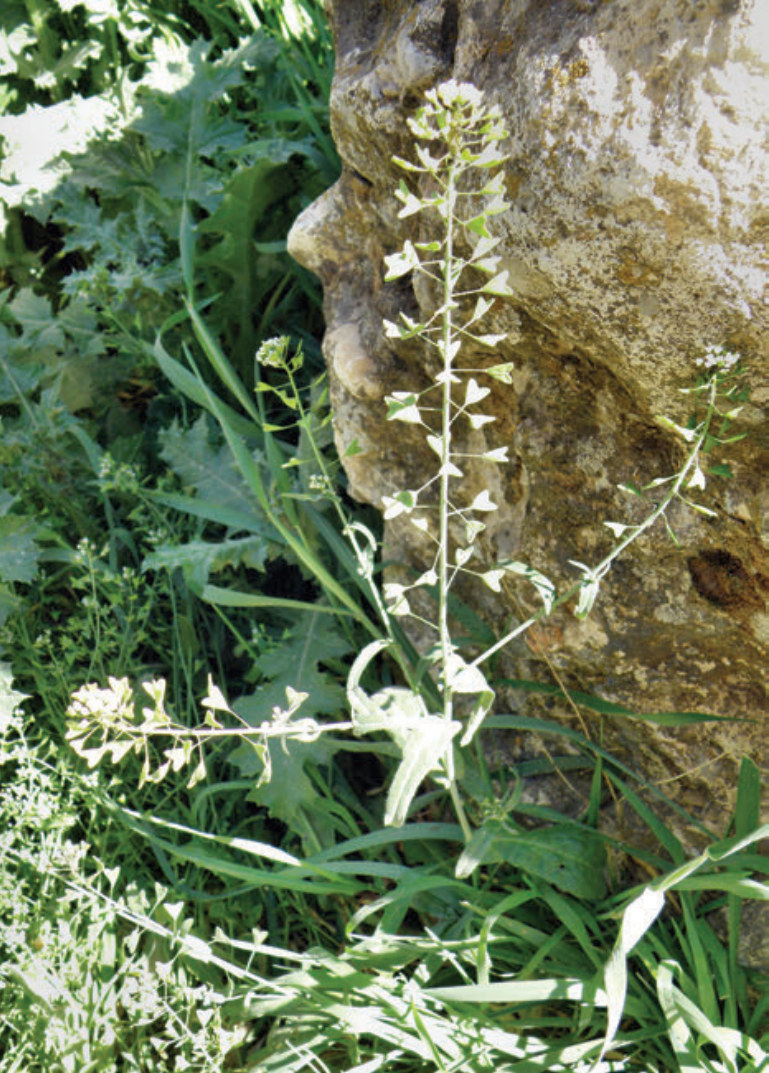
Plant name
Shepherd's Tassel
Latin name
Capsella bursa-pastoris (L.) Medikus
Common names
Shepherd's purse, shepherd's bag
foreign names
Eng. Shepherd's burse, Fr. Bourse à Pasteur
The group
cabbage
Habitat and Geographic Distribution
A nearly universally distributed plant
Botanical description
cm.
The stem is erect, simple or branched from the bottom.
The lower leaves are 50 cm long, forming a basal rosette, obovate, tapering gradually to form leaf spoons, entire, toothed, or lobed, 16 cm long, linear-edged.
The upper leaves are oblong, flat, with the base of the blade partially bordering the stem, with a toothed or entire margin (mm), gathered in 2-4 clusters.
The flowers are small, terminal, densely flowered inflorescences.
The petals are free sepals.
The corolla is 4 cm long, the calyx is white, and the stamens are of varying lengths.
(Male).
The female is bicarpel-like, with an ovary consisting of 4 + 2 (one lobe divided into two by a false septum).
The inflorescence is elongated, with flattened (semi-horizontal) stalks, slender, triangular, thread-like.
The umbel-shaped, heart-shaped apex.
The seeds are in each carpel. The number of seeds increases until flowering, from December to April.
Used part
The aerial parts and seeds are consumed.
The leaves are eaten raw or cooked and are usually available year-round.
They can also be dried for later use.
The leaves contain 2.9% protein, 0.2% fat, 3.4% carbohydrates, and 1% ash.
They are rich in iron, calcium, and vitamin C.
The small flower buds and seeds can also be eaten raw or cooked.
The seeds contain 35% fatty oil, which can be extracted and is edible.
The plant capsule has been shown to absorb heavy metals in high concentrations, so caution should be exercised with long-term use.
chemical components
The aerial parts contain cardiac isoforms that can be found in the seeds, including: rutin, luteolin-7-rutinoside, luteolin-7-valvonoids (including luteolin and others), methylsulfinyl nonyl glucosinolate (singrin glycosides, histamine), bursin, tyramine, triamnium, acetylcholine, acetylcholine (amino compounds including choline), potassium salts, and chlorogenic acid (caffeic acid and its derivatives).
Properties and medical uses
The plant, with its flavonoids and tyramine content, positively affects the contraction and temporal rhythm of the heart muscle and blood vessels (improving blood circulation).
It is used to treat nosebleeds, wounds, burns, premenstrual syndrome, and to reduce excessive menstruation and stop uterine bleeding.
It also acts as a diuretic due to its potassium salt content.
It is used to treat dysentery, boils, urinary tract infections, and fever.
Its compounds are included in medications for varicose veins, hemorrhoids, and burns.
It is recommended for lowering blood pressure and accelerating labor (it increases uterine contractions).
The flavonoid compounds are considered...
The plant's components are antiseptic and antibacterial, effective in treating cystitis and hypercholesterolemia.
It also activates liver enzymes (animal models).
In traditional Chinese medicine, it is used to treat eye diseases, including glaucoma, and it is considered an antioxidant.
The fresh plant is more potent than the dried form, and it can be used as a tincture, solution, or decoction like tea.
Drug interactions and precautions: It should not be used with antibiotics.
It interacts with anticoagulants (aspirin and coumarin), diuretics, and sedatives.
Palpitations, irregular heartbeat, difficulty breathing, and muscle paralysis may occur with excessive doses, and its seed components can cause skin irritation.
Its use is not recommended during pregnancy due to its uterine-contracting effect, and it is also advised against in cases of hypothyroidism (like other members of the Brassicaceae family) and various heart conditions.
Side effects and precautions
It should not be used with anticoagulants (aspirin and coumarin), diuretics, or sedatives.
Palpitations, irregular heartbeat, difficulty breathing, and muscle paralysis may occur with overdoses, and its seed components can cause skin irritation.
Its use is not recommended during pregnancy due to its uterine-contracting effect, and it is also not recommended for use in cases of hypothyroidism (like other types).
the environment
The plant grows in meadows, orchards, along roadsides, in fertile fields, and on embankments.
It grows in most types of soil, even in the vertebrate varieties, but in this case, its height does not exceed a few centimeters before it flowers and its seeds are dispersed, whereas in fertile soils, it can reach a height of 60 centimeters.
Agriculture and productivity
It propagates by seeds (which germinate quickly) that can be sown at any time of year, but spring is the preferred time for sowing in shallow beds or furrows with moderate soil moisture.
Care must be taken to prevent the seeds from being scattered randomly into crop and vegetable fields.
The plant is cut back completely when it flowers and the fruit begins to form, and then dried in the shade and in open air, away from direct sunlight. Diplotaxis harra (Forssk.) Boiss. Sinapis harra Forssk
History and Heritage
The scientific name of the genus is derived from the Latin capsa or capsula, meaning "box" or "bag," alluding to the apparent resemblance between its heart-shaped seed pods and the leather pouches that shepherds used to carry.
Shepherd's purse is a medicinal herb with a place in both Eastern and Western traditions.
The English name "Mother's Heart" indicates its use in treating gynecological ailments.
It is primarily known as an astringent, hence its name "wound herb." The seeds of this plant have long been used in China to improve eyesight.
Nicholas Cleiber, writing in 1653 about shepherd's purse, said, "Few plants have advantages that surpass those of this plant, yet it is completely neglected."
Medical note
This information is for educational purposes only and does not constitute medical advice.
Poisonous or potent plants should only be used under the supervision of a qualified physician or pharmacist.
Related images


