Autumn colchicum | Medicinal plant in the Akhdar Encyclopedia
Colchicine alkaloid is highly toxic. It possesses properties that inhibit cell division in both mitosis and meiosis, and it inhibits chromosome migration. It is used to inhibit cell division (in some types of cancer). It is not given orally except to treat acute attacks of rheumatism, joint pain, g…
Plant name
Autumn Surangan
Latin name
Colchicum automnale L
Common names
Autumn crocus, autumn crocus, autumn crocus, false crocus
foreign names
Eng. Colchicum, Fr. Colchique
The group
Al-Lahlahiyah
Habitat and Geographic Distribution
The regions bordering the Black Sea, where it is believed that the word overlooking Colchis is derived from the province of Colchicum, Taurine and Saharan—that sea.
Mediterranean, Iranine Arabic.
Species of the genus are widespread in the cold and humid regions of Central Europe and the coasts of European countries bordering the Mediterranean Sea.
Botanical description
A perennial herb propagated by corms.
The corm is ovoid, enclosed in dry, brown, net-like leaves (sheaths), convex on one side, flattened and elongated downwards on the other.
Each year, a new corm is replaced by one that develops alongside the previous year's corm at the base of the flowering stem.
The leaves and flowering stem are enclosed in a white tubular sheath that turns brownish.
They are located at the base of the plant, linear to uterine, and appear with the flowers or after the following year's flowering.
The leaves are sparsely inflorescences, with tubular bases.
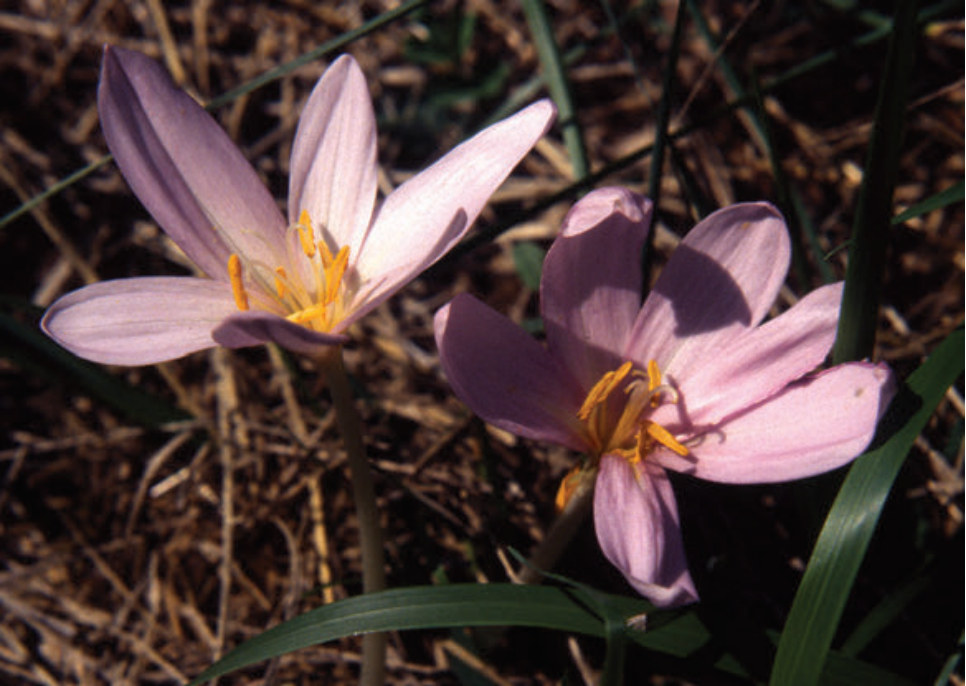
The flowers are solitary or clustered in a squamous raceme, hermaphroditic, and brightly colored.
The calyx is simple, squamous, pink, purple, or white (rarely yellow), funnel-shaped, and composed of lobes.
The calyx is lobed, with a long tube and a six-part blade.
The internal rotating stamens are slightly longer than the external ones.
The ovary is located in the order Tertiary, and each stone is free, thread-like, elongated, and protruding from the sleeve tube.
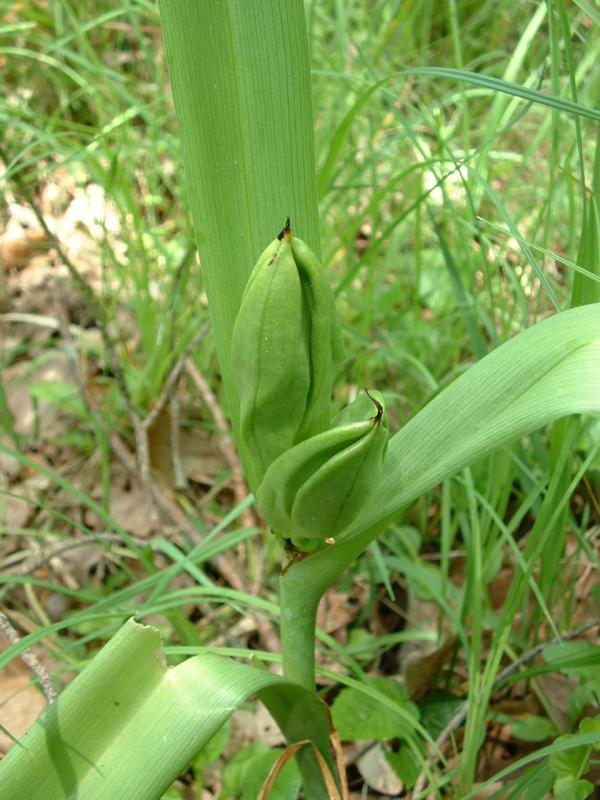
The fruit is a capsule, ovoid to elliptical, containing several ovules.
The tertiary lobes are ribbed, tapering to a beak-like apex, borne on a long stalk, and mature near the surface of the order.
The seeds are spherical or angular. Most species flower in late autumn and early winter.
Used part
Flowers, ripe seeds (collected at the beginning of summer), corms
chemical components
Colchicine, the most important component, is colchicine (0.25-1.2%).
The entire plant is poisonous.
The seeds contain alkaloids of the rhitopolone group and fatty oils.
Colchicoside is a glycosidic compound.
The corms contain a lower percentage of rhitopolone alkaloids, the most important of which are colchicine, apigenine, and several organic acids.
The pigment valvularia and apigenine are also present.
Colchicoside is a glycoside, in addition to starch. The flowers contain alkaloids similar to those found in the corms.
Properties and medical uses
Colchicine alkaloid is very toxic.
It has properties that inhibit cell division in mitosis and meiosis, and inhibits chromosome migration.
It is used to inhibit cell division (in some types of cancer).
It is not given orally except to treat acute attacks of rheumatism, joint pain, gout, and Familial Mediterranean Fever (FMF).
Colchicine is used topically to treat rheumatism and joint pain, skin tumors, psoriasis, chronic eczema, and eye inflammations.
It has been used to treat asthma, gout, and dysuria.
It is an anti-inflammatory and antifibrotic agent.
Its leaves contain components that are acaricidal.
The corm powder can be used as an anticide (RIFA).
Pharmaceutical preparations are available as a syrup and ampoules.
Tablets, tincture, dry extract.
Side effects and precautions: Highly toxic.
Unsupervised use can cause smooth muscle paralysis, abdominal pain, diarrhea, nausea, vomiting, gastrointestinal bleeding, liver and kidney irritation, anemia, neuritis, myopathy, and bone marrow damage.
Not for use in the elderly.
Do not use in cases of heart disease, kidney disease, digestive disorders, or liver disease.
Prolonged use leads to... Hair loss; not to be given to pregnant or breastfeeding women.
pharmaceutical forms
It is available in the form of a cream, ampoule, tablets, tincture, and dry extract. Side effects and
Side effects and precautions
Highly toxic, its unsupervised use can cause smooth muscle paralysis, abdominal pain, diarrhea, nausea, vomiting, gastrointestinal bleeding, liver and kidney irritation, anemia, neuritis, myopathy, and bone marrow damage.
It should not be used in the elderly.
Its preparations should not be used in cases of heart disease, kidney disease, gastrointestinal disorders, or liver disease.
Prolonged use leads to hair loss. It should not be given to pregnant or breastfeeding women.
the environment
The Souring variety tolerates cold and frosty conditions for extended periods without significant damage thanks to the hardiness of its internal tissues.
It is suitable for all agricultural soils, but prefers sandy and silty soils containing lime and organic matter (which helps protect the corms at pH) to produce large corms. It tolerates acidic soil and is resistant to fungal and bacterial infections.
Agriculture and productivity
In temperate regions, colchicum is grown in late summer and early autumn, using seedlings or corms, while in cold regions it is grown in spring using corms.
When propagating by seedlings, it is important to take seeds from fresh fruit and soak them in hot water (45°C) for several minutes, then in regular water for 24 hours to facilitate germination.
The seeds are sown in covered nurseries during the autumn and left until small seedlings with small corms develop.
These corms are then transplanted to their permanent location in early autumn of the following year.
The seedlings or corms are planted in rows spaced 60-65 cm apart.
Plant corms 25 cm apart in a row, then irrigate immediately after planting.
Water the plants once a month, as excessive soil moisture leads to corm rot.
Stop watering when the leaves turn almost yellow.
It is recommended to add some trace elements (copper and manganese) when applying conventional fertilizers, as they are important for the formation of active compounds.
Harvest the corms during the flowering period, when the leaves have withered and before the new bulb forms.
Collect the seeds after they have ripened.
The fruit ripens in late summer, depending on the region.
After harvesting, the corms are washed, cleaned, and cut into thin crosswise slices.
They are then spread out to dry in the sun, gathered, packed, and stored in a well-ventilated, cool, and dry place.
One hectare yields 2.5-2 tons of dried corms.
(Terminalia chebula Retz., Myrobalanus chebula Gaertn (Retz.), Myrobalanus gangetica Kostel (Roxb.), Terminalia gangetica Roxb., Terminalia reticulata Roth B. Heyne ex., Buceras chebula (Retz.) Lyons. Combretaceae)
History and Heritage
The scientific name for this plant, Colchide, derives from the well-known poisonous plant of Medea, the ancient Greek homeland, referring to its toxicity.
The term "automnale" (autumnal) describes the species, indicating its autumn flowering.
The name "Sourjan" (Sourjan) is of Persian origin and is mentioned in Ibn al-Baytar's lexicon. Ancient physicians recognized it as both a poisonous and medicinal plant.
Medical note
This information is for educational purposes only and does not constitute medical advice.
Poisonous or potent plants should only be used under the supervision of a qualified physician or pharmacist.
Related images