Gundelia | A medicinal plant in the Akhdar encyclopedia
Research has demonstrated the antioxidant properties of the plant (especially the seeds), and has shown the effect of plant extracts on several enzymes (phase II enzymes) that contribute to the treatment of cancer cells (glutathione-S-transferases such as phenolic compounds). It also exhibits antif…
Plant name
Akoub
Latin name
Gundelia tournefortii L
Common names
Akoub, Salbani, Ka'ub
foreign names
Eng. Tumbleweed, Gundelia, Fr. Gundelia, Akoub
The group
Star
Habitat and Geographic Distribution
In the eastern Mediterranean regions, the Gundelia plant grows wild in Syria, Palestine, Jordan, Iraq, Iran, Azerbaijan, Armenia, and Anatolia, and is cultivated in some countries as a type of vegetable.
Botanical description
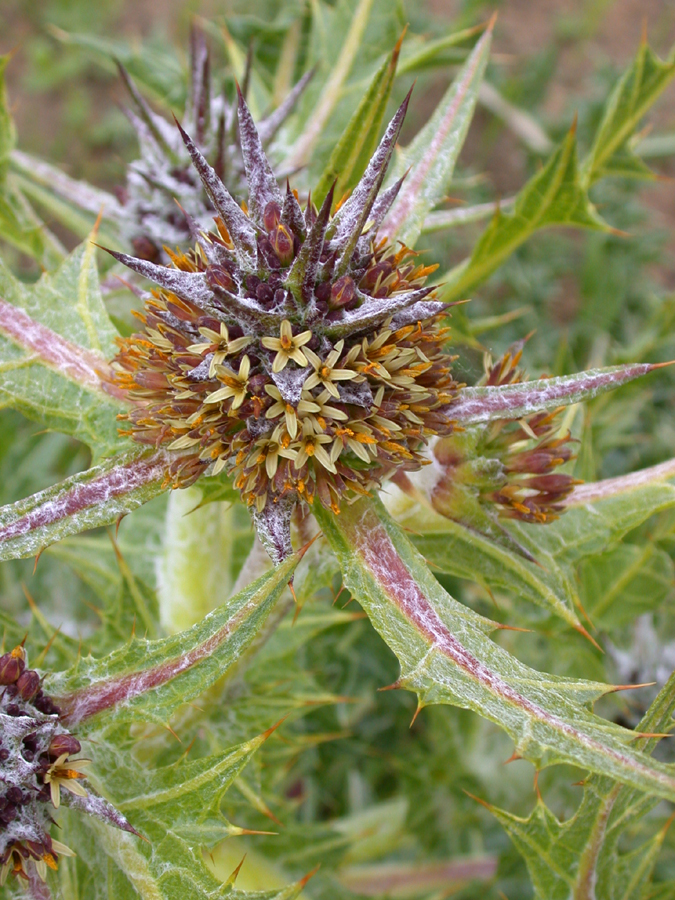
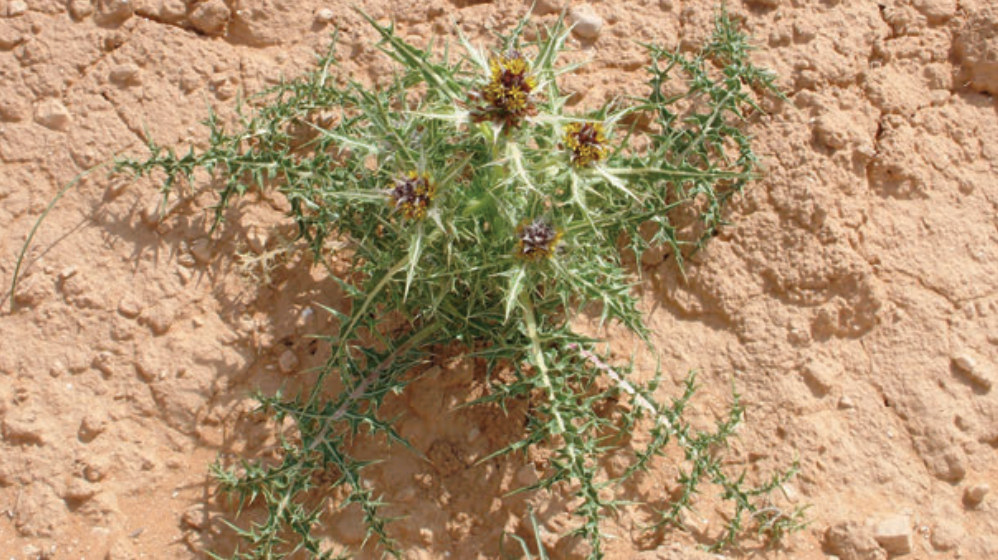
50 - A spiny, perennial herb, secreting vegetative shoots, 1 cm long, covered to varying degrees with spider-like hairs, and may be almost hairless.
The stems are thick, grooved, simple or branched at the top.
They break off near the base when mature and roll in the wind.
The leaves are large, hairy, oblong to oblong-female, with very thick veins and toothed, spiny lobes.
The lower leaf blades taper gradually, while the remaining leaves are flat.
The flower heads are broad, ovate, compound, comprising numerous densely clustered heads supporting flowers, 7 - each with a spiny bract.
The single head is 1 cm long, surrounded and covered by leaves.
8 - The central flower is fertile (hermaphrodite), while the peripheral ones are sterile.
The diameter of the upper compound head is [missing information].
The bracts are female, leathery in their lower part, covered with spider-like hairs, and terminate in a strong spine.
The flowers are crimson on the outside, yellow on the inside.
The anthers are yellow.
The fruits are acinus, individually enclosed in somewhat woody cones resulting from the fusion of the bracts of the single heads.
The acinus is surmounted by a toothed crown. Flowering occurs from March to May.
Used part
Aerial parts and seeds
chemical components
A mixture of sterol compounds, including scopoletin and esculin, is present in the aerial parts.
The main components are coumarin compounds, primarily molluscicidal saponins, stigmasterol, sitosterol, and gallic acid (phenolic compounds), including gallic acid derivatives, cryptochlorogenic a., chlorogenic a., neochlorogenic a., and caffeic a.
(caffeic acid derivatives).
Other components include a volatile oil, the most important of which are: a-terpinyl acetate, methyl eugenol, eugenol caryophellene, and zingiberene.
Properties and medical uses
Research has demonstrated the antioxidant properties of the plant (especially the seeds).
It has also shown the effect of plant extracts on several enzymes (phase II enzymes) that contribute to the treatment of cancer cells (glutathione-S-transferases, such as phenolic compounds).
It acts as an antifungal and antibacterial agent.
Research has also shown its ability to reduce uric acid levels in the blood.
Another study indicated a moderate effect of the plant in inhibiting platelet aggregation.
The leaves, stems, tender flower buds, roots, and seeds are used traditionally to treat digestive disorders, particularly liver disorders, and in cases of hypotension, rheumatism, and allergies.
Side effects and precautions
Allergic reactions or drug interactions may occur; self-use should be avoided by pregnant and breastfeeding women, children, and patients with chronic diseases.
Other uses
The bases of the leaves, stems, and tender flower buds are included in the culinary traditions of some in Syria, as are the underdeveloped flower heads, which are cooked in Syrian cuisine as a substitute for artichoke.
the environment
The Gundelia plant thrives in arid, semi-arid, and sunny regions, spreading across fallow, rocky, and hilly lands.
It prefers well-drained sandy soils.
Regarding cultivation and productivity: The plant is not subject to intensive harvesting during the spring to obtain its tender parts for food consumption, which places significant pressure on the species.
Therefore, it is recommended to adopt appropriate cultivation methods to compensate for the depletion caused by these practices.
Experiments have shown that its seeds are difficult to germinate easily, and current research is focused on finding a suitable method for stratifying its seeds or attempting vegetative propagation using modern techniques.
The plant is propagated by seeds, which require treatment for more than 4 weeks with a suitable hormonal solution containing 4-O4 + 4-Gerbilic acid.
Straining is carried out at a temperature between [temperature range missing in original text] for germination.
Agriculture and productivity
The plant is subjected to intensive harvesting during the spring season to obtain its tender parts for food consumption.
This places significant pressure on the species and threatens its survival.
Therefore, it is recommended to adopt suitable cultivation methods to compensate for the depletion caused by these practices.
Experiments have shown difficulty in seed germination, and current research is focused on finding a suitable method for seed stratification or attempting vegetative propagation using modern techniques.
The plant is propagated by seeds, which require appropriate hormonal treatment with gibberellic acid.
Stratification at temperatures between -4°C and +4°C for 2-4 weeks increases the germination rate. Matricaria recutita L. M. chamomilla L.
History and Heritage
The name "Gundelia" was given to the genus M.
1668-1715 by Andreas Gundelsheimer, after the Amerinian scientist.
The name "Gundelia" is of Aramaic origin.
The Latin name for the plant species, "Akkoub," was given to the species by Tournefort, 1656-1708, after the French scientist.
The plant has good nutritional value and multiple medicinal uses.
The species gained prominence a year later after the discovery of its pollen in abundance on linen fabric believed to be a shroud, which is currently preserved in the Cathedral of St. John the Baptist in Turin, Italy.
Medical note
This information is for educational purposes only and does not constitute medical advice.
Poisonous or potent plants should only be used under the supervision of a qualified physician or pharmacist.
Related images