Male fern | Medicinal plant in the Akhdar encyclopedia
This poisonous plant, containing alpha-vacuosidic and vellicinic acids, possesses antiviral and anthelmintic properties, effective against parasites such as liver flukes and tapeworms. However, it is ineffective against roundworms and Oxyuris b (a type of nematode). Extracts of the male fern are po…
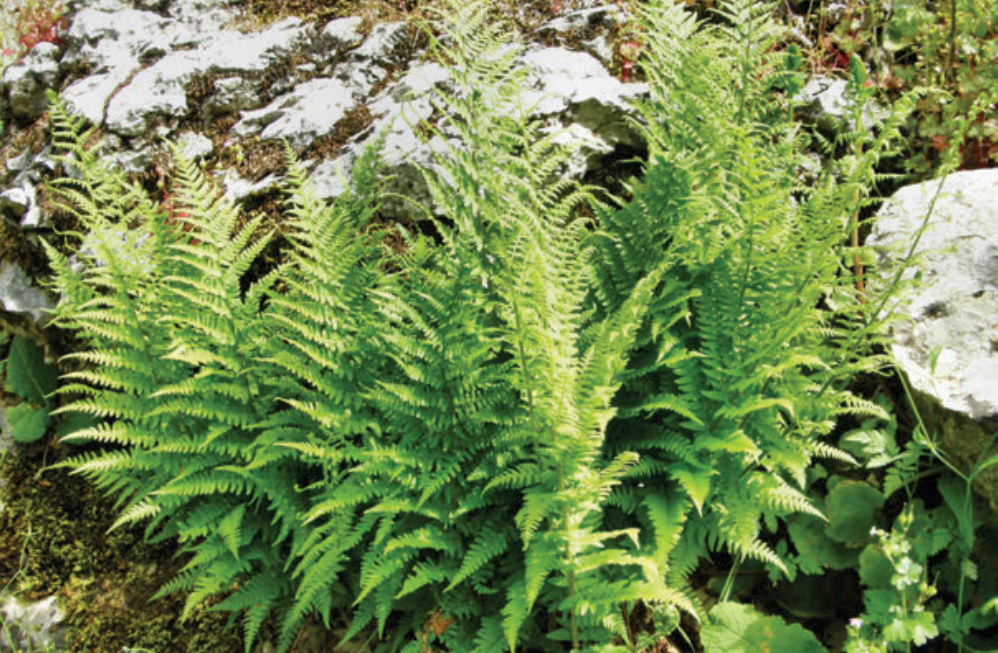
Plant name
Male fern
Latin name
Dryopteris filix-mas (L.) Schott
Common names
Masculine rasakhs, khanshar, rush
foreign names
Eng. Male Fern, Fr. Fougère mâle
The group
Portulacaceae
Habitat and Geographic Distribution
Siberian, Mediterranean-European
Botanical description
A perennial herb propagated by thick rhizomes.
The leaves are uniform in shape, 1 cm long.
The petioles are less than 30-10 x 120-28 cm.
They are borne in winter, one-quarter the length of the leaf, bearing scales at the base.
The scales are scattered, brown, and have two distinct lobes: the first is broad, and the second is hair-like (only this species has two distinct lobes of scales without intermediate lobes).
The blade (Akhdar) is dull, uterine, with a toothed to lobed edge.
The stamens are uterine, divided twice deeply into ovoid segments—solid, ovoid, kidney-shaped, and arranged in rows midway between the midrib and the leaf margin.
The stamen is also spherical, glabrous, and lacks glands. Spores are formed from June/July to September.
Used part
dry or tender rhizomes
chemical components
The rhizome contains a mixture of phloroglucinol derivatives, present as mono-, di-, tri-, and tetracyclic compounds located in the internal secretory hairs of the rhizome and the parenchyma of the leaf bases.
The condensation of these cyclic compounds produces several important compounds, the most important of which are: albasidine, spinidol, filicinic acid, and flavaspidic acid.
The leaves contain the above compounds (6%), sugars, starches, fats (5%), tannins, minerals, and some flavonoid compounds (0.2%).
Properties and medical uses
This poisonous plant, containing alpha-felaspidic and vellicinic acids, possesses antiviral and anthelmintic properties, effective against parasites such as liver flukes and tapeworms.
However, it is ineffective against roundworms and *Oxaustis cerevisiae* (a type of nematode).
Extracts of the male fern are popularly used for deworming and are applied topically to treat rheumatism, sciatica, hemorrhoids, neuralgia, bite pain, and hemorrhoids.
It is also used to treat inflammation, rheumatoid arthritis, wounds, and ulcers.
Extracts of the plant are effective against edema of the feet, do not cause skin ulceration, and have no side effects that irritate the stomach.
The plant is considered safe for treating acute inflammatory conditions.
However, it is a poisonous and skin irritant.
High doses can lead to permanent disabilities such as paralysis and blindness.
And possibly death, which necessitates its use under medical supervision.
Male fern or any of its preparations are not prescribed for patients with liver, kidney, heart, or diabetic conditions, nor are they prescribed for the elderly or pregnant women.
Side effects and precautions
This poisonous plant is a skin irritant.
High doses can lead to permanent disabilities such as paralysis, blindness, and possibly death, necessitating its use under medical supervision.
Male fern or any of its preparations should not be prescribed to patients with liver, kidney, heart, or diabetic conditions, nor to the elderly or those with preeclampsia.
the environment
It also tolerates 30°C - the fern grows in shady, moist areas of forests.
It tolerates temperatures as low as 3°C - drought in shady locations.
It grows in places exposed to light, but it grows best in shady locations with a mulch layer and does not like clay soils.
It prefers moderate or slightly acidic soils and thrives in soils with a few hours of sun per day.
Agriculture and productivity
It is rarely cultivated as a crop, growing wild or as an ornamental plant.
It propagates by sporangia on the undersides of the leaves and by stem division with a portion of the rhizome.
The sporangia containing the spores are sown in pots filled with sterile compost and kept moist by placing the pot in a black plastic bag.
The spores germinate after 1-3 months at a temperature of 20°C.
The seedlings are placed in a shady place until they grow, and are planted in the spring in the permanent ground.
The plant can be propagated by division in the spring.
Divided plants can be planted directly in their permanent location with their rhizomes if they are large enough.
However, it is preferable to start them in a nursery or greenhouse in moist, humus-rich soil in a shady location.
This is done by covering them shallowly with soil, then watering them with a fine mist, ensuring good drainage of excess water, until strong rhizomes develop.
They are then transplanted to their permanent location the following spring.
The rhizomes are usually harvested at the end of summer when they have reached their maximum growth.
Portulaca oleracea L.
Portulaca hortensis Rupr.
Portulaca officinarum Crantz, Portulaca oleracea var. sylvestris DC., Portulaca oleracea subsp. sylvestris Čelak
History and Heritage
The scientific name for the genus *Dryopteris* is its Greek name, and the descriptive name for the species *Filixmas* means "male fern." It was used in ancient times as a vermifuge for various types of worms.
It was mentioned by Dioscorides, Al-Ghassani, Ibn al-Baytar, and Al-Antaki.
Ibn Sina wrote about it, saying, "It has a bitter taste and kills worms." The parts used are the rhizomes (dry or fresh), the basal leaves (fronds), and the terminal bud. Rhizomes are usually collected in late summer and autumn.
Medical note
This information is for educational purposes only and does not constitute medical advice.
Poisonous or potent plants should only be used under the supervision of a qualified physician or pharmacist.
Related images


