Zalloua | A medicinal plant in the Akhdar encyclopedia
The plant *Zalou'* is considered a stimulant and aphrodisiac. Among its properties are stimulating the heart and nervous system, and aiding in cell regeneration. Experiments conducted on male mice showed that the compounds ferutinin and teferdin increase testosterone levels, and it was also observe…
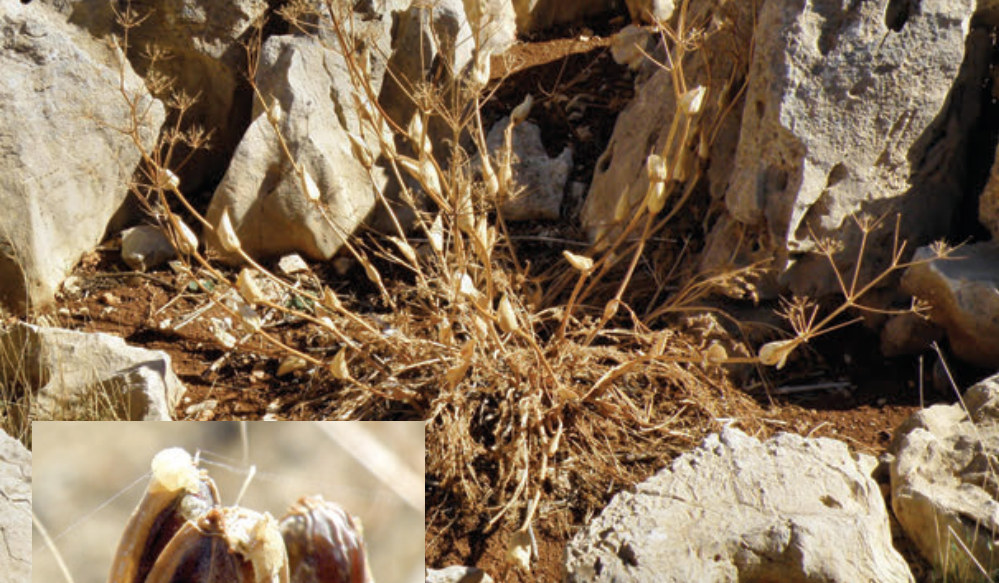
Plant name
Zallouh
Latin name
Ferula hermonis Boiss
Common names
Zallou', Rashsh al-Zallou', Shamar Abi al-Tayyib
foreign names
Eng. Sallua, Fr. Zallouh
The group
celery
Habitat and Geographic Distribution
Native to the mountain slopes of the Anti-Lebanon mountain range in Syria and Lebanon, at an altitude of over 2000 meters above sea level
Botanical description
M, branching, with branching occurring in the 1.5 mm section - a perennial herb whose upper part of the plant is arranged in whorls.
The leaves are glabrous, the lower ones bluish-green, generally ovate in shape, with broad bases of the petioles partially encircling the stem.
They are pinnately compound, with first-order lobes with thick petioles, and others that are thread-like, numerous, and branching at the apex.
The upper leaf blade is reduced pleurisally and almost pinched against the sheath, which becomes broad (exceeding the width of the central, thread-like, 8 mm) and embraces the stem.
The flowers are gathered in inflorescences composed of bracts with a wide, almost non-existent bracts.
The bracts are small, oblong, and ovoid.
The fruit is ovoid, about 5 mm long, dorsally compressed, flattened, with a thick margin.
Its dorsal ribs are of equal dimensions, thread-like, brown, and prominent, while the lateral ribs are close to the margin.
The plant has a strong odor and sometimes secretes small, orange resinous masses. It blooms from May to August.
Used part
Roots and rhizomes (collected in autumn), the resinous gum found in the rhizomes
chemical components
The roots contain a homogeneous mixture of resinous material, volatile oil, ferolic acid compounds, and gum.
The most important components of this mixture are: α-pinene ferulic acid, α-pinene, ferutinin, teferdin, α-bisabolol sesquiterpenes, azarinine, and carbene, in addition to 38% triterpene saponins and steroidal compounds.
Properties and medical uses
Zallou' is considered a stimulant and aphrodisiac.
Among its properties are stimulating the heart and nervous system, and aiding in cell regeneration.
Experiments conducted on male mice showed that the compounds ferutinin and teferdin raise the level of the hormone testosterone.
It was also observed that the compound teferdin increases the sexual abilities of male mice, while the compound ferutinin negatively affects the sex hormone in female mice and reduces their libido.
The Lebanese Society of Urology conducted several clinical trials on the plant's root, and the study concluded that the root of the plant contains elements that stimulate blood circulation, including ferulic acid, which dilates and activates blood vessels.
The volatile oil found in the roots, containing monoterpene and sesquiutespene compounds, exhibits high activity against Gram-positive bacteria such as Staphylococcus aureus and S.
fecalis.
The resin in the rhizomes also exhibits high efficacy against bacteria, particularly Gram-negative bacteria such as Salmonella typhi, Escherichia coli, and Pseudomonas aeruginosa.
The root of the plant is used traditionally for general weakness, as a tonic and stimulant for physical and sexual health, a nerve tonic, and in the treatment of asthma and whooping cough.
It is also used to expel gases that cause colic and to treat urinary tract diseases.
Furthermore, the root is believed to have benefits in delaying aging, strengthening hair, and promoting the regrowth of lost hair.
Ferula is available in the markets mixed with honey and royal jelly, in the form of capsules containing powdered ferula roots.
Side effects and precautions
Colon irritation has been observed with prolonged use.
Some users of the plant also experienced flushing and headaches due to its effect on stimulating blood circulation.
Doctors advise against using the plant's root for individuals with high blood pressure, heart disease, or diabetes, except under the supervision of a qualified physician.
the environment
The plant *Zalou3* grows in high mountainous regions, on highlands, slopes, and cold plateaus.
It thrives in humid and semi-humid environments where coolness or moderate temperatures are present, and it is a light-loving species.
It grows in agricultural lands and even rocky mountainous areas. It prefers moderately fertile, loose, and well-drained soils.
Agriculture and productivity
The plant is propagated by seed, and planting takes place in regular rows at the end of winter and the beginning of spring.
It flowers in spring, and the roots are collected in autumn and early winter and dried in the sun.
(Species: Foeniculum vulgare Mill., Anethum pannorium Roxb., Ligusticum foeniculum (L.) Crantz., Anethum dulce (Mill.) DC., Anethum foeniculum L., Anethum rupestre Salisb.)
History and Heritage
Any "carrying" refers to the use of the stem.
The scientific name of the genus is the ancient Latin poison of the plant, derived from its ancient role in maintaining, carrying, and transporting fire.
The scientific name of the species refers to its natural distribution in the Hermon Mountains of Syria.
The parts used are the roots and rhizomes (collected in autumn), and the resinous gum found in the rhizomes. Latin name: Ferula hermonis Boissus
Medical note
This information is for educational purposes only and does not constitute medical advice.
Poisonous or potent plants should only be used under the supervision of a qualified physician or pharmacist.
Related images


