Field horsetail | Medicinal plant in the Akhdar Encyclopedia
The plant possesses diuretic (potassium and flavonoid) and antispasmodic properties, and also has astringent and uric acid-lowering effects. It is used internally to treat edema, to cleanse the urinary tract in cases of infection, and to treat kidney and ureter stones. Externally, it is used to tre…
Plant name
Field horsetail
Latin name
Equisetum arvense L
Common names
Field horsetail, field broom
foreign names
Eng. Horse tail, Fr. Field horsetail
The group
horse tails
Habitat and Geographic Distribution
The plant's native habitat is Europe and Asia.
Botanical description
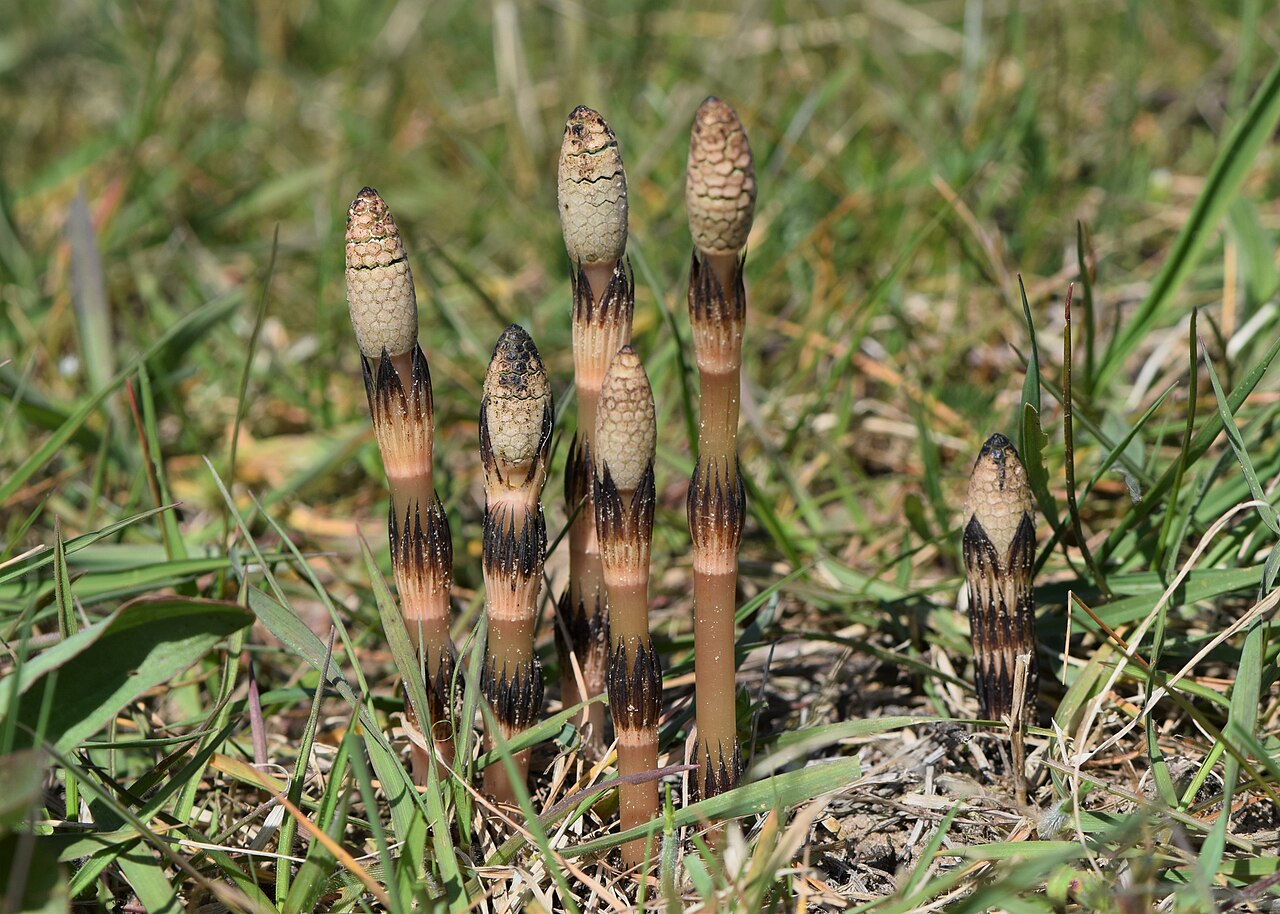
A perennial plant propagated by creeping rhizomes, brown to black in color, exhibiting two types of stems: in spring, fertile, erect, rigid, and short (35 cm), chlorophyll-free, unbranched stems appear, terminating in elongated spikes bearing numerous brown sporangia (35 cm).
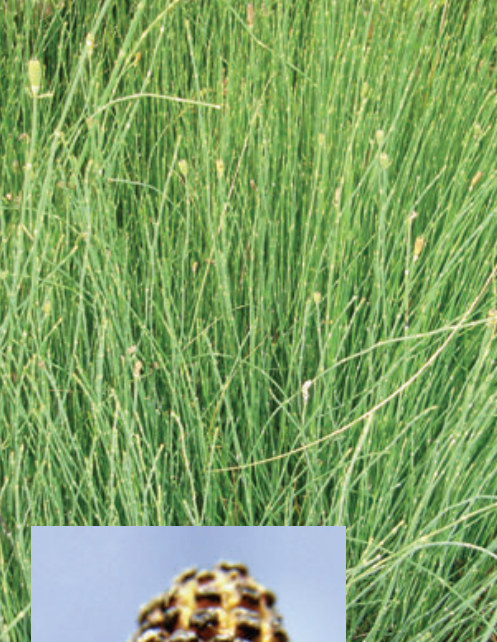
In summer, sterile branches grow, approximately 35 cm long and branched, with rotating branches.
The stem is hollow (with prominent longitudinal ribs), and lobed (possessing between 6 mm), composed of successive nodes and internodes.
35 - its thickness is 6 cm.
The internodes are located at the level of the nodes.
The internodes are 6 cm long, with a membranous sheath, its edges lined with brown teeth, triangular to uterine in shape, their number corresponding to the number of ribs, and they are equivalent to the leaves.
Flowering occurs from February to October. Other species in the genus include: *Equisetum marsh* (Equisetum maxima).
Used part
Flowering heads and herbaceous plant: Latin name: Equisetum arvense L
chemical components
Valvonoids (quercetol, kaempferol): Organic phenolic acids, including caffeic acid and gallic acid.
Valvones.
Traces of equisetonine.
Saponins (kaempferol, kaempferol, luteoline, luteolin glycosides, isoquercitoside, methoxypyridine, palustrine, palustrine, nicotine alkaloids, nicotine, mineral salts, including potassium chloride. 80% - Inorganic acids, including silicic acid
Properties and medical uses
The plant has diuretic properties (potassium and flavonoids), is an antispasmodic, and also has astringent and uric acid-lowering effects.
Horsetail is used to treat edema, to wash the urinary tract in cases of infection, and to treat kidney and ureter stones.
Externally, it is used to treat wounds and burns.
It is traditionally used to treat cancer, diarrhea, gout, rheumatism, mouth infections, nosebleeds, hemorrhoids, and fluid or urinary retention in elderly men with prostate enlargement (edema).
A decoction of the plant is used topically to treat stubborn skin lesions such as eczema and lupus (tuberculosis affecting the skin of the tip of the nose on both sides, causing ulceration).
It is also used as a gargle to treat tonsillitis, tooth decay, and bad breath.
This species has antibacterial effects against Gram-positive bacteria and may be a new treatment for diseases associated with hypertonicity, oxidative stress, and programmed cell death when administered in low doses.
It has an anti-inflammatory effect and has been added to toothpaste and mouthwashes to prevent gum disease.
Combining horsetail extracts with licorice root improves the development of new oral health products.
It aims to promote gum health and may enhance anti-inflammatory effects.
The nourishing properties of horsetail products for hair, bones, nails, and connective tissue have not been confirmed.
pharmaceutical forms
Horsetail is available as a liquid extract.
Side effects, interactions, and precautions: Possible side effects of horsetail include allergic reactions, fever, irregular heartbeat, mental impairment, impaired coordination, and weight loss.
Particular caution should be exercised when combining horsetail with diuretics and central nervous system stimulants.
It should be noted that the plant contains nicotine, and the use of large quantities may cause nicotine toxicity.
The plant should be avoided in patients with diabetes or who are ill. Other uses: It is used as a cleaner for vessels, furniture, and floors.
Side effects and precautions
Potential side effects of horsetail include allergic reactions, fever, irregular heartbeat, mental impairment, impaired coordination, and weight loss.
Particular caution should be exercised when combining horsetail with diuretics and central nervous system stimulants.
It should be noted that the plant contains nicotine, and consuming large quantities may cause nicotine toxicity.
This plant should be avoided by pregnant and breastfeeding women. Other uses include cleaning dishes, furniture, and floors.
the environment
The plant grows on riverbanks, marshes, damp meadows, forest edges, and damp, shady areas in temperate and warm regions of the world, with a suitable temperature range of 24°C to 30°C.
It can tolerate cold air.
Horsetail is a shade-tolerant species and prefers moist, fertile soils rich in organic matter.
Agriculture and productivity
It reproduces by rhizomes and spores (seeds), which germinate after 25-40 days.
Vegetative growth lasts 40-90 days, and flowering 90-120 days.
During its growth, the plant requires essential maintenance such as pruning (during dormancy), fertilization, hoeing, and weeding.
The plants mature in summer, and harvesting takes place in late summer and autumn by cutting the stems and shoots, bundling them, drying them, and storing them until use.
(Arbutus unedo L., Arbutus serratifolia Salisb., Arbutus unedo var. serratifolia Rouy)
History and Heritage
The name Equisetum, meaning "horsetail," is a translation of the genus's scientific name, meaning "long hair," referring to its resemblance to a horse's tail.
The suffix "-seta" means "horse" or "mare." This genus is a relic of prehistoric times, closely related to the trees that grew on Earth a million years ago, which are the source of the well-known coal seams.
The ancient Greeks used it to treat wounds.
It was mentioned by Antiochus, Ibn al-Baytar, and al-Ghassan.
Ibn Sina stated that horsetail is astringent, and its sap is very effective in stopping bleeding.
Medical note
This information is for educational purposes only and does not constitute medical advice.
Poisonous or potent plants should only be used under the supervision of a qualified physician or pharmacist.
Related images