Oleander | Medicinal plant in the Akhdar Encyclopedia
Oleander has a positive effect on myocardial contraction and a negative effect on cardiac chronometry. The cardenolide glycosides found in oleander have an effect similar to digitoxin, but are weaker, possibly due to the body's difficulty in absorbing these compounds. [The text abruptly ends here.]
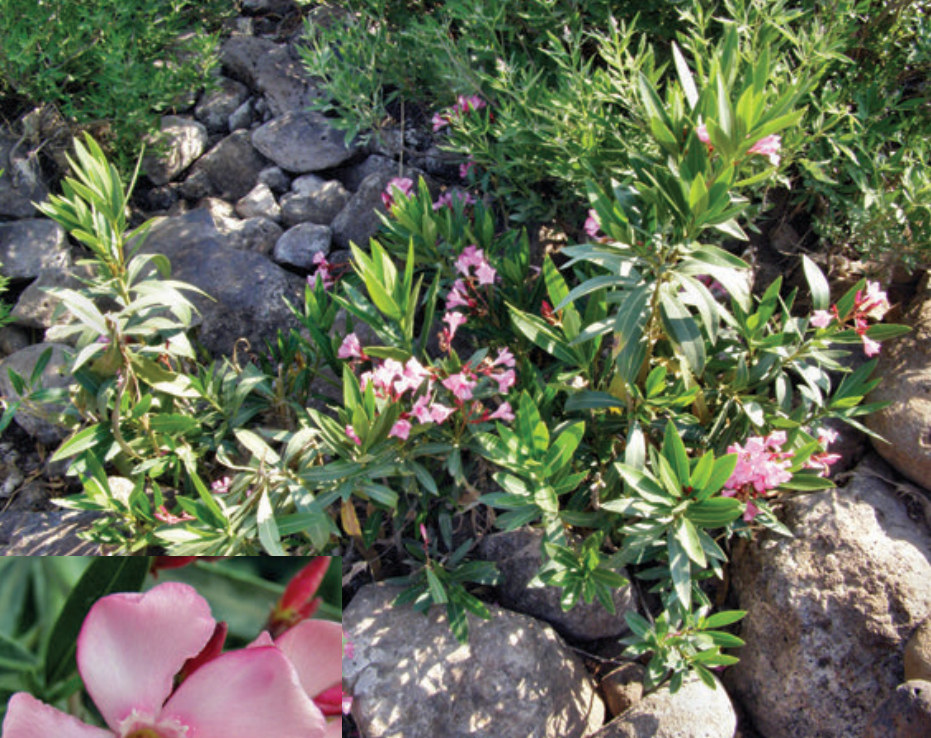
Plant name
Oleander
Latin name
Nerium oleander L
Common names
Oleander, oleander, donkey rose, donkey poison, H Bin, Alaa, Al-Tarish
foreign names
Eng. Rose laurel, Fr. Laurier - rose
The group
The Apocrypha
Habitat and Geographic Distribution
The Mediterranean basin is the native habitat of this species, where it grows naturally in Syria, Lebanon, Palestine, Jordan, Iraq, and Cyprus.
It also grows in other parts of the world, such as Japan and Korea. It is cultivated as an ornamental shrub in gardens and public streets.
Botanical description
M, semi-barren, 4 - evergreen shrub, secretory, with erect branches.
The leaves are pinnate (arrhytid: arranged in whorls of rhizomes, pointed, - cm, leathery, linear, 10 leaflets), about 4 cm long, with short petioles, and their undersides are covered with dense hairs.
The flowers are relatively large, gathered in terminal cymose inflorescences.
The calyx is divided into 5 cm, its telomes fused into a tube that suddenly widens and splits.
The corolla is white or pink, with lobes, linear, serrated edges.
The male has five stamens arranged in lobes, and around the mouth of the tube is a corona composed of 5 to 5 stamens.
On the corolla tube in the middle, the anthers are longer than the filaments, fused at the middle with the stigma, and their tips bear tendrils that intertwine.
The fruit consists of two fused follicles that separate at maturity.
The seeds are numerous, woolly, and their tips end in a cluster of hairs. Oleander blooms from spring to autumn.
Used part
The leaves are picked just before flowering.
chemical components
The leaves contain cardiotonic steroid glycosides from the cardenolide class, the most important of which are oleandroside and pregnane. They also contain neriumoside and nerigoside.
Properties and medical uses
Oleander has a positive effect on myocardial contraction and a negative effect on cardiac chronometry.
The cardenolide glycosides found in oleander are similar in effect to digitoxin, but weaker, possibly due to the body's difficulty in absorbing these compounds.
It is traditionally used to treat heart failure, heart rhythm disorders, and skin diseases.
In Indian medicine, the juice of the leaves is used topically to treat eye diseases, as well as hemorrhoids and scabies.
The crude flower extract possesses antimicrobial, anti-inflammatory, and anticancer properties with no known toxicity at typical doses.
Phenolic compounds extracted from oleander leaves have shown inhibition of colorectal cancer cell growth.
Side effects, interactions, and precautions: Oleander should not be used with quinidine, calcium salts, or glucocorticoids.
High doses can cause toxicity manifested by nausea, vomiting, diarrhea, and tachycardia.
Side effects and precautions
Oleander should not be used with quinidine, calcium anamides, or glucocorticoids.
High doses can cause toxicity manifested by nausea, vomiting, diarrhea, and tachycardia.
the environment
Oleander is naturally found on water scums, yet it tolerates drought.
It thrives in areas with moderate temperatures and high humidity.
While it is salt-tolerant, salt retention slows plant growth and results in high sodium and low potassium and calcium content in the leaves.
Cultivation and Productivity: The plant is propagated by stem cuttings collected during pruning.
Cuttings are planted in sloping beds in the nursery, or in pots or black plastic bags.
They can also be propagated by suckers, which are long cuttings, each containing a small section of the plant's stem called a heel, from which the mother plant can be propagated.
The cuttings or suckers are transplanted to the permanent location in the spring.
Agriculture and productivity
The plant is propagated by stem cuttings collected during pruning.
These cuttings are planted in slanted beds in the nursery, or in pots or black nylon bags.
It can also be propagated by suckers, which are long cuttings, each containing a small section of the mother plant's stem called a heel.
These cuttings or suckers are transplanted to their permanent location the following spring.
Vinca herbacea Waldst.
& Kit.
V.
libanotica Zucc., Vinca pumila E.D.
Clarke., Vinca sessilifolia A.DC., Vinca mixta Velen., Vinca herbacea subsp. libanotica (Zucc.) Bornm., Vinca bottae Jaub. & Spach
History and Heritage
It is the name of a similar plant, later adopted to designate this genus.
The scientific name for the genus, *Nerium oleander*, comes from the Greek word *Olea sp.*, meaning olive, due to the resemblance of its leaves to those of the olive tree.
This species is known for its extreme toxicity.
Ibn Sina and Ibn al-Baytar mentioned that oleander is beneficial for knee and back pain when applied as a poultice, and that inhaling its steam soothes toothache.
It is used metaphorically to describe bitterness, as in the saying, "Bitter as oleander." The part used is the leaves, harvested just before flowering. Its Latin name is *Nerium oleander* L.
Medical note
This information is for educational purposes only and does not constitute medical advice.
Poisonous or potent plants should only be used under the supervision of a qualified physician or pharmacist.
Related images


