Datura | A medicinal plant in the Akhdar encyclopedia
Datura is an ingredient in a large number of pharmaceutical preparations. Its properties are numerous and comparable to those of badonna and anesthetic. It is used against spasms, asthma, acute rheumatism, neuralgia, hiccuping coughs, and nocturnal enuresis, either as an infusion, tincture, extract…
Plant name
The dia
Latin name
Datura stramonium L
Common names
The dia
foreign names
Eng. Thornapple, Fr. Stramoine, atura
The group
eggplant
Habitat and Geographic Distribution
Europe, Asia, and North Africa.
It is found throughout the world.
It is present in the Americas.
It is also found in many scattered locations in the Arabian Peninsula and in Syria.
Botanical description
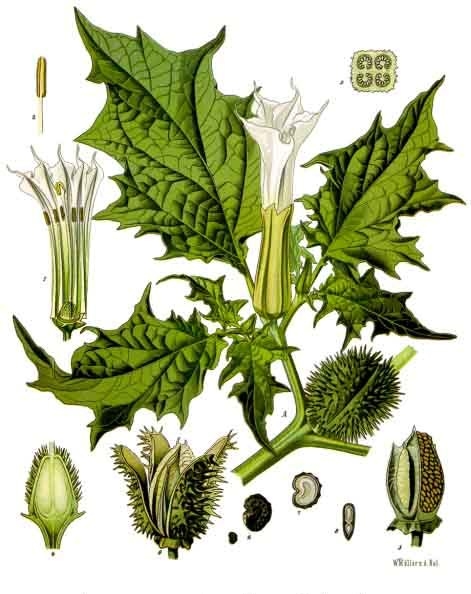
100 cm, hairless or slightly stubby - summer-flowering perennial herb, long downy, Akhdar.
Stem erect, sturdy, smooth, branching near the soil surface.
Leaves simple, long-petioled, semi-hairless, ovate, acute apex or 20 - toothed margin, 2 cm long, apex lobed.
Flowers solitary, axillary, erect.
Calyx tubular, 2 cm, lobes triangular, apex.
Length increases towards the base with the fruit.
Corolla white, funnel-shaped, twice the length of the calyx, lobes five ovate, acuminate.
Male: five stamens, set at the base of the corolla, equal in length, enclosed in the corolla.
Female: two carpels, ovary superior, bisectoral.
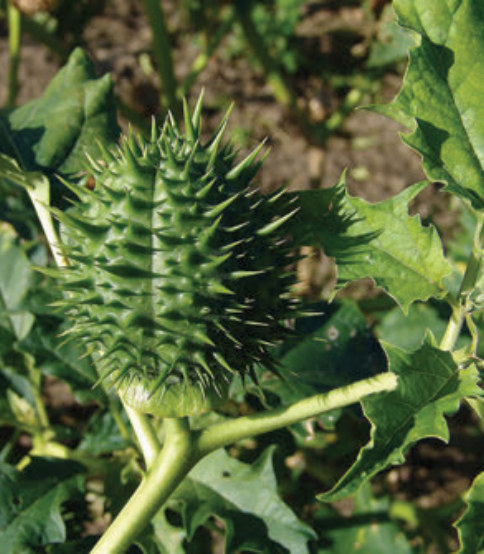
Fruit, 2 cm, 4 - ovoid capsule, 2 valves long.
Erect, spiny, kidney-shaped, black, perforated seeds. Flowering from May/July to Tuesday/November.
Used part
The aerial parts, leaves, and sometimes seeds
chemical components
The plant contains alkaloids, reaching up to 0.36% in the leaves and a maximum of 0.66% in the fruits.
The main alkaloids are hyoscyamine and scopolamine, in addition to apotropine, atropine, badonine, and hyoscyamine oxide.
Scopolamine is more abundant than hyoscyamine in older leaves, while hyoscyamine is more abundant than scopolamine in young leaves.
It also contains ethanolides, lectins, peptides, and coumarins.
It also contains the following compounds: scopoletin, hyoscyamilactol, N-trans-feruloyltryptamine, daturadiol, daturaolone, umckali-ferrulicasyl-tyramine, cleomycosin A, frexetin, 1-acetyl-7-hydroxy-beta-carbol-N, and 7-hydroxy-beta-carbolyl-propionic acid (21).
It contains the alkaloids hyoscyamine and hyoscine, atropine, and other tropane alkaloids, in addition to proteins and lipids.
All parts of the plant contain tropane alkaloids.
The average total alkaloid content in the stem is 0.24 0.06% in the body, 0.27-0.12% in the roots, 1.9-0.13% in the flowers, 0.22-0.08% in the seeds, and 0.37-0.25% in the leaves.
Properties and medical uses
Datura is an ingredient in a large number of pharmaceutical preparations.
Its properties are numerous and comparable to those of badonna and henbane.
It is used against spasms, asthma, acute rheumatism, neuralgia, hiccuping cough, and nocturnal enuresis, either as an infusion, tincture, extract, or smoke.
Currently, it is used against nocturnal asthma and shortness of breath in tuberculosis patients.
Datura is used for paralysis and cerebral palsy, relieving the injury and additional symptoms except for tremors.
It is also used in chronic rheumatic diseases and acute rheumatoid arthritis.
It is used to treat fever, expel worms, and treat skin diseases and indigestion.
pharmaceutical forms
Its properties are numerous, comparable to those of datura and henbane.
It is used against spasms, asthma, acute rheumatism, neuralgia, hiccupying cough, and nocturnal enuresis, either as an infusion, tincture, extract, or smoke.
It is currently used against nocturnal asthma and dyspnea in tuberculosis patients.
Datura is used for paralysis and cerebral palsy, alleviating the pain and additional symptoms except for tremors, as well as for chronic rheumatic diseases and acute rheumatic arthritis.
It is used to treat fever, expel worms, and treat skin diseases and indigestion.
Side effects and precautions
Datura is a highly poisonous plant; its leaves, seeds, and roots can poison humans and animals, causing headaches, nausea, intense thirst, itching, burning skin, severe delirium, vision loss, involuntary movements, and then severe disturbances that may lead to death. It can also sometimes cause mental illnesses such as dementia and insanity.
the environment
The plant grows near dwellings, roadsides, and in damp places, and is cultivated for medicinal use.
Agriculture and productivity
The best time to plant datura is early spring.
Sowing is done by broadcasting or wintering, and soaking the seeds is recommended to break dormancy.
It was observed that soaking datura seeds in a 200 ppm KNO3 solution for 15 minutes improves germination by 30%.
Soaking the seeds in a 200 ppm Cytosine solution also increased plant height, number of leaves, stem branching, and the dry and fresh weight of its various parts.
Soaking in a 400 ppm Cytosine solution also yielded positive results.
This leads to an increase in the percentage of chlorophyll A and B, carotene, nitrogen, crude protein, and alkaloids in the vegetative mass.
When propagating by seedlings, the seeds are scattered in the nursery bed about a month and a half before transplanting.
Transplanting is done with watering, in rows with a spacing of 75 cm between rows and 50 cm between seedlings in the same row.
One hectare requires 2.5-5 kg of seeds for broadcast sowing, or 25,000-30,000 seedlings can be obtained from 600-800 grams of seeds.
Seeds germinate in less than two weeks when the soil temperature is 27°C.
Two weeks after transplanting, the empty planting holes are filled in.
Water is applied after the initial irrigation, at a rate of once every one to two weeks, depending on the soil type, its water retention capacity, and the ambient temperature.
This plant is nitrogen-loving due to its importance in the formation of alkaloid compounds.
Approximately 75 kg of nitrogen, phosphorus, and 45 kg of potassium are added per hectare, half at planting and the other half during thinning.
(Hyoscyamus muticus L., Hyoscyamus datora Forssk., Scopolia mutica L., Dunal., Hyoscyamus boveanus Dunal, Asch. & Schweinf)
History and Heritage
The scientific name of the genus is mentioned in the previous section.
As for the descriptive name of the species, stramonium, it is likely that the word is of Greek origin, referring to a region in Greece.
It has been suggested that the genus name Datura is derived from dhatura, the Bengali name for the plant, meaning "caution," and that the species name stramonium is of Greek origin, composed of two words: strychnos, referring to the gooseberry plant, and makinos, meaning "mad," due to the plant's narcotic properties.
In Algeria, it is called the "tree of hell," and Ibn al-Baytar calls it "inclined walnut," also known as "Jawz Rabb." It is commonly known as the "marqad" tree in Andalusia and Morocco.
Al-Antaki stated that "inclined walnut is what is known as 'marqad' among the people of the Iqal," and the people of Egypt call it datura.
Ibn Sina mentioned that inclined walnut is a narcotic poison similar to walnuts, and al-Ghassani, famously known as al-Wazir, called it "banj," also known as "al-sakran" (the drunkard).
The Bohemians used datura for narcotic purposes.
In 1762, the scientist Stoerck was able to incorporate the Datura plant, famous for its toxicity, into the composition of some medicinal substances to treat certain diseases such as pemphigus, convulsions, seizures, and mental disorders.
Medical note
This information is for educational purposes only and does not constitute medical advice.
Poisonous or potent plants should only be used under the supervision of a qualified physician or pharmacist.
Related images