Datura | A medicinal plant in the Akhdar encyclopedia
The pharmacological activities are attributed to the presence of the alkaloid hyoscyamine and its derivative, atropine, in addition to the alkaloid scopolamine. These alkaloids, with parasympathicolytic effects on acetylcholine receptors, possess muscarinic and acetylcholine-dissolving activity, as…
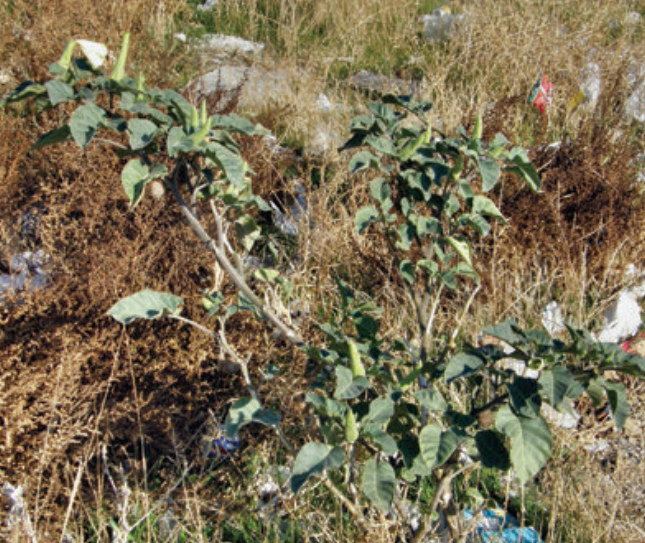
Plant name
The dia
Latin name
Datura metel L
Common names
Datura, slanted walnut
foreign names
Eng. Hindu datura, Jimson weed, Fr. rules
The group
eggplant
Habitat and Geographic Distribution
Native to South America, it is cultivated in North Africa, India, and some European countries.
It is widely found in Asia, Africa, England, and other tropical and subtropical regions, from Texas to Colombia.
Botanical description
A 1.5 m herbaceous plant reaching a height of [insert height here] and is grayish-hairy.
The leaves are ovate to lanceolate with crenate serrations.
The flowers are white to off-white, tinged with purple, [insert length here] cm.
The fruits are ovate with short spines, [insert length here] cm, opening grayishly to a uniform diameter.
Used part
The aerial parts, especially flowers
chemical components
Alongside it are hyoscyamine and scopolamin, the most important of which are: scopolamin (0.8%), alkaloids that reach their highest concentrations in flowers; daturalinol with ametelin; and daturamethylin, including: daturalinol with ametelin; hyoscyamine; daturamethylin; and the compound daturamethylinol with ametelin.
Properties and medical uses
The pharmacological activities are attributed to the presence of the alkaloids hyoscyamine and its derivative, atropine, in addition to the alkaloid scopolamine.
These alkaloids, with their parasympathicolytic effects on acetylcholine receptors, possess muscarinic and acetylcholine-reducing activity, as well as centrally stimulating and inhibiting acetylcholine release.
Hyoscyamine and atropine have centrally acting effects.
Scopolamine's inhibitory effect on secretion is stronger than that of atropine or hyoscyamine, while scopolamine's effect is stronger than that of both atropine and hyoscyamine.
The drug is highly potent whether administered orally or by inhalation.
It generally has a smooth muscle relaxant effect, reduces oral secretions, and exhibits a tachycardic and central sedative effect, particularly in cases of impaired concentration.
The plant is popularly used to treat muscle spasms, as a pupil dilator, and in the treatment of whooping cough, asthma, Parkinson's disease, and to relax the muscles of the urinary, digestive, and bronchial tracts.
pharmaceutical forms
Datura preparations are available in oral and suppository forms.
Some people inhale it in cigarettes, while others burn it into a powder and inhale the fumes.
Side effects, interactions, and precautions: Side effects include blurred vision, difficulty swallowing and speaking, dilated pupils, dry and hot skin, redness or flushing of the skin, fever, symptoms of hypertension such as headache, symptoms of hypotension such as dizziness and weakness, mental disturbances, confusion, memory impairment, visual and auditory hallucinations, respiratory distress, muscle weakness, rapid pulse, thirst, photophobia, and water retention.
Ingestion of large quantities of the plant can cause coma, complications, respiratory failure, and cardiac arrest.
Ingestion of the seeds can cause poisoning or death.
The drug should not be taken in large quantities.
It should also be taken with caution in certain situations, including: antihistamines used to treat coughs, allergies, and hay fever; other levodopas that interact with atropine and levofloxacin; anticholinergics such as atropine; Norpace levodopa medications such as nitrazepam; phenothiazines used for anxiety, nausea, vomiting, and other mental disorders; thiazide diuretics such as Qunaglute dura tabs, Symmetrel SR procain, and torazepam; long-acting rheumatic drugs such as natrotin, diuryl, methadone, and tricyclic antidepressants.
The plant should be avoided in patients with glaucoma, tachycardia, hyperthyroidism, urinary or gastrointestinal obstruction, and myasthenia gravis.
Side effects and precautions
Side effects include blurred vision, difficulty swallowing, dilated pupils, dry, hot, red, or flushed skin, fever, symptoms of hypertension such as headache, symptoms of hypotension such as dizziness and weakness, mental disturbances, confusion, memory impairment, visual and auditory hallucinations, psychological confusion, muscle weakness, rapid pulse, thirst, sensitivity to light, and urinary retention.
Ingestion of large quantities of the plant can cause coma, seizures, respiratory failure, relaxation of the cardiovascular muscle, and sometimes death.
Consuming 50-100 seeds can cause poisoning or death.
This drug should not be taken with antihistamines used to treat coughs, allergies, and hay fever, with levodopa (Norpace), anticholinergics such as atropine, or other drugs that interact with atropine and levofloxacin, such as nitrazepam.
Phenothiazines, used for anxiety, nausea, vomiting, and psychiatric disorders, such as Torazine, prolonged procaine (Symmetrel SR), Qunaglute dura tabs, and procaine, as well as thiazide diuretics like Natrotin, Diuril, and Metahydrin, and tricyclic antidepressants, should be avoided.
The plant should be avoided by pregnant or breastfeeding women and is contraindicated in cases of glaucoma, tachycardia, hyperthyroidism, urinary or gastrointestinal obstruction, and myasthenia gravis.
Other uses
An ornamental plant, pesticide, and insect repellent, used
the environment
The plant grows in warm regions, preferring humid soils with moderate acidity.
Agriculture and productivity
The plant is propagated by seeds; it is best to soak them for 21 hours in warm water before sowing. They can be planted.
History and Heritage
Datura is an Arabicized word of Sanskrit origin, and the scientific name is derived from the Arabicized form.
The adjective (2009) is similar to the Arabic word (metel), which refers to the thorny datura, called the "tree of hell" in Algeria.
Ibn al-Baytar called it "inclined walnut" and also "the walnut of the Lord," describing it as "the tree of the grave" among the people of Andalusia and Morocco.
He noted that it grows tall, its leaves are like those of the eggplant, but are softer and smoother, and it has a large white flower...
Al-Antaki stated that "the inclined walnut is known as the 'marqad,' and the people of Marrakesh call it datura.
It is a plant, distinct from the eggplant, and it grows in riverbeds and mountains.
It has a white flower and green husks...
and the variety found in hot countries is more potent.
The part used is the seed located inside the nut." Ibn Sina also mentioned it.
Al-Ghassan ibn al-Shahri, known as al-Wazir, called it "banj" and it is also known as "al-sakran."
Medical note
This information is for educational purposes only and does not constitute medical advice.
Poisonous or potent plants should only be used under the supervision of a qualified physician or pharmacist.
Related images


