Wall poppy | Medicinal plant in the Akhdar encyclopedia
A decoction of the flowers of the *Philadelium* is used for its calming and soothing properties, and to help reduce nervous hyperactivity and insomnia. It is also used for respiratory disorders and sleep disturbances in children and adults (the alkaloid rhoeadine is an expectorant and helps treat c…
Plant name
wall poppy
Latin name
Papaver rhoeas L
Common names
Wall poppy, scattered poppy, anemone
foreign names
English: Corn poppy, French: Coquelicot
The group
poppy
Habitat and Geographic Distribution
Europe, the eastern Mediterranean countries, and North Africa
Botanical description
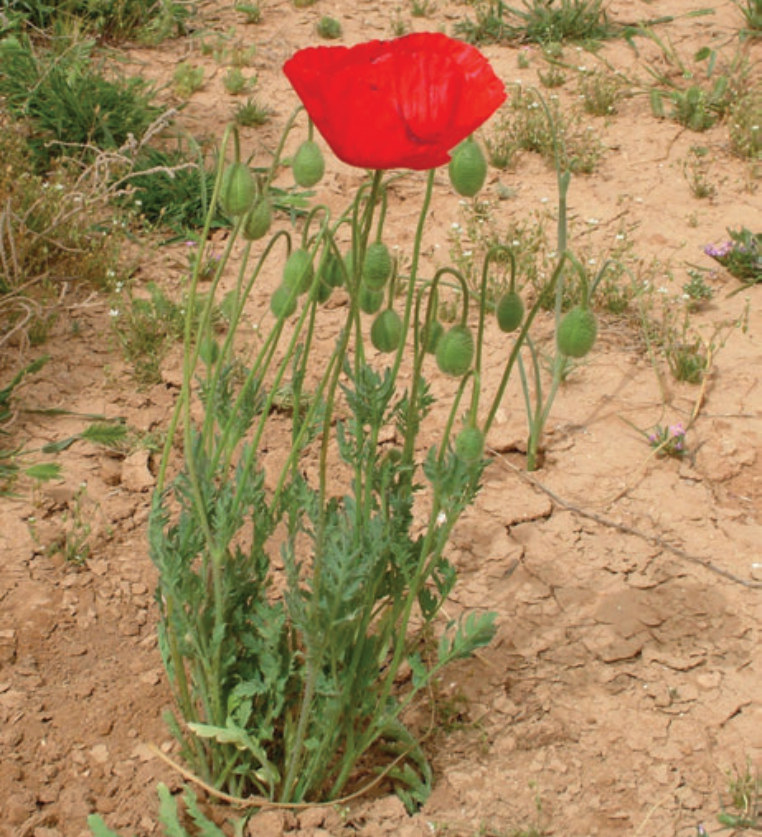
The stem is simple or branched, erect.
The leaves are of varying shapes, usually medium or deeply lobed, and rarely nearly complete.
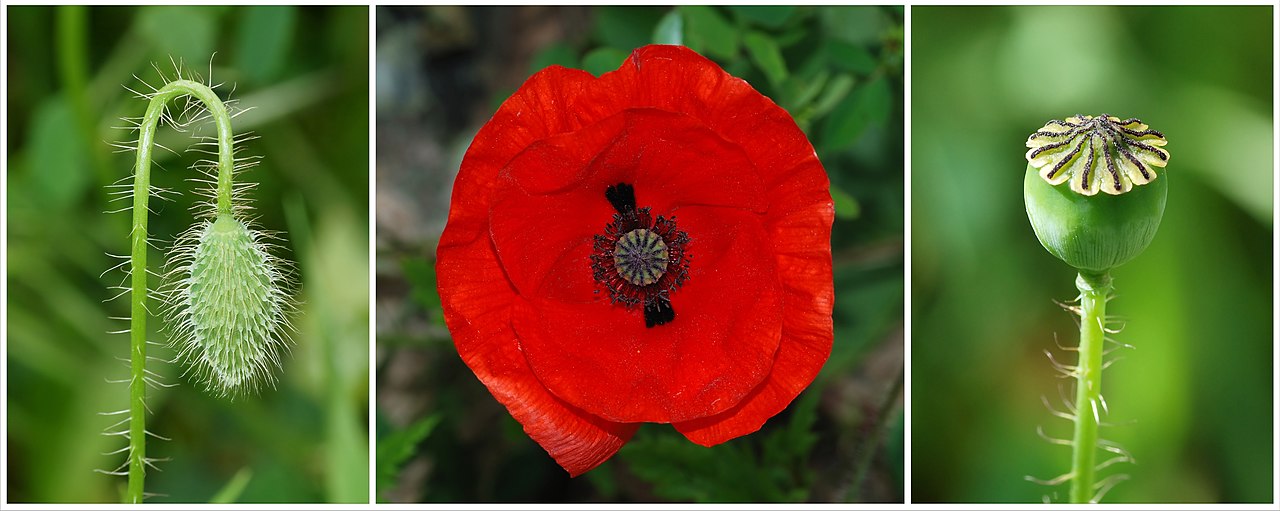
The flowers are oblong in diameter, covered with hairy hairs.
The calyx has two sepals, is hairy, and falls quickly.
They then become fully erect before opening, are ovate, rounded to elliptical, red with a black spot at their base.
The male corolla has many stamens.
The female is composed of several carpels that form a segmented ovary with indistinct septa, thus it is considered a solitary stamen.
Above it are radially arranged stigmas that form a stigma disc (patterns are absent).
The fruit is a capsule, bluish-green, rounded to oblong-spherical or obovate, with a flattened stigma that exceeds the capsule's diameter by approximately 1 cm.
Its lobes are rounded, overlapping each other with their edges.
The capsule opens through small perforations located beneath the stigma.
The seeds are small and numerous, dispersed outside the capsule by wind. Flowering occurs from March to June.
Used part
Flower bits (dry carefully, as they spoil quickly) and seeds. Chemical components contain the bits.
chemical components
The most important components of the flowers are: rhoeadine (1%), isoquinoline alkaloids (including isocorydine, coptisine, rhoeagenine, isorhoeadine, cyanine, mecocyanin, anthocyanin pigments, quercetin flavonoids, quercetin glycosides, meconic acid, and tannic acid), and mucilages (salivary or gelatinous substances).
Properties and medical uses
A decoction of the flowers of the *Philadelium* is used for its calming and soothing properties, and to help reduce nervous hyperactivity and insomnia.
It is also used for respiratory disorders and sleep disturbances in children and adults (the alkaloid rhoeadine is an expectorant and helps treat coughs and asthma; it is mucolytic).
In folk medicine, the flowers of the *Philadelium* are used for their diaphoretic and antipyretic properties.
Side effects and precautions
Allergic reactions or drug interactions may occur; self-use should be avoided by pregnant and breastfeeding women, children, and patients with chronic diseases.
the environment
The common poppy is found in fallow land and agricultural fields.
It can be cultivated from the equator to the north.
Its seeds are delicate and require a warm climate to germinate.
The poppy is a day-loving plant. It needs humus-rich soil and thrives in calcium-rich soil.
Agriculture and productivity
Poppies are cultivated as a winter crop in warm regions or a summer crop in cold regions, using either direct sowing or transplanting.
Direct sowing is done in broadcast beds or in rows spaced 30-40 cm apart.
When planting by transplanting, the land is marked out into rows 50 cm apart, and seedlings are planted 40 cm apart within each row.
Transplanting to the permanent field is done when the seedlings have 3-4 leaves. (Pinus spp.)
History and Heritage
The name "pappa" comes from the Latin "papaver," and its genus name means "food" or "milk," referring to the milky sap that flows from the plant's rhoeas.
The species name is Greek and means "red," referring to the color of the flowers.
Medical note
This information is for educational purposes only and does not constitute medical advice.
Poisonous or potent plants should only be used under the supervision of a qualified physician or pharmacist.
Related images