Khreiniba | A medicinal plant in the Akhdar encyclopedia
Research has shown moderate to weak efficacy of the aqueous extract of the aerobic parts against some types of bacteria and fungi that cause certain skin diseases. A decoction of the leaves is used traditionally to treat kidney stones and lower blood sugar. A decoction of the leaves, flowers, and f…
Plant name
Khreiniba
Latin name
Prosopis farcta (Banks et Sol.) Macbride,
Common names
Khreiniba, goat carob, yenbut, arak, sheeshalen
foreign names
Eng. Syrian mesquite,Mesquite
The group
Acacia (Fabaceae)
Habitat and Geographic Distribution
Touraine, extending to the Mediterranean region - Iran and the Arabian Sahara
Botanical description
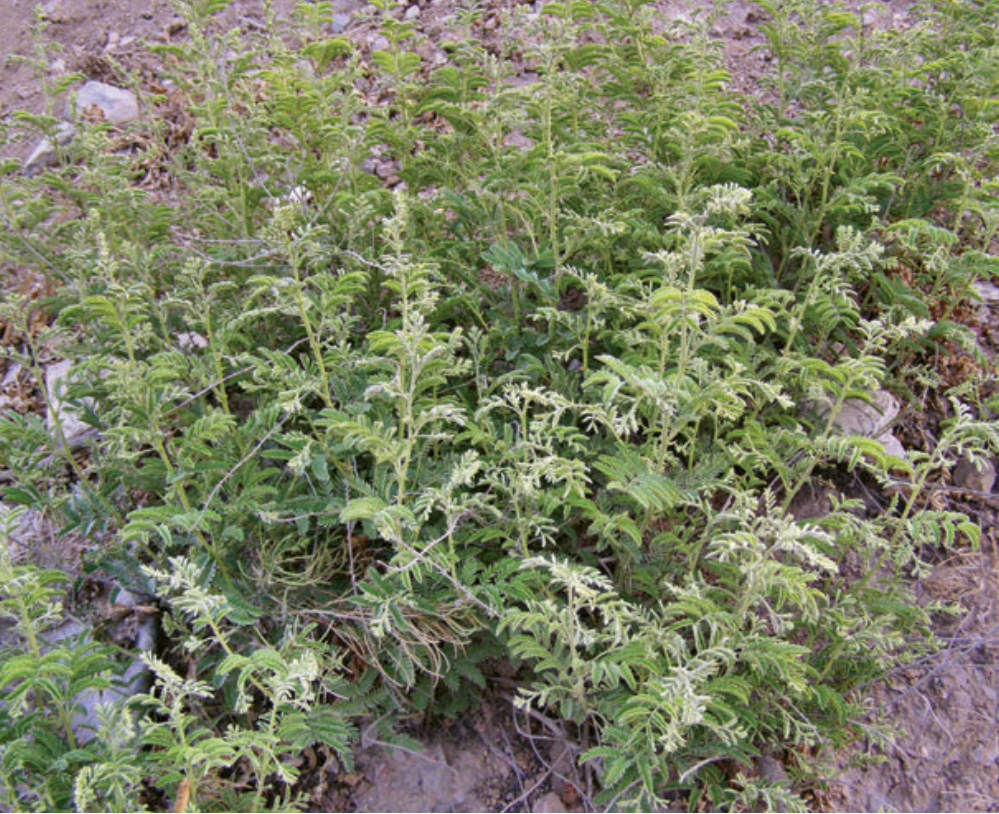
The shrub is 100 cm long and 100 cm long, branching from the base and propagating via bare roots.
The roots and rhizomes are slender, thorny, and young.
They extend deep into the root system, reaching 1 cm in length, and are generally ovate in shape, with the main axis bearing hairs.
The leaves are bipinnately compound, with up to two pairs of leaflets.
The leaflet is semi-plying, and there are 15 pairs of secondary axils, each bearing 7 mm.
The stipules fall off quickly.
The flowers are gathered in 2 x 7 cm oblong, pointed-ape, covered with short hairs, and measuring 1 cm.
The flower has a short peduncle and is hermaphroditic.
The calyx has five teeth.
The inflorescences are spike-like, axillary, and about 100 cm long.
The stamens are free, slightly protruding from the corolla, and pale yellow.
Male 5 - Female corolla is single-carpeled, and the ovary is superior.
The fruit is 3-1 x 5-2 cm, an unopened pod, ovoid in shape, turning dark brown when ripe.
The middle pericarp is spongy.
The seeds are compressed, few in number, and dark brown. Flowering occurs from April to August.
Used part
Leaves, fruit, and seeds. Latin name: Melilotus officinalis (L.) Lam. Trifolium melilotus officinalis L
chemical components
Phenolic compounds, volatile compounds, sugars (glucose, fructose, sucrose, etc.).
Luteolin 7-O-glucoside: Valvoline glycosides.
Myricetin, rutin, isovitexin, vitexin, etc.
Organic acids including: oxalic, malic, certic, tartaric.
Moisture (saliva), especially in the seeds.
The seeds also contain tannins and fatty oil composed of unsaturated fatty acids (oleic, linoleic, linolenic) and saturated fatty acids (palm).
Properties and medical uses
Research has shown moderate to weak efficacy of the aqueous extract of the aerobic parts against some types of bacteria and fungi that cause certain skin diseases.
A decoction of the leaves is used traditionally to treat kidney stones and lower blood sugar.
A decoction of the leaves, flowers, and fruit is also used as an expectorant, to treat rheumatism, and for insect bites.
The pods and seeds possess astringent properties (tannins) and are used to treat diarrhea.
Aqueous and alcoholic extracts of the leaves and fruits are used against cutaneous leishmaniasis caused by Leishmania major, compared to current reference drugs (glucantime).
Side effects and precautions
Allergic reactions or drug interactions may occur; self-use should be avoided by pregnant and breastfeeding women, children, and patients with chronic diseases.
Other uses
Tannins extracted from plants are used in leather tanning.
the environment
The plant spreads on warm, sunny, loamy, saline soils in neglected places, valleys, lowlands, and neglected field walls, whether in the valleys or near the shores.
Agriculture and productivity
An invasive plant that can become a difficult-to-eradicate pest in agricultural lands, it reproduces via adventitious roots that arise at the base of the stem and via rhizomes.
Retama raetam (Forssk.) Webb & Berthel.
Lygos raetam (Forsskal) Heywood Genista raetam Forssk., Lygos raetam (Forssk.) Heywood, Spartium raetam (Forssk.) Spach
History and Heritage
The Arabic word for carob is خرينيبة, a diminutive form of خرونوب, referring to the similarity of the fruits to it.
Medical note
This information is for educational purposes only and does not constitute medical advice.
Poisonous or potent plants should only be used under the supervision of a qualified physician or pharmacist.
Related images


