Carob | Medicinal plant in the Akhdar Encyclopedia
The infusion of the fruit pulp is used for its laxative properties and is beneficial in reducing coughs. It is also used to treat colitis, diarrhea caused by Salmonella bacteria or viruses, especially in acetonemic cases, and hyperacetoneemia in infants and children, thus reducing water loss associ…
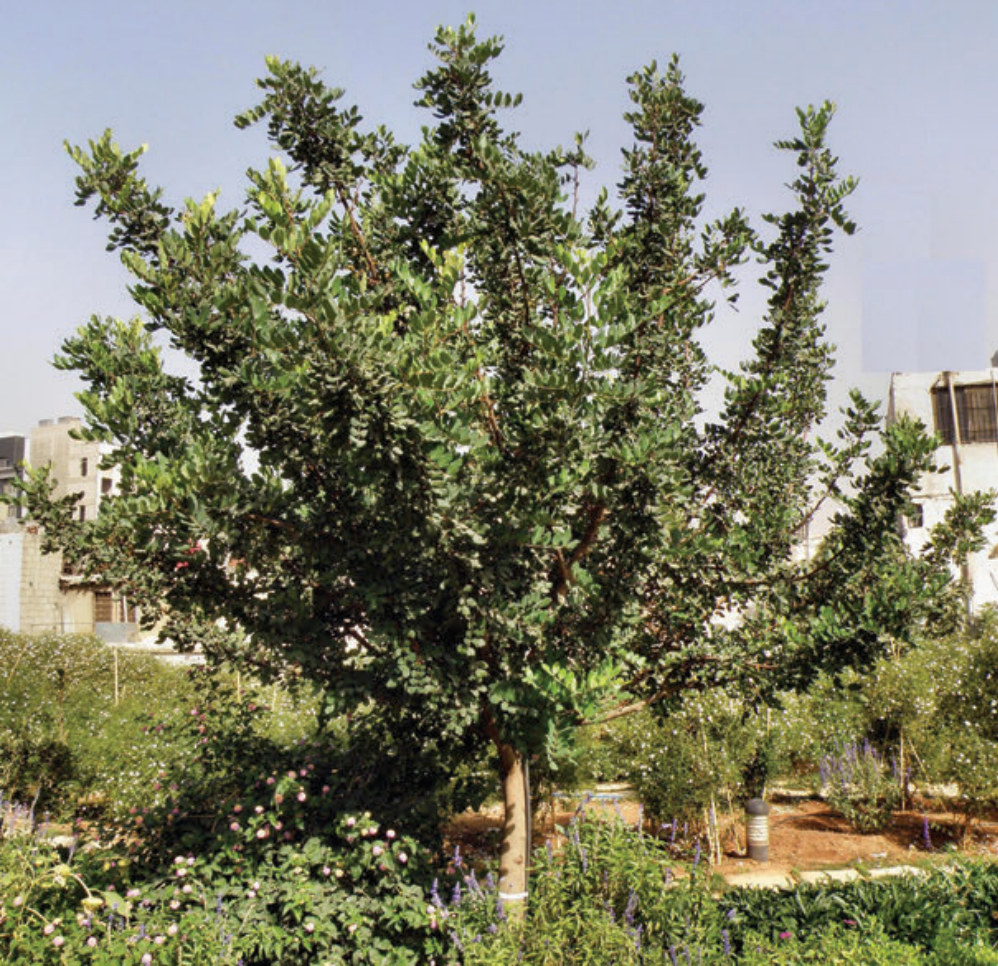
Plant name
carob
Latin name
Ceratonia siliqua L
Common names
Carob, locust
foreign names
Eng. Carob, Fr. Caroubier
The group
Sesalpinia (Fabaceae)
Habitat and Geographic Distribution
Native to the Mediterranean region.
It occurs naturally in the Eastern Mediterranean countries, including Syria, Lebanon, Palestine, Cyprus, Jordan, Cyprus, and extending to Turkey, Southern Europe, and North Africa.
Several cultivated, high-yielding varieties are widespread in many parts of the world (America, Australia, South Africa, and the Mediterranean region).
Botanical description
The branches are curved and zigzagging, and the crown is spherical.
The leaves are compound, 10 cm long.
The leaflets are oblong-ovate, dull or 25 cm long, pinnately paired, and 5 cm long.
The inflorescence is racemose, axillary, cylindrical, erect, solitary, or in clusters.
The flowers are unisexual, small, with stamens ranging in color from reddish-yellow to Akhdar.
The calyx is five-toothed.
The corolla is absent.
The male part of the flower is composed of a single carpel, and the ovary is superior, thick, and oblique.
The pod is linear, straight or slightly curved, 1 cm long, and about 3 cm thick and rough: 30 mm in diameter, containing numerous seeds, and is purplish-brown in color.
It stands erect when ripe.
The seeds are flat and slightly convex, separated by septa of sweet-tasting pulp.
Pods form at the end of summer and the beginning of autumn. Flowering occurs from August to November.
Used part
The pods or fruits (the pulp of the fruits) and the seeds that give a white powder called "carob gum".
chemical components
The fruit pulp contains sugars (70%) (sucrose, fructose, xylenose, and ceratose), mucilage (2-3%), pectins, flavonoids (schaftoside, neoschaftoside, isosschaftoside), proteins, and parabutyric acid (responsible for the pulp's distinctive flavor).
Properties and medical uses
The infusion of the fruit pulp is used for its laxative properties and is beneficial in reducing coughs.
It is also used to treat colitis, diarrhea caused by Salmonella bacteria or viruses, especially in acetonemic cases, and hyperacetoneemia in infants and children.
It reduces water loss associated with diarrhea, which leads to a loss of body salts.
Studies have shown that carob gum regulates blood sugar and lowers blood lipids by activating digestive enzymes and increasing the viscosity of digestive juices.
Carob gum is used to reduce blood clotting and is included in weight-loss diets.
It is also used in many food industries and pharmaceutical preparations due to its antiviral properties and its ability to cleanse the intestines of toxins and harmful secretions, as well as neutralize their acidity.
Carob seeds are used to make flour that is used to make bread beneficial in treating vomiting in pregnant women and infants. It is also used to treat malabsorption caused by gluten found in regular bread.
Side effects and precautions
Allergic reactions or drug interactions may occur; self-use should be avoided by pregnant and breastfeeding women, children, and patients with chronic diseases.
Other uses
The fruit pulp is used for its sweet and nutritious taste; it is mixed with nuts, and a type of chocolate has been made from it.
the environment
Carob trees are sensitive to frost, especially during the young planting stage.
They struggle to tolerate temperatures as low as -5°C to -4°C, and their fruits drop at temperatures below -7°C, becoming soft and succulent.
The plant's tolerance to low temperatures increases with age.
Carob trees need sunny locations and are resistant to hot summer winds, high temperatures, dry air, and desert climates.
They are drought-tolerant and grow better when water is available.
Carob trees tolerate calcareous and sulfate soils and are recommended for planting in these soils in temperate regions.
However, excessive lime can cause yellowing of the leaves due to iron deficiency, hindering successful cultivation.
They can also survive in relatively saline soils, but they are susceptible to waterlogged, poorly drained soils.
Carob trees thrive in poorly aerated soils and respond well to nitrogen fertilization because their roots are not capable of fixing atmospheric nitrogen.
Agriculture and productivity
Carob is propagated by seeds.
It can also be propagated by budding, but it is difficult to propagate by cuttings.
Seedlings are transferred from the nursery to the permanent ground after grafting them with buds taken from hermaphrodite trees, at one year old, and at a height between 90-120 cm.
Trees are trained in the first years of their life with 4-5 branches distributed regularly around the main axis.
In subsequent years, this is followed by thinning the dense and crowded shoots and cutting off diseased and dry branches throughout the tree's life.
Good training helps in the regularity of the yield.
The tree begins to bear fruit at 15-20 years of age.
Female trees bear fruit every two years (biennial bearing), and in this case, it is necessary to ensure that male trees are near the female trees for pollination and fertilization.
Glycyrrhiza glabra L.
G.
glandulifera Waldst.
et Kit., G.
hirsute Pall., alalensis X.Y.Li. alaschanica Grankina, brachycarpa Boiss., echinata Lepech
History and Heritage
The genus name Ceratonia comes from the Greek word meaning "horn," derived from Kèras of Kerâtonia siliqua, whose fruit is a pod.
The descriptive name for the species also means "horn," referring to the poisonous altin of the carob pod.
It was cultivated in the Mediterranean region long before the Greeks, and its benefits and uses were known to the Mediterranean people, as Ibn Sina mentioned it as an astringent.
Its seeds were used by the ancients as a unit of weight (it is said to be the origin of the carat used to weigh precious stones).
Medical note
This information is for educational purposes only and does not constitute medical advice.
Poisonous or potent plants should only be used under the supervision of a qualified physician or pharmacist.
Related images


