Marshmallow | Medicinal plant in the Akhdar Encyclopedia
The medicinal value of the plant stems from its mucilaginous properties, which protect against irritation of the mucous membranes. Preparations made from the roots of the plant *Acrimus dalkhia* are used as a soothing and laxative agent, in addition to neutralizing stomach acid and being beneficial…
Plant name
Seal
Latin name
Althaea officinalis L
Common names
Marshmallow, common mallow, hollyhock, sweet herb, healing herb
foreign names
Eng. Marshmallow, Fr. Guimauve
The group
bakery
Habitat and Geographic Distribution
European-Siberian, Mediterranean, Iranian-Turanian.
The plant is widespread in Syria, Lebanon, Palestine, Jordan, and most of Europe except for the northern regions. It is also found in North Africa, Iran, and Afghanistan.
Botanical description
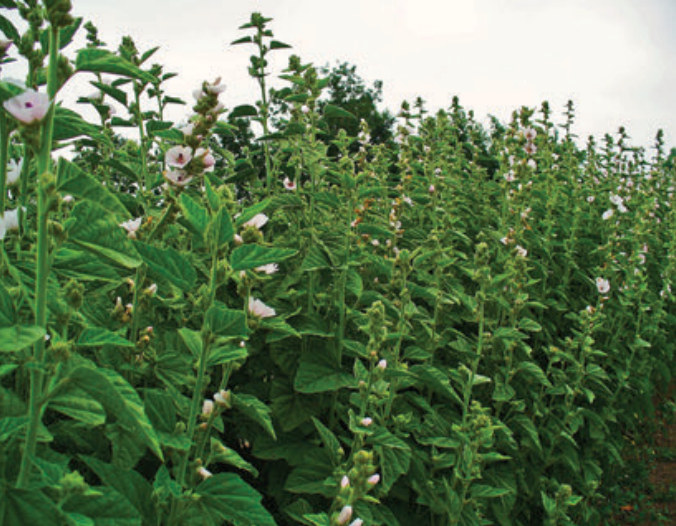
A perennial, hairy herb with a hard, woody base, sparsely branched.
The roots are thick, fibrous, and whitish.
The leaves are alternate, usually with petioles that are flatter than the blade.
The stipules are deciduous.
The blade is toothed.
The margin is pubescent and thick, downy, whitish, and has a venation of 7-2 x 10 cm.
The lower leaves are ovate, heart-shaped, almost complete to shallowly lobed; the upper leaves are triangular in general shape, lobed to varying degrees, with a cut or pedicel base.
The inflorescence is thick, flatter than the flowers, and elongates laterally.
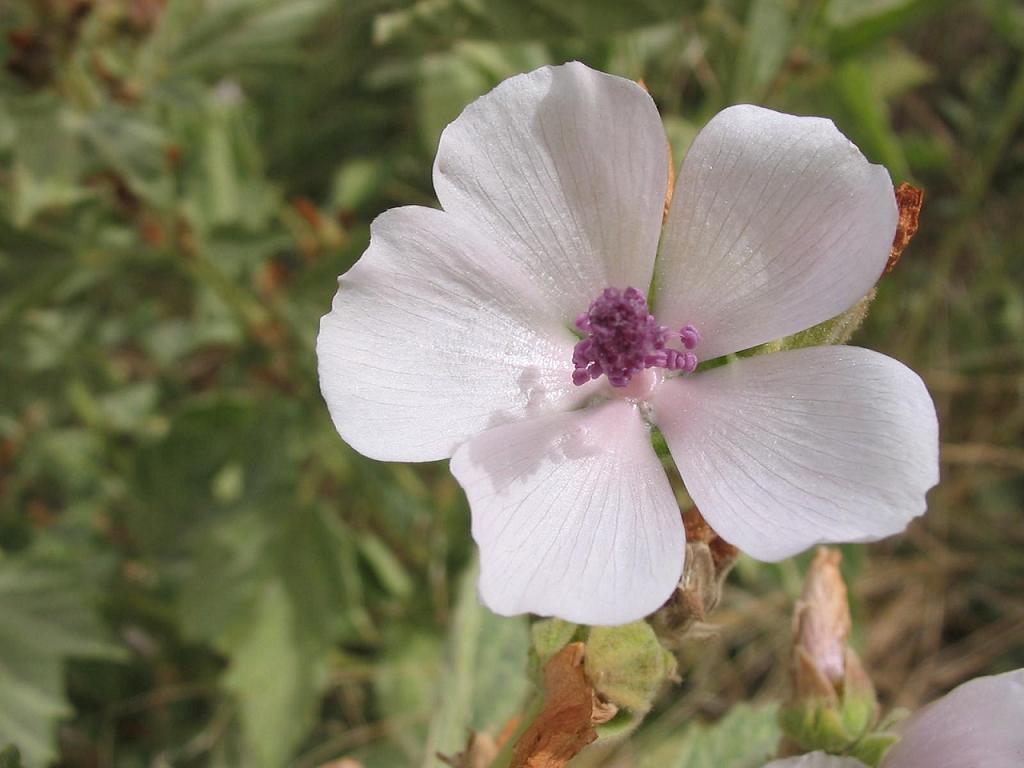
The calyx (3) – The flowers are gathered in axillary clusters comprising a segment fused to their bases and two discs of 12-mm, five-lobed, hairy, supported by a calyx of 10-cm, composed of five white to pink, ovate, oblong to uterine petals.
The corolla is about 2-3 mm in diameter, obovate, notched at the apex, and twice the length of the calyx.
The filaments of the stamens fuse together to form a stomatal tube surrounding the style, from which numerous anthers branch.
The carpels are numerous, free, and arranged in a ring around a disc-shaped umbel.
The ovary chambers are divided by a septum.
The fruit is disc-shaped, 9 mm in diameter, composed of unistone fruit segments, hairy on the outside and with radial veins.
The seeds are black, brown, glabrous, kidney-shaped, and slightly compressed. Flowering occurs from June to November.
Used part
Roots (collected during October and November), leaves (collected after flowering begins), flowers (collected at the beginning of the flowering period).
chemical components
5.
Mucilage: The roots of the marshmallow plant contain mucilage (carbohydrate compounds consisting of a mixture of 35% sugars, penta- and hexa-sugars yielding pentose, galactose, rhamnose, asparagine, pectin, and dextrose), starch, tannins, lecithin, 4% betaine, 2% betaine, phenolic acids, enzymes, scopolamine, flavonoids, starch, and traces of volatile oil.
The leaves contain mucilage, starch, penta- and hexa-sugars, pectin, tannins, and traces of oil.
8.
The flowers contain aromatic volatile mucilage, in addition to flavonoids.
The amount of mucilage in the leaves, flowers, and roots increases with the age of the plant, reaching its peak at the beginning of flower formation.
Properties and medical uses
The medicinal value of the plant is due to its mucilaginous substances, which have protective properties against irritation of the mucous membranes.
Preparations made from the roots of the plant *Aquila dalkhia* are used as a soothing and laxative agent.
They also neutralize stomach acid and are beneficial in treating inflammation of the mucous membranes lining the digestive system (inflammation of the mucous membranes, gastric and duodenal ulcers) and inflammation of the respiratory system (laryngitis, pharyngitis, and bronchitis).
This is achieved by forming a gelatinous layer that covers the irritated area, helping to soothe pain, regenerate cells, and accelerate healing.
The mucilaginous substances found in the leaves are also included in the treatment.
The flowers are used in the preparation of expectorant medicines, cough medicines, and remedies for bronchitis and asthma.
They are also used as enemas for chronic constipation.
Saliva is an ingredient in mouthwashes (oral gargles that disinfect the mouth and gums), ointments, and pastes for treating wounds and skin ulcers.
Saliva is also used in the manufacture of pharmaceutical tablets.
The method of obtaining saliva varies depending on the intended use.
If the intended use is internal, the saliva is obtained by soaking it in cold water to prevent spoilage.
Starch, but in the case of external use, salivary substances can be extracted and used
Side effects and precautions
Allergic reactions or drug interactions may occur; self-use should be avoided by pregnant and breastfeeding women, children, and patients with chronic diseases.
the environment
The hollyhock is a light-loving species.
It thrives in warm, dry, semi-dry, and semi-humid environments.
High temperatures and low humidity (85% fruit set and 35°C humidity) result in moderate vegetative growth and consequently reduced fruit yield.
Hollyhocks grow on various soil types but flourish in fertile soils rich in organic matter, and in deep, moist, loamy soils. They are tolerant of salinity. The suitable pH range is 5-8.8.
Agriculture and productivity
The plant is propagated by seeds, which are sown in spring in the nursery in beds or rows at a distance of 50 cm.
They are transferred to the permanent ground when they have four leaves.
Seeds can also be sown directly in the permanent ground in warm regions.
The plant can also be propagated by division, which is done by dividing the lower part of large plants into several sections, each containing a small root system, which develops to give a complete plant after 7-8 months.
The plants are cut at the beginning of the flowering stage, about 5 cm above the soil surface, during the summer, and then dried in a shaded area.
One hectare yields 6-7 tons of green grass.
The roots are collected when the plant is 2-3 years old, and the yield of aerial dried roots reaches 2-3 tons per hectare. Hibiscus sabdariffa L. Sabdariffa rubra Kostel
History and Heritage
The scientific name of the genus is derived from the Latin and Greek Althianô, meaning "healed" due to the use of some species of the genus Althaea in medicine, while officinalis is from the Latin and means "doctoral".
The ancient Egyptians were aware of the medicinal properties of this plant and used it to treat many diseases as early as the 9th century BC.
The Greek thinker Gesiod wrote of the plant, "It was well-known among the ancient Greeks, who called it Herbaomniborbium (meaning 'herb for all diseases'), and considered it a friend of the poor." Theophrastus and Dioscorides also mentioned it.
Its use was widespread in ancient Egypt.
Ibn Sina praised it, describing it as a laxative and expectorant, and beneficial for many muscular and nervous ailments.
It was mentioned by Ibn al-Baytar and al-Antaki.
The parts used are the roots (collected during October and November), the leaves (collected after flowering begins), and the flowers (collected at the beginning of the flowering period).
Medical note
This information is for educational purposes only and does not constitute medical advice.
Poisonous or potent plants should only be used under the supervision of a qualified physician or pharmacist.
Related images