Bitter melon | A medicinal plant in the Akhdar encyclopedia
Anthropoietic glycosides are generally known for their laxative and purgative properties. Until recently, colocynth was considered one of the most potent herbal laxatives, widely used to treat chronic constipation. Recent studies have shown that leaf glycosides inhibit the proliferation of breast c…
Plant name
Bitter melon
Latin name
Citrullus colocynthis (L.) Schrad
Common names
Bitter melon, colocynth, bitter apple
foreign names
Eng. Colycynth,Bitter apple, Fr.Coloquinte
The group
The lottery
Habitat and Geographic Distribution
Native to the Arabian desert, it grows wild on the coastal sands of North Africa, Southern Europe, and Western Asia.
It is also found growing wild in the Syrian Desert. The main exporters of its fruit are Egypt, Sudan, Turkey, and Spain.
Botanical description
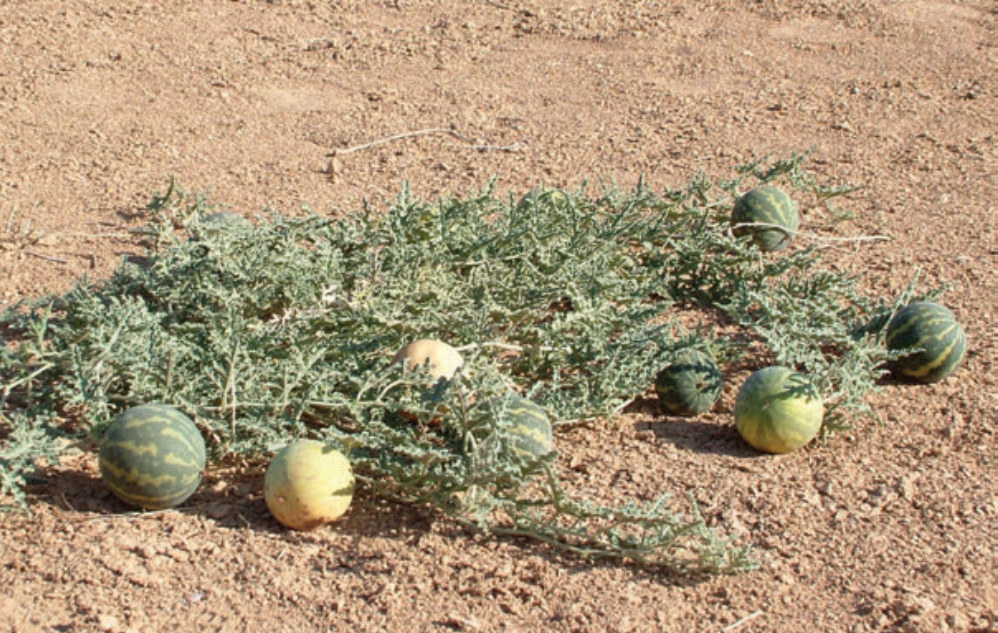
Gray in color, rough to the touch, branching from the base.
The stem is slender, ribbed, of varying lengths.
A perennial herb, *Akhdar* spreads along the ground, covered with bristles.
The tendrils are short and slender, simple or branched.
The leaves are stiff, rough-faced, ovate in general appearance, pointed—the upper surface is pale, the lower surface grayish and covered with stiff hairs; triangularly lobed.
The lobe is dull-tipped, sinusoidal-wavy, divided in turn into 7—the apex is heart-shaped at the base, deeply divided into lobes.
The flowers are unisexual (monoecious), solitary, and yellow.
The male flowers have fused petals in the form of a broad tube ending in 5: narrow, with the same length as the receptacle; the corolla is 5 sac-like, the sepals are stamens, and the filaments are sac-like.
The calyx in the female flowers resembles a calyx with five pointed apex lobes and a stamens.
The male flowers have sterile stamens (7 stamens).
The fruit is a spherical, nipple-shaped berry, about the size of a male orange; the ovary is inferior, hairy (and contains a small amount of sebum), slightly hairy at the beginning of its development, then becomes bare when ripe, green marked with yellow veins (about 10 in diameter), wavy, turning yellow when dry.
The pericarp is spongy, white, and very bitter.
The seeds are numerous, compressed, smooth, glossy, and brownish in color. Flowering occurs from May to August.
Used part
The spongy pulp of mature fruits (colocynth), seeds, and leaves
chemical components
The fruit pulp (colocynth) contains anthraquinone glycosides (cucurbitacinsin and elaterin), bitter compounds (colocynthin and colocynthetin), organic acids derived from caffeic acid (including chlorogenic acid), alkaloids, resins, and pectin compounds.
The seeds (sometimes called "hebeed") contain 15-20% yellow fatty oil, rich in fatty acids (70% linseed acid, 10-16% oleic acid, palmitic acid, and nutmeg acid), and other unidentified compounds.
After, it has a blood sugar-lowering effect, and contains phytosterols, alkaloids, saponins, and sugars.
The leaves contain cucurbitacins B and E.
Medicinal Properties and Uses: Anthraquinone glycosides are generally known for their laxative and purgative properties.
Until recently, colocynth was considered among the strongest herbal laxatives widely used in the treatment of chronic constipation.
Recent studies have shown the effect of leaf glycosides in reducing the proliferation of breast cancer cells, and the alcoholic extract of the leaves has shown Anti-inflammatory activity.
Research has demonstrated the blood sugar-lowering effects of an aqueous extract of colocynth seeds, in addition to the effectiveness of an alcoholic extract of the seeds and leaves against certain types of bacteria, such as Bacillus pumilus and Staphylococcus aureus.
An aqueous infusion of the fruit pulp is used traditionally for chronic constipation, to stimulate bowel and stomach motility, aid digestion, reduce flatulence, and treat liver and gallbladder diseases (jaundice).
An extract of the leaves is used as a diuretic and in the treatment of asthma and jaundice.
The oil is used...
The seeds are used to treat hemorrhoids and some skin diseases such as inflammations, ulcers, and scabies.
They are also used as poultices to relieve rheumatic and joint pain.
The use of colocynth has declined in recent times and is now limited to veterinary applications in treating skin diseases (scabies and tick infestations).
The fruit is used to treat colds, parasitic worms, dropsy, ulcers, bronchitis, splenomegaly, cervical tuberculosis, anemia, and elephantiasis.
The root has also been used to treat abdominal distension, coughs, and asthma attacks.
Properties and medical uses
Anthropoietic glycosides are generally known for their laxative and purgative properties.
Until recently, colocynth was considered one of the strongest herbal laxatives, widely used to treat chronic constipation.
Recent studies have shown the effect of leaf glycosides in reducing the proliferation of breast cancer cells, and the alcoholic extract of the leaves has demonstrated anti-inflammatory activity.
Research has also shown the blood sugar-lowering effect of the aqueous extract of colocynth seeds.
In addition, the alcoholic extract of the seeds and leaves of Bacillus pumilus and Staphylococcus aureus has been shown to be effective against some types of bacteria.
A decoction of the fruit pulp is popularly used for chronic constipation, to stimulate bowel and stomach motility, aid digestion, and reduce flatulence.
It is also used to treat liver and gallbladder diseases (jaundice).
The leaf extract is used as a diuretic and to treat asthma and jaundice.
The seed oil is used to treat hemorrhoids and some skin diseases such as inflammation, ulcers, and scabies.
It is also used in the form of compresses to relieve rheumatic and joint pain.
The use of colocynth has declined in recent times, and it is now limited to veterinary applications in the treatment of skin diseases (scabies, ticks).
Side effects and precautions
The fruit pulp, containing cucurbitacin, causes a severe irritant to the intestinal mucosa, accompanied by severe bloody diarrhea.
Generally, an overdose causes vomiting, enteritis, gastritis, bloody diarrhea, colic, kidney irritation, abdominal cramps, fatigue, weakness, dizziness, and liver damage.
A lethal dose begins with respiratory arrest, circulatory arrest, and paralysis of the limbs.
If not treated as quickly as possible, it can lead to death.
Its use is contraindicated during pregnancy and breastfeeding.
Latin name: Citrullus colocynthis (L.) Schrad. Cucumis colocynthis L., Colocynthis vulgaris Schrad
Other uses
Ground seeds (washed with water and salt to remove bitterness), roasted and rich in fatty oils and proteins, are used in the preparation of some types of soup.
the environment
The colocynth is an xyrophytic plant, thriving in sunny, dry, and desert environments.
The ideal temperature for flowering and fruit ripening ranges between 25-27°C.
Insufficient light results in delayed appearance of female flowers compared to male flowers.
It prefers light soils, especially sandy and gravelly ones, and tolerates high levels of salinity and alkalinity. The suitable pH is 7-8.
Agriculture and productivity
The plant is propagated by fresh seeds.
Sow the seeds during spring and early summer in wide rows (1-180 cm) in holes spaced 25-30 cm apart, at a rate of 2-3 seeds per hole.
Thinning is carried out later, leaving two plants per hole.
Appropriate care practices include moderate watering, fertilization, and pest control.
The plant flowers during spring and summer, depending on the region.
Harvest the fruits when they are ripe, indicated by the yellowing and drying of the leaves.
The fruit turns a greenish-yellow color and its skin hardens.
After harvesting, the fruit is transported to a drying area and left in a shaded place for several days.
It is then packed and stored in a well-ventilated area, away from moisture.
Yield per hectare ranges from 1.5 to 1 ton of whole, dried fruit or 1 ton of segmented fruit.
(Species: Ecballium elaterium (L.) A.
Rich, Momordica elaterium L., Bryonia elaterium (L.) E.H.L. Krause, Ecballium agreste Rchb., Ecballium elaterium var. monoicum Batt.)
History and Heritage
The scientific name for the genus is Citrus, a diminutive form of Citrus, due to the similarity in size and color of its fruit when ripe to that of oranges (lemons).
The species name comes from the Greek word kolokynthis, meaning gourd.
The Romans, Greeks, and Arabs used it to treat constipation and cleanse the digestive system.
Ibn Sina said of it: "There are male and female colocynth varieties.
The male has a fibrous pulp, while the female is soft and smooth.
The best is the pure white variety, while the black is inferior.
It is harvested in the autumn.
Its pulp should not be removed from its interior when harvested, but rather left as is.
Doing so weakens it.
It should not be harvested until it has begun to turn yellow and the greenness has completely faded; otherwise, it is harmful and of poor quality."
Medical note
This information is for educational purposes only and does not constitute medical advice.
Poisonous or potent plants should only be used under the supervision of a qualified physician or pharmacist.
Related images


