Wildflower | A medicinal plant in the Akhdar encyclopedia
The herb *Handaqouq* is used to treat disorders related to chronic venous insufficiency, edema, hemorrhoids, and lymphatic congestion. In folk medicine, it is used to treat bronchial diseases and for eyewash. Topically, it is used as a poultice to accelerate wound healing and to treat bruises, cont…
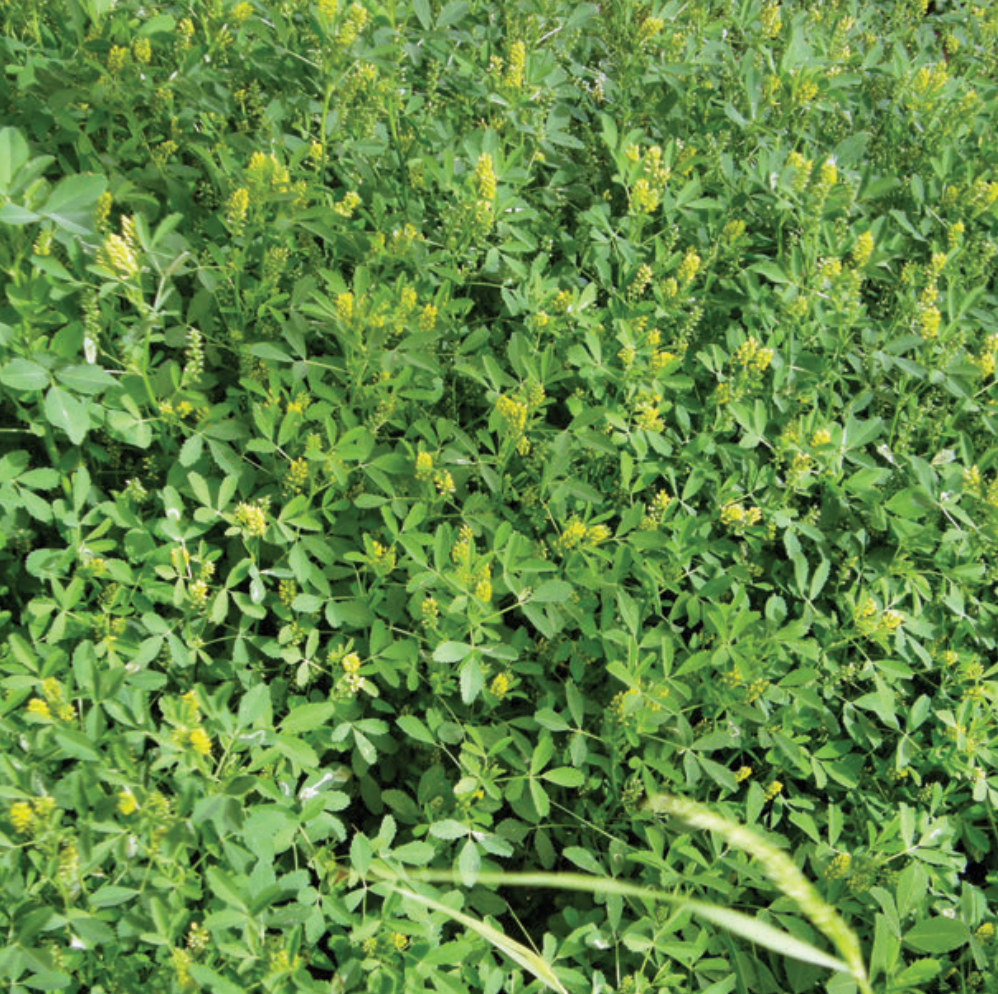
Plant name
Handaqouq
Latin name
Melilotus officinalis (L.) Lam.
Common names
Handaqouq, the king's crown, dung
foreign names
Eng. Sweet clover, Sweet Melilot, Fr. Melillot
The group
Pea beans
Habitat and Geographic Distribution
Europe and Asia, northern Turkey, and parts of Syria and Lebanon.
The genus includes several similar species, distinguished by a set of characteristics, the most important of which are: flower color (white in the species M.
albus, and yellow in the other species); 1. pod dimensions and the shape of the decorations on its surface; 2.
Botanical description
cm.
Stem erect, branching.
Leaves alternate, trifoliate, long-petioled.
100 - Biennial herb, the two lateral leaflets are obovate, the middle one oblong with toothed margins; the stipules are fused to the petioles.
mm, squasic inflorescence.
Inflorescence densely racemose, axillary, much longer than the leaves.
Flowers small, about stamens, yellow.
Stamens dioecious.
Pod: gray.
5 The calyx is squasic, ending in five teeth of equal length.
Corolla: mm, its surface bearing lateral wrinkles: regular gray.
3 Opening, monosperm, ovate, its apex ending in a spadix, about 3 cm long. Flowering from March to May.
Used part
Fresh or dried flowering tops.
Dried herbs have an aromatic scent.
The chemical constituents include free coumarins (0.4-0.9%), formed from coumarin acids during the drying process.
Coumarin derivatives are present as glycosides or hydroxycoumarins, including herniarin, fraxidin, scopoletin, umbelliferone, melilotin, melilotol, and coumarin.
Phenolic acids are also present, including salicylic acid, ferulic acid, caffeic acid, melilotic acid, chlorogenic acid, and rosmarinic acid.
Favonoids are present, the most important being kaempferol-quercetin glycosides, rutin, and isoquercitrin.
Terpene saponins are present, including melilotigenin, aglycones, soya sapogenols B and E, azuki saponin II, and azuki.
The seeds also contain saponin-V-carboxylate and the alkaloids trigonelline and canavanin.
chemical components
It consists of coumarin acids during the drying process.
0.9-0.4% free coumarins are coumarin derivatives, some in the form of coumarin acid glycosides or hydroxycoumarins.
Examples include fraxidin, scopoletin, umbelliferone, melilotin, melilotol, coumarin, and herniarin.
Other examples include salicylic acid, ferulic acid, caffeic acid, and melilotic acid.
Phenolic acids include kaempferol and quercetin glycosides.
The most important flavonoids are terpene saponins, such as melilotigenin, aglycones, soy sapogenols B and E, azuki saponin II, and azuki saponin-v-carboxylate. The seeds also contain canavanin and trigonelline.
Properties and medical uses
Fennel is used to treat disorders related to chronic venous insufficiency, edema, hemorrhoids, and lymphatic congestion.
In folk medicine, it is used to treat bronchial diseases and for eyewash.
Topically, it is used as a poultice to accelerate wound healing and to treat bruises, contusions, and sprains.
Extracts of the plant, rich in polyphenols, have inhibitory activity against α-amylase and α-glucosidase enzymes.
It is considered a promising plant for developing natural dietary supplements that combat diabetes and inflammation. Studies have revealed its effectiveness in treating multiple sclerosis.
pharmaceutical forms
Infusion (tea), liquid used for injections, ointments, suppositories, plasters, or compresses
Side effects and precautions
There are no health risks or side effects if the prescribed dose is followed.
However, taking high doses can lead to headaches and dizziness, and may also cause temporary liver damage.
Other uses
Dicoumarol is extracted from the plant on an industrial scale for the production of rodenticides.
The leaves are used in salads, and the seeds are used for their flavoring properties.
It is grazed by livestock.
Regarding its effects, interactions, and precautions, there are no known health risks or side effects if the prescribed dosage is followed.
However, high doses can lead to headaches and dizziness, and may cause temporary liver damage.
The dried leaves can be toxic if they rot, because the coumarins they contain are converted into dicoumarol, an anticoagulant, upon spoilage.
Therefore, the plant should be handled with caution and not given to people with slow blood clotting or those taking warfarin.
The drug should be stored in airtight containers, protected from light, to prevent the coumarins from degrading.
the environment
This plant grows in fields, meadows, fallow land, along roadsides, and in steppes.
It thrives in acidic soils and prefers well-drained, slightly alkaline soils.
It prefers sunny locations and dislikes shade. Mature plants are drought-tolerant.
Agriculture and productivity
It is propagated by seeds, which are sown directly in the permanent ground in spring and into early summer.
The seeds are soaked in lukewarm water for 12 hours before planting.
Germination takes approximately two weeks.
The plant is harvested during the flowering period and then dried in the shade.
Some types of nitrogen-fixing bacteria in the soil live symbiotically with the plant's roots.
Prosopis farcta (Banks & Sol.) J.F.Macbr., Mimosa farcta Banks et Sol., Lagonychium farctum (Banks et Sol.) Bobr., Prosopis stephaniana (M.B.) Kunth ex Spreng., Mimosa stephaniana M.B., Acacia stephaniana (M.B.) Wilid., Lagonychium stephanianum (M.B.) M.B
History and Heritage
The scientific name of the genus is derived from the Greek melilôtos, which is the name of the plant, from meli meaning "honey", and lotus meaning "lotus".
The descriptive name of the species, *Officialis*, means "medicinal." This herb was used in ancient times to treat a number of conditions as a carminative, expectorant, anticoagulant, and antibiotic.
A decoction of *Ecballium officinalis* aids digestion, and its flowers attract bees and repel moths.
*Ecballium officinalis* was used in powdered form, and its leaves can be eaten, though somewhat bitter.
Prospero mentions that *Ecballium officinalis* is a warming herb and is used, among other ingredients, in poultices to treat fevers.
Its seeds are added to a basic syrup to relieve pain.
In a Coptic medical papyrus, *Ecballium officinalis* is mentioned as an ingredient. One of the medications used in the treatment of diseased testicles
Medical note
This information is for educational purposes only and does not constitute medical advice.
Poisonous or potent plants should only be used under the supervision of a qualified physician or pharmacist.
Related images


