Fenugreek | A medicinal plant in the Akhdar encyclopedia
Fenugreek seeds possess cholesterol-lowering and triglyceride-lowering properties, contributing to the prevention of cardiovascular diseases. They also have blood sugar-lowering properties and protect against liver diseases, particularly cirrhosis. The antioxidants present in fenugreek appear to co…
Plant name
ring
Latin name
Trigonella foenum- graceum L
Common names
ring
foreign names
Eng. Fenugreek, Fr. Trigonelle
The group
Pea beans
Habitat and Geographic Distribution
Originating in North Africa (the Nile Valley) and the Middle East, its cultivation has spread to tropical and subtropical regions.
The most important fenugreek-producing countries are Pakistan, India, China, Cyprus, Syria, and the Maghreb countries.
Botanical description
cm.
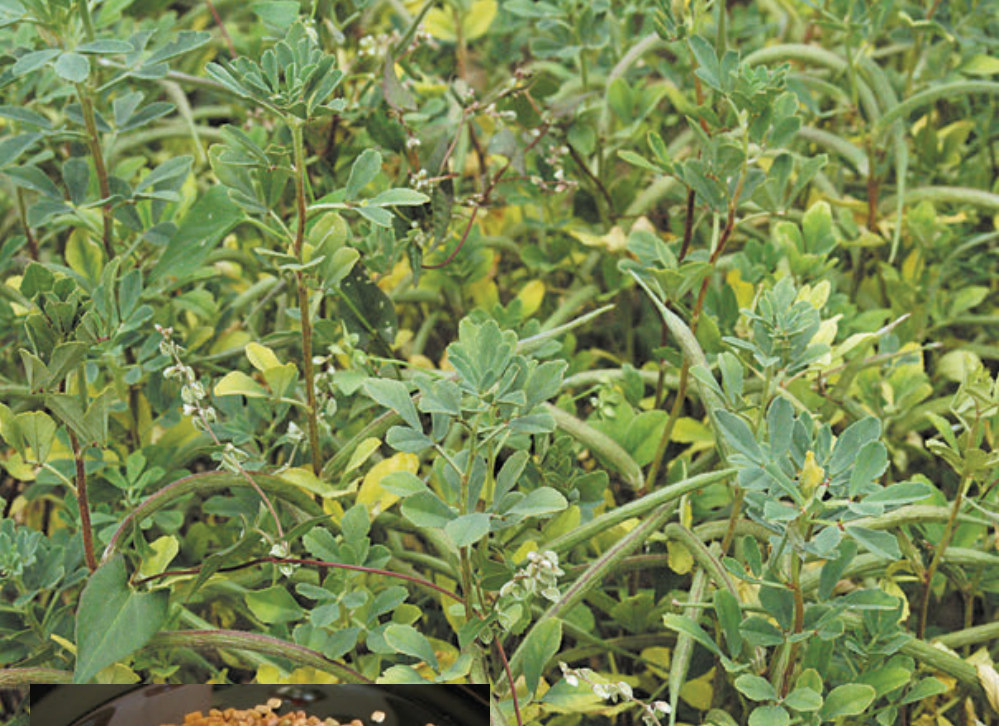
Stem 50 - biennial herb, hairy or glabrous, simple or sparsely branched, erect.
Leaves composed of three leaflets, stipule-like, alternate, petiolate.
Stipules triangular, 1.5 - 0.8×3 cm - uterine, apical, complete.
Leaflets - obovate, dull-pointed, toothed margin - oblong upper part, glabrous.
Inflorescence - raceme, slender or sub-millimeter.
18 - flower often).
The flowers (2) are tubular, with even teeth and a narrower apex than the tube, and are hairy.
The corolla is white to cream-colored, twice the length of the calyx, with an obovate, notched apex, and longer than the wings.
The horn is flat, linear, straight or curved, smooth or hairy, and bears a network of nerves.
The horn is 5-4 x 15 cm, 3-5 mm long, and 5-5 cm wide.
The seeds are numerous, 4-4 cm long, tapering gradually to form a beak.
They are light brown or reddish-gray to yellowish, ribbed, rhomboid, irregularly rounded, wrinkled, and leathery.
Flowering occurs from March to April.
It is the most widespread fenugreek species in arid and semi-arid regions.
Wild species include: Arabian fenugreek (T.
caerulescens), blue-flowered fenugreek (T. stellata), star-shaped fenugreek (T. filipes), and thread-like fenugreek.
Used part
seeds
chemical components
Fenugreek seeds contain 30% fats, 25-45% proteins (mannogalactans), and mucilage.
They also contain mucilage and trigofoennosides, the most important of which are 1-5% steroid saponins, in addition to 10% steroidal saponins (gytogenin, yamogenin, and diosgenin).
These include aglycones (diosgenin, aglycones, and aglycones), smilagenin, foenugraenin, isovitexin, orientin, saponaretin, and vicenin.
Other flavonoids include 0.4% trigonelline and 1.3% choline.
The seeds also contain a volatile oil composed of sesquiterpene compounds and lectins, sugars (including galactose and mannose), and minerals. (Phosphorus, iron, sulfur, calcium, magnesium) and vitamins A, C and B
Properties and medical uses
Fenugreek seeds possess cholesterol-lowering and triglyceride-lowering properties, contributing to the prevention of cardiovascular diseases.
They also have blood sugar-lowering properties and protect against liver diseases, particularly cirrhosis.
The antioxidants in fenugreek appear to help prevent liver, colon, and breast cancers.
Steroidal saponins, particularly diosgenin, are the primary precursors in the intrinsic synthesis of sex hormones, and research has shown the benefits of fenugreek seeds in facilitating childbirth.
They also promote milk production in nursing mothers (tigogenin, diosgenin).
The mucilaginous components help soothe sore throats and treat asthma.
The seeds are used traditionally as an appetite stimulant, for those suffering from anemia, to lower blood sugar levels, as a stomachic and digestive tonic, and to treat stomach and duodenal ulcers, chest ailments and coughs, to expel intestinal worms, and to treat hemorrhoids, dysuria, menstrual cramps, and diarrhea.
Fenugreek is also used topically for its laxative and antiseptic properties in treating burns, skin diseases, cracked skin, eczema, boils, foot ulcers, and anal abscesses.
Drug Interactions and Precautions: Due to fenugreek's effect on lowering blood sugar, using it with blood sugar-lowering medications can lead to severe hypoglycemia.
It is advised to avoid using fenugreek at the beginning of pregnancy, as it can induce miscarriage during the first trimester.
Nutritional Uses: Fenugreek is widely used throughout the world as both food and medicine.
Fenugreek seeds are distinguished by their high nutritional value and are recommended for people who perform strenuous work, as they help them endure fatigue and exhaustion.
They also appear to maintain the health of the elderly, strengthen their immune system, and help them resist diseases.
In North African and Middle Eastern countries, fenugreek seeds are used in the preparation of flavorful spice blends that stimulate the appetite.
They are also an ingredient in many traditional dishes of those countries.
Consuming fenugreek seeds gives urine a distinctive odor.
The green tops and leaves of the plant are eaten due to their high nutritional value (Alzheimer's disease).
Side effects and precautions
Due to fenugreek's effect on lowering blood sugar, using it with blood sugar-lowering medications can lead to severe hypoglycemia.
It is advised to avoid using fenugreek during early pregnancy, as it can induce miscarriage in the first trimester.
In terms of culinary uses, fenugreek is widely used throughout the world as both food and medicine.
Fenugreek seeds are highly nutritious and are recommended for people engaged in strenuous work, as they help them cope with fatigue and stress.
They also appear to help maintain the health of the elderly, strengthen their immune system, and aid in disease resistance.
In North Africa and the Middle East, fenugreek seeds are used in the preparation of flavorful spice blends and many popular dishes.
Consuming fenugreek seeds gives urine a distinctive odor.
The tops and leaves of the plant are also eaten due to their high nutritional value. (Alzheimer's disease)
Other uses
Fenugreek is used as a cheap raw material in the production of sex hormones (birth control pills) and cortisone.
This explains the weight gain associated with fenugreek consumption, as it contains female hormones that increase body fat. The fruit is also used to dye fabrics a beautiful crimson red color.
the environment
Fenugreek thrives in diverse climatic conditions, tolerating drought, high temperatures, and frost, but it grows best in temperate regions.
Although fenugreek is a winter crop with a short photoperiod, long photoperiods and intense sunlight promote rapid vegetative growth, early flowering, and early fruit ripening.
Fenugreek grows in all soil types except waterlogged and alkaline soils, and it flourishes in light soils with high calcium carbonate and readily absorbable phosphorus content.
Agriculture and productivity
The plant is propagated by seed, sown in early autumn.
Fertilization with essential nutrients improves yield.
Pods are harvested when the base of the plant has dried, most leaves have turned yellow, and the pods are almost dry, light brown, and their seeds are fully mature and hard.
The plants are cut on the topsoil in the early morning to prevent the pods from splitting open and scattering the seeds.
One hectare yields 1.2-2 tons of seeds.
Quercus infectoria G.Olivier, Quercus infectoria subsp.
euinfectoria A.Camus, Quercus lusitanica subsp.
infectoria (G.Olivier) Mouill., Quercus lusitanica var. infectoria (G.Olivier) A.DC
History and Heritage
The scientific name of the genus is derived from the Latin *trigonus*, meaning "triangular," referring to the shape of the corolla in the species *T.
foenum-grae-cum* in particular.
The species name *foenum-grae-cum* means "fodder" or "Greek," as *afoenum* means "fodder" in Latin and *graecum* means "Greek." Its Arabic name, *halba*, comes from the word *halba*, which has a hieroglyphic origin.
Fenugreek has been cultivated and its seeds used since ancient times in food and traditional medicine in India and the Nile Valley.
Ancient Egyptians used it to facilitate childbirth, and the Egyptian Ebers Papyrus records a recipe for treating burns with fenugreek.
The Greek physician Hippocrates mentioned it as one of the most important and beneficial plants, and Dioscorides recommended fenugreek as a remedy for gynecological ailments, including inflammation of the uterus and vagina. Ancient Arabs used it as both medicine and food.
Medical note
This information is for educational purposes only and does not constitute medical advice.
Poisonous or potent plants should only be used under the supervision of a qualified physician or pharmacist.
Related images


