Lemongrass | Medicinal plant in the Akhdar Encyclopedia
The leaves or essential oil possess analgesic and sedative properties, are antiemetic, and expel gas and associated gastrointestinal disturbances. The essential oil, containing the compounds citral and myrcene, also possesses anti-inflammatory, antibacterial, and antifungal properties. Research has…
Plant name
lemongrass
Latin name
Cymbopogon citratus (DC) Desf
Common names
Lemongrass, Melissa officinalis
foreign names
Eng. Lemongrass, Fr. Citronnelle d´Inde
The group
kidney
Habitat and Geographic Distribution
It is native to India and Madagascar, and grows in the tropical regions of Asia, Malaysia, Southeast Asia, and California.
It is cultivated in many countries in Asia, Africa, America, and some Arab countries such as Syria, Egypt, Sudan, and Saudi Arabia.
Botanical description
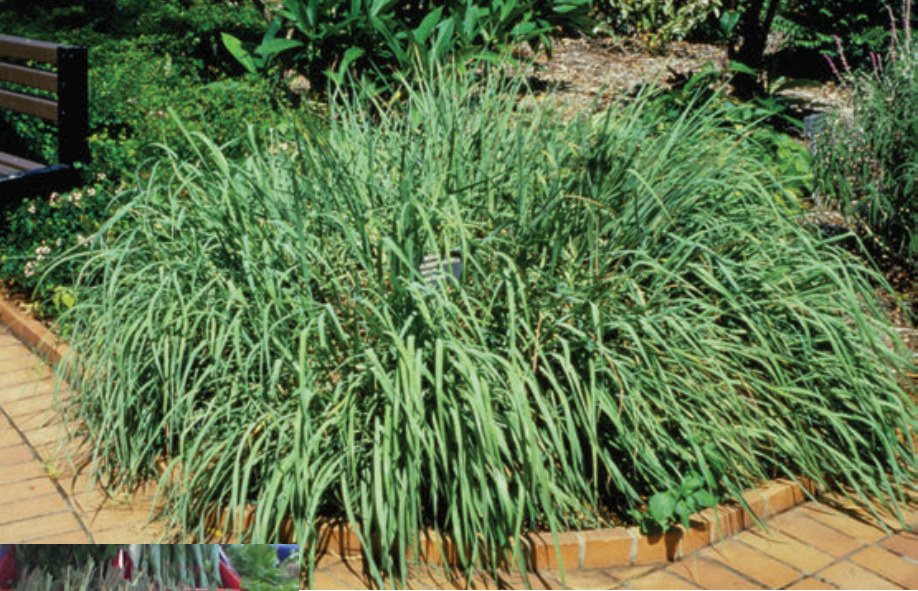
A fragrant perennial herb, growing in dense clumps, reaching a height of 1 meter in large thickets.
Its roots are strong and can remain in the ground for up to 1.5 years.
The foliage thins during winter.
The stems are white.
The leaves are pinnate: narrow-bladed, rough to the touch, and wavy-edged.
The inflorescence is a raceme, supported by a sheath similar to that surrounding the stamen, composed of bundles of stamens that emerge in pairs.
From the axil of each pair emerges a single inflorescence.
The spikelets are arranged in pairs and contain two flowers, one fertile and the other sterile, which are pressed against the stamen.
One spikelet is sessile and hermaphroditic, the other sessile and either male or neuter.
The sessile spikelet is compressed, pubescent, and the two stamens are equal in length.
The stamen in the hermaphroditic flower has a two-lobed terminal.
Stamens.
The spikelet is devoid of sheaths, and the sheath and the sheath are reduced or form a pocket from which sheaths emerge. The masculine is absent. The goddess is elliptical in shape.
Used part
The leaves, and the essential oil extracted from the leaves (lemon-scented).
chemical components
20-25% citral =) neral, 30-35% geranial aldehyde.
Its most important component: geranial aldehyde.
0.8-0.02% volatile oil, which is one of the components of the oil and to which the distinctive flavor is attributed.
75- These compounds constitute what is between 3% citronellal, eugenol, citronellol, geraniol, geraniol, linalol of the plant.
Mono-artic phenols of linalool.
Germacren, caryophyllene, be-ocimene, geranylactetate, methyl citronellal, caryophyllene oxide, eugenol glycosides.
Alcoholic or phenolic compounds found in the volatile oil, for example, eugenol glycoside.
Caffeic acid (café acid), labiatic a.
= (rosmaric acid): the most important of which are 4.7% caffeic acid derivatives and others.
Cinnaroside, cosmosiin, rhamnocitrin, quercitrin: These are valphenoids, among others.
Ursolic acid, oleanolic acid: These are triterpene acids that, along with other triterpene compounds, contribute to the plant's antibacterial and antiviral activity. 4% (catechin tannins) (polyphenols)
Properties and medical uses
The leaves and essential oil possess analgesic and sedative properties, are antiemetic, and relieve gas and associated gastrointestinal disturbances.
The essential oil, containing the compounds citral and myrcene, has anti-inflammatory, antibacterial, and antifungal properties.
Research has demonstrated the positive effects of lemongrass in eliminating cancer cells.
A decoction of the leaves is used traditionally as a mild diuretic, a general tonic, and to improve body odor.
It is beneficial in treating kidney and digestive problems, expelling roundworms, and is a mild lowering agent for high blood pressure.
The leaf paste is used topically to reduce headaches.
The essential oil or leaf paste is used topically to treat skin inflammations, acne, neuralgia, chronic rheumatism, sprains, bite pain (resulting from lactic acid buildup), and sciatica.
Side effects and precautions
It should not be given to a woman experiencing pregnancy, and caution should be exercised when using it by people with a particular sensitivity to volatile oils.
Other uses
The leaves are used in preparing many appetizing soups.
The essential oil is used in the manufacture of perfumes, hair care products, cleansers for oily skin, and soaps.
The lemony scent of the leaves also repels insects.
Precautions: It should not be given to pregnant women, and caution should be exercised when using it by people with a particular sensitivity to essential oils.
the environment
Lemongrass is a light-loving species that tolerates partial shade.
It grows in diverse environments and thrives in hot, tropical, and subtropical climates.
The plant grows slowly in autumn and spring and enters a dormant period in winter.
It is tolerant of cold weather and resumes growth as soon as temperatures rise.
Growth is optimal in warm conditions (1°C - slightly cooler than humid).
It prefers light, fertile, well-drained, and aerated soils. It can be grown in sandy and loamy soils and tolerates alkaline conditions.
Agriculture and productivity
The plant propagates by offshoots, and also by division in temperate regions, where it does not flower.
In hot regions, it is propagated by seeds.
Healthy offshoots, 15-20 cm long and no more than 3 years old, are used and planted in the spring at a rate of 25,000 offshoots per hectare.
Planting can also be done in holes 3 cm deep.
The plants are irrigated after planting and fertilized.
The foliage of the plant is harvested twice in the first year, and 3-5 times annually in subsequent years.
One hectare yields approximately 25 tons of foliage in the first year.
Cymbopogon schoenanthus (L.) Spreng., Andropogon schoenanthus L., Cymbopogon citriodorus Link, Sorghum schoenanthus (L.) Kuntze, Trachypogon schoenanthus (L.) Nees
History and Heritage
Derived from the Greek *Melissa*, the scientific name for the genus *Mellisa officinalis* means honeybee, and the descriptive form means medicinal or pharmaceutical.
People have associated gentian with bees since ancient times, and gentian has long possessed medicinal properties, known to the Greeks, Romans, and Arabs.
It was considered a tonic with properties similar to honey.
The plant has been known for centuries, and gentian was a favorite herb in the Middle Ages for preparing what was called "the elixir of youth." Until the 8th century, gentian was believed to "rejuvenate youth" and to "comfort the heart and dispel sorrows." The parts used are the stems and leaves (which have a lemony aroma and are harvested just before flowering). Latin name: *Mellisa officinalis* L.
Medical note
This information is for educational purposes only and does not constitute medical advice.
Poisonous or potent plants should only be used under the supervision of a qualified physician or pharmacist.
Related images


