Letter | Medicinal plant in the Akhdar encyclopedia
Garden cress is widely used in traditional medicine to treat respiratory disorders such as asthma, bronchitis, and coughs. The plant possesses antibacterial properties (which depend on the age of the plant used). It has also demonstrated antiviral activity in mice (against the Columbia SH encephali…
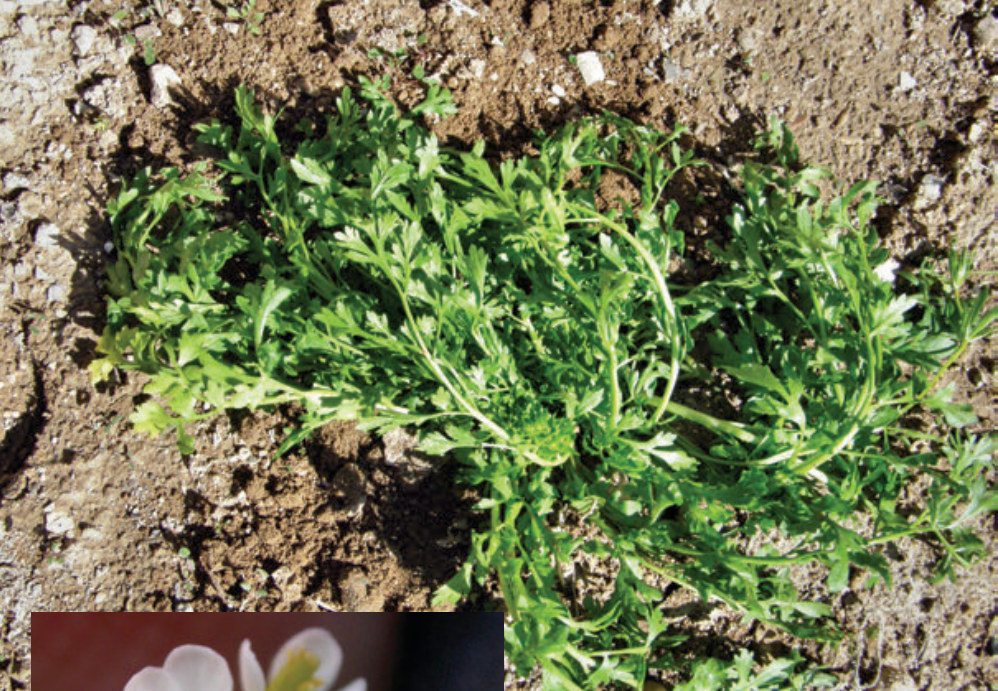
Plant name
Letter
Latin name
Lepidium sativum L
Common names
Harf, Rashad, Qarnoush
foreign names
Eng. Garden cress, Fr.Resson olenoise
The group
cabbage
Habitat and Geographic Distribution
It is multi-regional, found in temperate and subtropical regions. It has spread to many parts of the world and is widely cultivated.
Botanical description
cm.
Stem 60 - Perennial herb, glabrous, erect, branching.
Lower leaves petiolate, divided pinnately once or twice into irregular lobes; stem leaves bryophyte or pedunculate; upper leaves entire, linear.
Inflorescence: raceme, axillary, terminal: squamous, squamous, white.
Calyx: squamous, flowers about half the length of the petals, pubescent.
Pecanth: erect, flattened than the fruit.
mm: ellipsoid to 5-3x6 mm.
Fruit: drupe, round, glabrous, two distinctly winged lobes, the wing widening towards the apex to form a pocket: narrow, flattened slightly or equal to the style. There is one seed in each drupe. Flowering: March to May.
Used part
The tender or dried aerial parts are harvested during or shortly after the flowering season.
chemical components
The tender leaves contain glucosinolates, the most important of which is glucotropaeolin.
When the plant is crushed, it produces benzyl isothiocyanate (benzyl mustard oil) and its decomposition products (benzyl cyanide, 3-phenylpropionitrile, and benzaldehyde).
It also contains ascorbic acid (vitamin C, comprising 37%), and the minerals iron, phosphorus, manganese, iodine, calcium, arsenic, and potassium.
The seeds contain glucosinolates (3.5%).
Up to 5.3% (glucotropaeolin, cucurbitacins) (triterpene compounds).
Cardiac steroids.
The seeds are a rich source of protein, dietary fiber, omega-3 fatty acids, iron, other essential nutrients, phytochemicals, mucilage, vitamins (such as vitamins D, C, A, B6, and cobalamin), phenolic compounds, flavonoids, tannins, benzoic acid, dihydroxybenzoic acid, gallic acid, chlorogenic acid, and 4-hydroxycoumaric acid.
Olivalenic acid, salicylic acid, pyrogalsol, catechin, caffeine, isoleucine, as well as imidazole and essential amino acids (lysine, valine, phenylalanine, isoleucine, arginine, histidine, threonine, methionine) and non-essential (glutamic acid, aspartic acid, gaine, proline, serine, alanine, tyrosine).
The most abundant fatty acid in L.
sativum seeds is α-linolenic acid (ALA).
Oleic, palmitic, and arachidonic acids are also present.
Linoleic, ginsenoic, behenic, and beta-sitosterol acids are present in varying concentrations.
The seed oils contain high amounts of gamma- and alpha-tocopherols (g-tocopherol and α-tocopherol).
Benzylcyanide and benzylisothiazolinate were detected.
LC-MS analysis of garden cress extracts revealed the presence of luteolin, quercetin, 7-hydroxy-4,6,5-trimethoxyisovafone, chlorogenic acid, cinnamic acid, ascorbic acid, para-coumaric acid, and 6-prenylnaringenin.
Properties and medical uses
Garden cress is widely used in folk medicine to treat respiratory disorders such as asthma, bronchitis, and coughs.
The plant possesses antibacterial properties (depending on the age of the plant used).
It has also demonstrated antiviral activity in mice (against the Columbia SH encephalitis virus).
The herb is used traditionally for its appetite-stimulating and digestive properties, in cases of vitamin C deficiency, to expel intestinal parasites, and to treat coughs, colds, chest ailments, and as a diuretic.
A decoction of the seeds is used to treat diarrhea and skin diseases.
The juice of the leaves is applied topically to strengthen and stimulate hair follicles and stop hair loss.
A paste made from the leaves is used as a poultice to treat skin inflammations, ulcers, abscesses, hemorrhoids, eczema, spots, and melasma on the face.
The aqueous extract of the seeds is effective in lowering blood pressure and increasing water excretion, without affecting normal blood pressure or heart rate.
Several studies have shown that garden cress extract is effective against bacterial spores and pathogens.
Numerous preclinical studies using different parts of garden cress have demonstrated its potential in alleviating various disorders and improving health (such as antimicrobial, antioxidant, anticancer, antidiabetic, anti-asthmatic, and anti-asthmatic properties, as well as its potential for various other preventative activities).
Precautions: The plant should be taken as a fresh herb in oral preparations.
Garden cress should not be used by those with stomach allergies, indigestion, or urinary tract weakness. Large doses of mustard oil can cause skin blisters and necrosis.
Side effects and precautions
The plant should be taken as a fresh herb in oral preparations.
Garden cress should not be used by those with stomach allergies, indigestion, or urinary tract weakness. Large doses of mustard oil can cause skin blisters and necrosis.
the environment
Cress grows wild in fallow land, the edges of cultivated fields, stream banks, and wetlands.
It thrives in most soil types and requires moist, partially shaded soil during the summer to avoid rapid flowering.
Agriculture and productivity
It is propagated by seeds and cuttings.
The soil is prepared for planting, and the land is divided into beds or furrows.
The seeds are scattered on the surface of the soil and are not covered with soil, but rather pressed down with a piece of wood, then watered moderately.
Planting takes place at the beginning of spring and can be done in batches every two or three weeks, with the final planting occurring at the end of June.
The seeds germinate in less than a week.
The plant grows quickly, and harvesting begins about 2-3 weeks after planting.
Harvesting is done at a height of 6-8 cm.
Nasturtium officinale R.Br.
Arabis nasturtium Clairv., Baeumerta nasturtium G.Gaertn., B.Mey. &Sherb. Cardamine aquatica Nieuwl
History and Heritage
Lepis, the scientific name for the genus, is a diminutive of the Greek word for scale, referring to the shape of the scales.
It is the ancient name for these species, meaning "cultivated." The name Sativum, the descriptive name for the species, indicates that garden cress has long been used as an appetite stimulant and digestive aid.
It was mentioned by Antiochus and Ibn al-Baytar.
Ibn Sina, quoting Dioscorides, stated that the best variety is the red Babylonian, and its potency is similar to that of mustard and radish seeds.
Medical note
This information is for educational purposes only and does not constitute medical advice.
Poisonous or potent plants should only be used under the supervision of a qualified physician or pharmacist.
Related images


