Tiger nuts | A medicinal plant in the Akhdar encyclopedia
The essential oil of the tubers exhibits cytotoxic, antioxidant, and antitumor properties. The tubers and rhizomes of the plant are used traditionally for their sedative, antiemetic, and carminative effects. The tubers are used to soothe headaches and to treat anxiety, fatigue, urinary and reproduc…
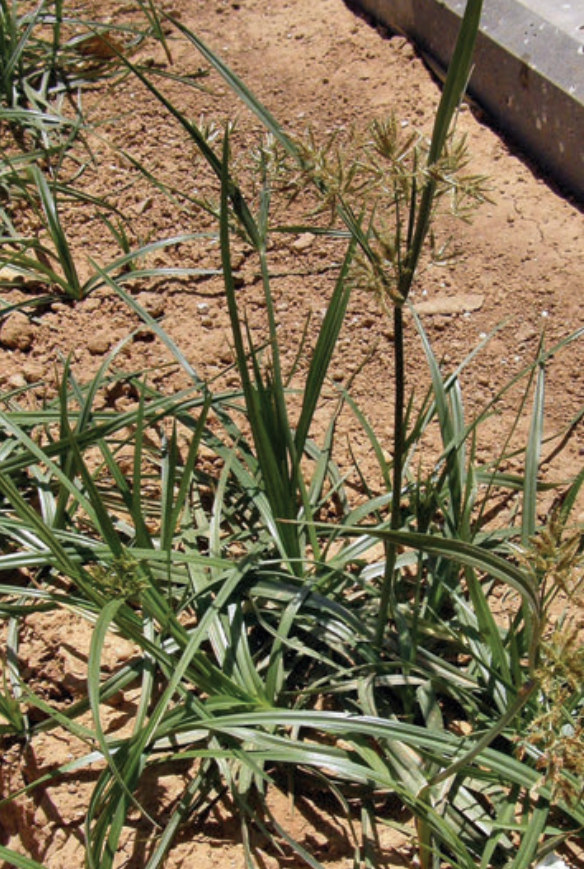
Plant name
groundnut
Latin name
Cyperus rotundus L
Common names
Love of the dear one, love of the companion, happiness, happiness, happiness of the donkey
foreign names
Eng. Cyperus
The group
Saadia
Habitat and Geographic Distribution
Taurine and tropical.
It is naturally distributed across wide areas of Asia, Africa, and Australia. - Mediterranean, Irene
Botanical description
60 cm, rhizome - a perennial herb, brown in length and slender, bearing reddish scales, with slender stalks ending in a dark brown, almost spherical tuber.
The stem is slender, triangular, leafy on the lower part.
The leaves reach a width of mm, are flat, pointed at the apex, and often squamous, about the same width as the stem.
The inflorescence is a simple or compound umbel, unequal, 9-3 cm long (its rays are 3 cm long), each ending in a short spikelet or a cluster of spikelets.
The bracts surrounding the inflorescence are longer than the inflorescence itself.
The spikelet is linear, tightly compressed, and its radius is pinnate.
The two bracts are superimposed, each ovate, boat-shaped, reddish to vascular.
The fruit is a nutlet.
The stigmas are obovate or elliptical, oblong, and triangular.
The fruit rarely reaches maturity and is often propagated by rhizomes.
Flowering occurs from February to December.
(The species above is similar in composition and uses. Earth almond) *Cyperus esculentus* L. There is another species called
Used part
Aromatic root tubers and rhizomes
chemical components
For the plant, it possesses antioxidant, antimicrobial, anticancer, neuritis, antidepressant, anti-inflammatory, anti-obesity, vasodilator, antispasmodic, bronchodilator, antiallergic, antifungal, antispasmodic, antidiarrheal, antiemetic, antiparasitic, antihistamine, antiglycemic, antihypertensive, and antimarinic properties, and has estrogenic functions.
The flavonoid compounds in the essential oil have analgesic and anti-inflammatory properties and are a safe and effective treatment for the side effects of laser hair removal.
The oil is used to treat trichomoniasis caused by nematodes of the genus Trichinella, particularly when combined with albendazole.
Properties and medical uses
The essential oil of the tubers exhibits cytotoxic, antioxidant, and antitumor properties.
The tubers and rhizomes of the plant are used traditionally for their sedative, antiemetic, and carminative effects.
The tubers are used to soothe headaches and to treat anxiety, fatigue, urinary and reproductive tract infections, and menstrual disorders.
Clinical studies have proven the properties of the plant's chemical components.
It is an antioxidant, antimicrobial, anticancer, anti-nerve, antidepressant, anti-inflammatory, anti-obesity, vasodilator, antispasmodic, bronchodilator, anti-allergic, antifungal, anticonvulsant, antidiarrheal, antivomiting, antiparasitic worm, antihistamine, anti-hyperglycemic, anti-hypertensive, anti-marigold, and has estrogenic biological functions.
The flavonoid compounds found in the essential oil possess analgesic and anti-inflammatory properties, and are a safe and effective treatment for the side effects of laser hair removal.
The oil is used to treat trichomoniasis caused by nematodes of the genus Trichinella, particularly when combined with albendazole.
Side effects and precautions
Allergic reactions or drug interactions may occur; self-use should be avoided by pregnant and breastfeeding women, children, and patients with chronic diseases.
Other uses
The tubers are used to produce a fragrant incense, especially for fumigating infants' clothing.
The tubers and rhizomes are eaten after being ground, despite their bitter taste.
the environment
It grows on the edges of swamps and shallow mudflats, rocky areas, and roadsides in tropical and warm temperate regions, preferring warm, humid environments.
Its foliage is affected by spring frosts.
It thrives in various soil types, provided they are well-drained.
Alluvial soils with relatively high sulfate, magnesium, calcium, and boron content are the most suitable for tiger nut growth.
It flourishes in sandy loamy soils.
In many countries, such as China, it is used for riverbank stabilization. Its pH ranges from 5.5 to 6.5.
Agriculture and productivity
It propagates by seeds scattered on fertile soil.
The seeds germinate within 2-6 weeks at a temperature of 18°C.
It is characterized by the rapid growth of its rhizomes and underground tubers, leading to the formation of large colonies that compete fiercely with cultivated plants, causing many problems for farmers.
It can be propagated by tubers collected from its colonies, especially those growing in agricultural land.
Dryopteris filix-mas (L.) Schott Polypodium filix-mas L., Aspidium filix-mas (L.) Sw, Lastrea filix-mas (L.) C.Presl, Thelypteris filix-mas (L.) Nieuwl., Aspidium nemorale Gray
History and Heritage
Any edible or nourishing plant, *C.
esculentus* is the name of one of its edible species, *kypeiros*, the scientific name of the genus, derived from the Greek *C.
papyrus*, whose sweet-tasting tubers are eaten.
It is known as *hab al-zamal* (tiger seed).
Another species is *C.
conglomeratus*, a domesticated plant whose sap is used to make papyrus paper.
In the Levant, the species called *al-thadaa* (breast) is important for stabilizing sand dunes in the arid regions of North Africa and the Levant.
It is believed that it was named *hab al-aziz* (tiger seed) because one of the kings of Egypt was fond of eating it, and the king of Egypt was called *Aziz Moras* (the Aziz of Egypt).
It was mentioned in ancient Egyptian prescriptions for expelling intestinal parasites and treating cataracts, eczema, itchy skin, and uterine infections.
Some archaeologists discovered its fruits in a chamber of the Monastery of Abu al-Naga, where they found a cup filled with tiger nuts.
Tiger nuts were also found around the neck of the mummy of the American king Kent.
The Arabs called the plant "Hab al-Zamal" and used it as a type of fruit. Ibn Sina said of it that it "tastes very well and increases semen."
Medical note
This information is for educational purposes only and does not constitute medical advice.
Poisonous or potent plants should only be used under the supervision of a qualified physician or pharmacist.
Related images


